

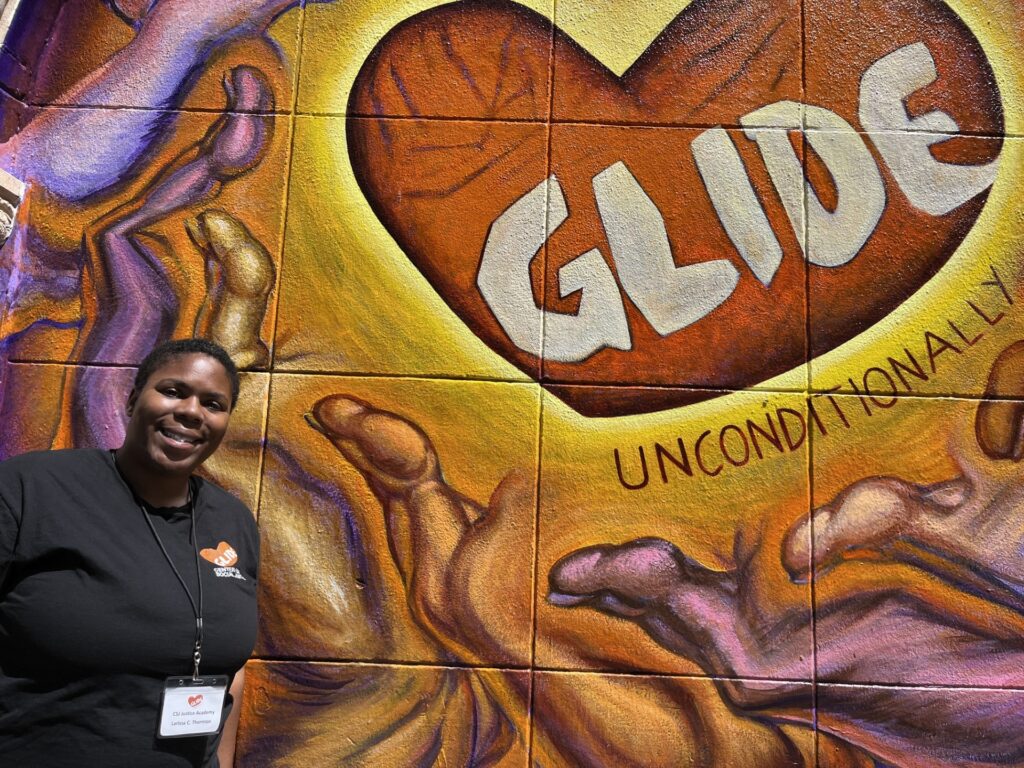
My name is Larissa Candice Thornton.
I’m a Bay Area native, but in 2015 I moved to San Francisco seeking something I wasn’t sure I could find anywhere else: a chance to rebuild my life. I was struggling with mental health challenges and substance use, and what began as a problem with alcohol eventually progressed to harder drugs. I’d heard San Francisco offered services and support for people facing the same struggles, and I came here hoping recovery might be possible for me too.
I first connected with GLIDE through the Free Meals program. I attended church services, received a Tuberculosis test at GLIDE’s Health Hub so I could access shelter services, and became familiar with the support available there. As I began rebuilding my life, I wanted a way to give back to the community that helped me. I started volunteering with the Free Meals program, serving breakfast and helping at GLIDE’s Thanksgiving event. Then I got an email from the Center for Social Justice and announced that a new cohort was forming. The message explained that participants could learn how GLIDE advocates for its programs, build skills for personal and professional growth, and become more involved in social justice work. That caught my attention!
By then, I had been in recovery for about a year, and today I’m proud to say I’m 20 months clean. I had already participated in community efforts like Drug-Free Sidewalks and had spoken at City Hall against budget cuts, but I wanted to understand more about how change happens—how organizations advocate, influence policy, and secure funding to save lives.
The Social Justice Academy (SJA) showed me how I could be involved in creating legislative change. It showed me how my lived experience could become a tool for advocacy and how much my voice mattered.
SJA moments of learning
I traveled to Sacramento to advocate for policy changes and funding for public health services, including health access centers. I learned how to use my personal story to explain why these services matter and how they help people recover. Being able to say, from my own experience, “This is a service that we need,” was incredibly powerful.
The work of the Health Hub saves lives because it keeps people connected to care, even when they’re not ready or able to stop using. Those services helped me through some of the hardest periods of my life. Instead of being judged, I was met with compassion and practical support. That gave me the space to reflect on my choices, recognize how far I had come, and move towards recovery.
Another memorable experience was visiting San Francisco City Hall and meeting with supervisors. Before the Academy, I didn’t even know who many of the supervisors were, let alone that I could speak with them directly. What surprised me most was learning that our stories weren’t just welcome—they were important. The supervisors wanted to hear directly from people affected by the issues they were discussing. Our experiences mattered to them when they made policy decisions.
It felt surreal to go from seeing public officials on television to sitting across from them and having real conversations. These are people who advocate for LGBTQIA+ communities, social services, and residents facing some of the city’s greatest challenges. They care about people struggling with addiction, illness, poverty, and homelessness, and they understand that everyone deserves a chance in life.
For the first time, I felt like some of the hardest experiences of my life could be used to help other people. Meeting State Assemblymember Matt Haney was especially meaningful. After listening closely to all the Social Justice Academy advocate’s stories, he shared thoughtful feedback.
I spoke with him about GLIDE’s Health Empowerment and Access services, including Narcan distribution, hepatitis C prevention, and drug-testing strips. These services help people stay safe while they’re struggling, and they often become the first step toward recovery. Meeting people where they are in life gives them the chance to make safer choices, reflect on the impact of substance use, and eventually move toward healing and recovery, just as I did.
A way forward thanks to GLIDE
To me, GLIDE stands for unconditional love. When you don’t love yourself, when you feel hopeless and directionless, that love can change everything. It starts with a warm hello, a hot meal, medical care, or someone simply treating you with dignity. Over time, that care helps you begin loving yourself again, taking better care of yourself, and believing that a different future is possible.
Looking ahead, I want to continue volunteering with the Free Meals program and remain involved with GLIDE’s Center for Social Justice. I want to attend more rallies, speak at City Hall, and continue advocating for resources that reach the people who need them most. One day, I would even love to serve on the San Francisco Board of Supervisors and use my experiences to help shape policies that support vulnerable communities.
I’m currently studying social work, and once I earn my associate degree, I hope to apply what I’ve learned and be able to support others as a case manager. That would mean everything to me.
One person who has deeply inspired me is Regina Wells Rashida Oji. She taught me the importance of “rest as resistance” and the value of caring for myself spiritually, mentally, and physically. Through grounding exercises and reflection, she showed us how to center ourselves before speaking and how to channel our energy into meaningful action.
Regina taught us that caring for ourselves isn’t separate from advocacy—it’s what makes advocacy sustainable. When we’re grounded, we’re better able to communicate our values, stand firmly in our convictions, and show up fully for our communities.
What does GLIDE mean to me?
When people ask what GLIDE has meant to me, I always come back to this: GLIDE will love you until you can love yourself. GLIDE meets you where you’re at and helps put you on a path toward a life that feels meaningful and worthwhile. No matter what you’re facing, I want people to know there is hope and there is life beyond the struggles of today.
Sometimes it begins with something as simple as being seen as a human being, sharing a hot meal, receiving medical care, accessing harm reduction services, or attending a church service. Those experiences restore your spirit. They remind you that you matter and that a future is still possible, even when life feels overwhelming.
When your basic needs are met and you’re supported in the present moment, you begin to imagine more for yourself. You start believing that you deserve healing, opportunity, and joy. GLIDE helps people get there, and I will always be grateful for that.
I wholeheartedly recommend the Social Justice Academy to anyone interested in advocacy, leadership, and self-empowerment. It can transform how you see yourself. You go from being someone who feels invisible, someone people won’t even look in the eye, to recognizing the power of your own lived experience.
Today, I know my story matters. I’ve created a YouTube channel where I share how I navigate mental health and substance abuse challenges. I’ve learned that every person deserves to be seen, heard, and given the opportunity to thrive. That’s what GLIDE gave me, and it’s what I hope to help provide for others in the years ahead.