

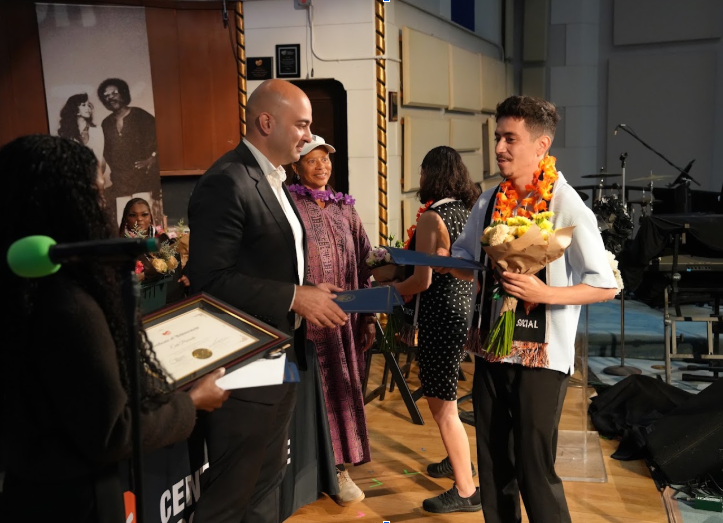
GLIDE’s Social Justice Academy (SJA) is a fellowship for people who have navigated tough times, and provides advocacy opportunities and skill training. Lawmakers benefit from hearing the lived experiences of the people their policies are intended to serve. Today we spotlight SJA fellow Erik Preciado, whose cohort was sponsored by a grant from Kaiser Foundation Hospital Fund for Community Benefit Programs at the East Bay Community Foundation. From suffering early hardship in childhood, to choosing community service as a young man, to obtaining an internship with Supervisor Bilal Mahmood, Erik has had an incredible journey– and he’s just getting started.
Erik originally encountered GLIDE as part of a group of LGBT+ people who volunteered with our Meals program. As a college student studying Social Justice with an emphasis on Chicano Studies at Chabot College, Erik thought the program was the perfect match.
The role of community during social crisis
“I really enjoy walking down streets of Tenderloin and speaking with people who are unhoused and people who are dealing with addiction. When you speak and connect with them, you see they are people who are just like you and I. There shouldn’t be any form of intimidation against them, because they have good hearts and are part of the community,” Erik said.
While at SJA, Erik learned about the weakness of governmental safety nets, and how grassroots organizations like GLIDE and others fill in the gaps. “Those organizations are made up of people who have experience with crises. People who know what it’s like to be unhoused, or experience behavioral health and access issues. People with those life experiences better understand how to support people in those same situations– which is sometimes lacking with politicians.”
Erik commented on how the average person believes governmental safety nets are strong and well-established and well-developed; but it’s not true. There are many bureaucratic obstacles to navigating EBT, Section 8 Housing, and other services. Erik believes that community involvement is vital to improving and strengthening safety nets.
Meeting with lawmakers and growing advocacy skills
Over the course of the program, Erik loved being able to show up to San Francisco City Hall and the State Capitol in Sacramento to advocate for transitional age youth, immigrants, and unhoused people. He advocated for budget allocation in the Tenderloin going towards behavioral health and overdose prevention. He also supported SB 1422, which protected Medi-Cal for undocumented adults, and AB 2161 which protected Medi-Cal coverage for low-income Californians.
Specifically, Erik was able to meet with Supervisor Myrna Melgar and Supervisor Bilal Mahmood in the course of his advocacy, who both made a wonderful impression on Erik. Describing Sup. Mahmood, Erik mentioned: “He was very attentive to issues we were bringing up around his district. He let us have a space where we could share our voices and concerns about behavioral health.” Erik applied for a September 2026 internship at Sup. Mahmood’s office– and was accepted!
Understanding systemic issues promotes forgiveness and love
An important piece of context Erik brings to policy discussions is his childhood experience with how the War on Drugs affected Mexico. U.S. policies often led to military hardware being in the hands of those who did not use it responsibly, causing an atmosphere of violence. When Erik was twelve, his father was murdered, and it left a deep impression on his young life. He sees his father’s death as related to the USA’s choice to practice mass criminalization on people south of the border.
But Erik spoke words of forgiveness: “At the end of the day, it’s not really the fault of the people who murdered my father. It’s the fault of the systemic issues that trap people, and force them to do these things. It was not right. It was horrifying to go through that. But it’s the systems that need to change.”
Erik went on to say how inspired he was by GLIDE’s motto of unconditional love. “Unconditional love is not just loving the people you surround yourself with every day. It’s also sharing love and help with people who do not share your political views– even people who have hurt you in some type of way. When people are in crisis, that’s not a time to be teaching them morals and ethics– that’s a time to lend a helping hand.” Erik’s voice echoed that of Reverend Cecil Williams, who focused on helping people that churches usually reject.
A hopeful future, big dreams
When asked how SJA contributed to his self-image and personal development, Erik explained SJA had made him more in touch with his own feelings and those of other people. SJA also boosted his confidence around understanding policy and discussing controversial issues.
In the future, Erik wants to volunteer with the HIV Advocacy Network, and support immigration rights and immigrant justice however he can. He also wishes to fight for the LGBT+ community, for the undocumented community, and for BIPOC people. “All communities who have been kept out of power, I want to continue to empower them,” Erik said.
In the long term, Erik would like to start a small nonprofit to help people in the small town where he grew up: Tecolotlan, Mexico. He would love to provide scholarships to people from his town and open an LGBT+ center for them. To support Erik in starting his own nonprofit someday, follow @lgbtqmasteco on Instagram: he will begin posting there when he is ready to work on building the nonprofit.
Erik is grateful to his SJA teachers, whom he describes as “extremely special, pillars of the community—not your orthodox teachers: they have very unique personalities who are extremely compassionate and resourceful.” He is also grateful to his fellow cohort members, who inspired him with their own tales of overcoming hardship.
Erik has often faced housing insecurity over the course of his life, but today he is feeling optimistic. Not only does he have an internship lined up, he’s also been working as a community organizer with the Working Families Party. “I have turned the energy of sadness and anger into really helpful things for myself and the people around me,” said Erik. “I got back into college at a 3.91 GPA despite struggling through high school.
In the future, Erik dreams of going to law school, running for election, and helping to shape policy. We’re all rooting for him here at GLIDE!