
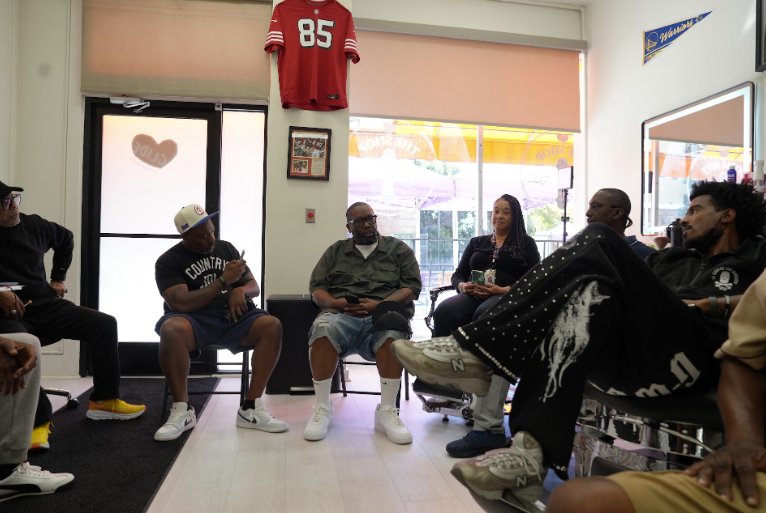
GLIDE’s barbershop, known as “The Shop” was opened to address the disproportionate impact of drug overdoses on older Black men in San Francisco. Black men over 50 have the highest rate of overdose fatalities in San Francisco: they account for 12% of recent overdose deaths, despite representing less than 1% of the population.
Barbershops are trusted spaces associated with dignity and care for older Black men. (Much of Dr. Martin Luther King Jr.’s civil rights organizing happened from his barbershop!) The Shop is a venue for health education and peer support groups, funded by the city of San Francisco to be a culturally responsive solution opening paths to treatment.
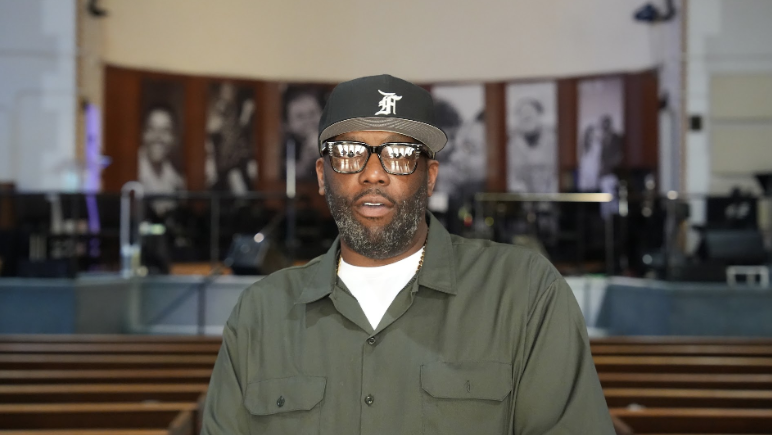
When Killer Mike visited GLIDE this week, he looked at The Shop and said, “This is beautiful. If you want to make a community healthier, go to the barbershop.” Killer Mike owns a barbershop in Atlanta that has a mission of lifting up men in the community who are out of work and help move them toward sustainable, lifelong careers. “I remember they told us we were crazy to open a barbershop in Edgewood, in the hood,” Killer Mike reminisced.
Naysayers always overlook the power, strength and resiliency, the beauty of the human spirit, that can be found in challenged neighborhoods like Edgewood or the Tenderloin. The older Black men who formed the peer support group Killer Mike attended all faced significant challenges, such as homelessness, trauma, and navigating health and recovery. Still, when asked to open the group by sharing their feelings, they spoke overwhelmingly of gratitude.
“I am overwhelmingly blessed by the things God is doing in my life,” said one. Many of them used the word blessed. One said enthusiastically, “I love that I was invited to an event of this caliber!” They acknowledged the pain of their lives, but the pain was not the focus. One of them said, “I’m trying to alchemize the pain into something beautiful.” The Shop has a leadership cohort training group, and one man spoke of his pride at graduating from the leadership cohort program.
Killer Mike responded to the enthusiasm at his presence by insisting that, on the contrary, he was the one who was honored! “As an organizer, educator, and working class kid, I am honored to be here. I appreciate all of you. There’s no place I’d rather be: I love being with people who are changing the world.” Then he talked about the activism work he’d been pursuing since 15 years of age, his focus on getting wrongfully convicted people out of jail. “If you do not organize WITH the people, you do not organize FOR the people,” he said.
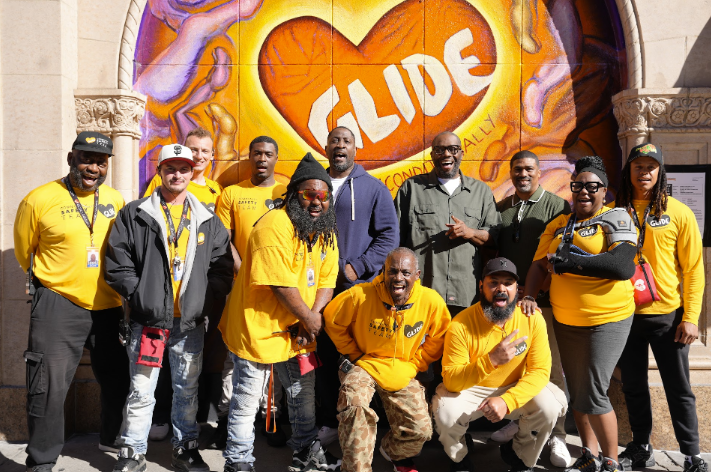
After introductions, the group’s therapist facilitator brought up the discussion topic of the day: What emotions were they encouraged to express as men, what emotions were they encouraged to hide?
The men in the room talked about childhoods and young adulthoods where they were taught that anger was the only acceptable emotion to reveal. Emotions they were pressured to hide included sadness, fear– even curiosity. One man talked about how when he read the dictionary for fun as a teenager and used the words he learned, people had negative reactions and pushed back.
Not everyone in the peer support group faced economic hardship in their youth: one man who shared his story was raised by a middle class family and had a good job for most of his life. But when a health tragedy struck, he lost everything. He discussed how the material losses came with spiritual gains. “Today, I live in a shelter,” he said, “But I don’t identify with that. I identify with what the word of God says I am: I walk around like a king.”
The group then discussed the connection between unexpressed negative feelings and substance use, and the importance of expressing your feelings in avoiding relapse. The therapist passed around worksheets designed to help men name and identify their feelings. Towards the end of the session, the conversation transitioned towards the passing on of intergenerational wisdom.
Killer Mike shared how he was raised by his grandparents, how proud he was of his grandmother who marched with Dr. Martin Luther King Jr. He described how his grandparents rarely used words to express their feelings, but expressed love through acts of service. “We always knew we were loved,” he said. “We have to let the youth know that they are loved! That’s what we need to do!”
The session closed by asking the room how they planned to encourage a young Black man after leaving that room today. “You don’t have to save the world,” Killer Mike said. “You just have to do one good thing, lift up one young person. It’s so good to be in a room of men going through it with their head up and their chest out!”