
2026 VOTER GUIDE
Election day is coming up, make sure you vote on or before Tuesday, November 3rd!
Use your voice, use your vote.
The positions in our voter guide are values-driven stances on the issues that affect the people who walk through our doors every day.
At GLIDE, we seek to empower community members to engage in advocacy and the political process and make informed decisions about issues that impact their daily lives.
To downlod the guide, click here.
REGISTERED TO VOTE?
Check your registration status at RegisterToVote.ca.gov. You can still vote even if you did NOT register! Go to City Hall or your polling place and tell them you want to "register conditionally and vote provisionally!" This still 100% counts! People on parole and with felony convictions can still vote as well.
WHERE TO VOTE?
You can vote at GLIDE (330 Ellis St) if it’s your polling place or you can drop off your ballot at GLIDE on Election Day, November 3, 7 AM – 8 PM! To find your specific voting location check sfelections.org/tools/map_poll_time/.
STATE PROPOSITIONS
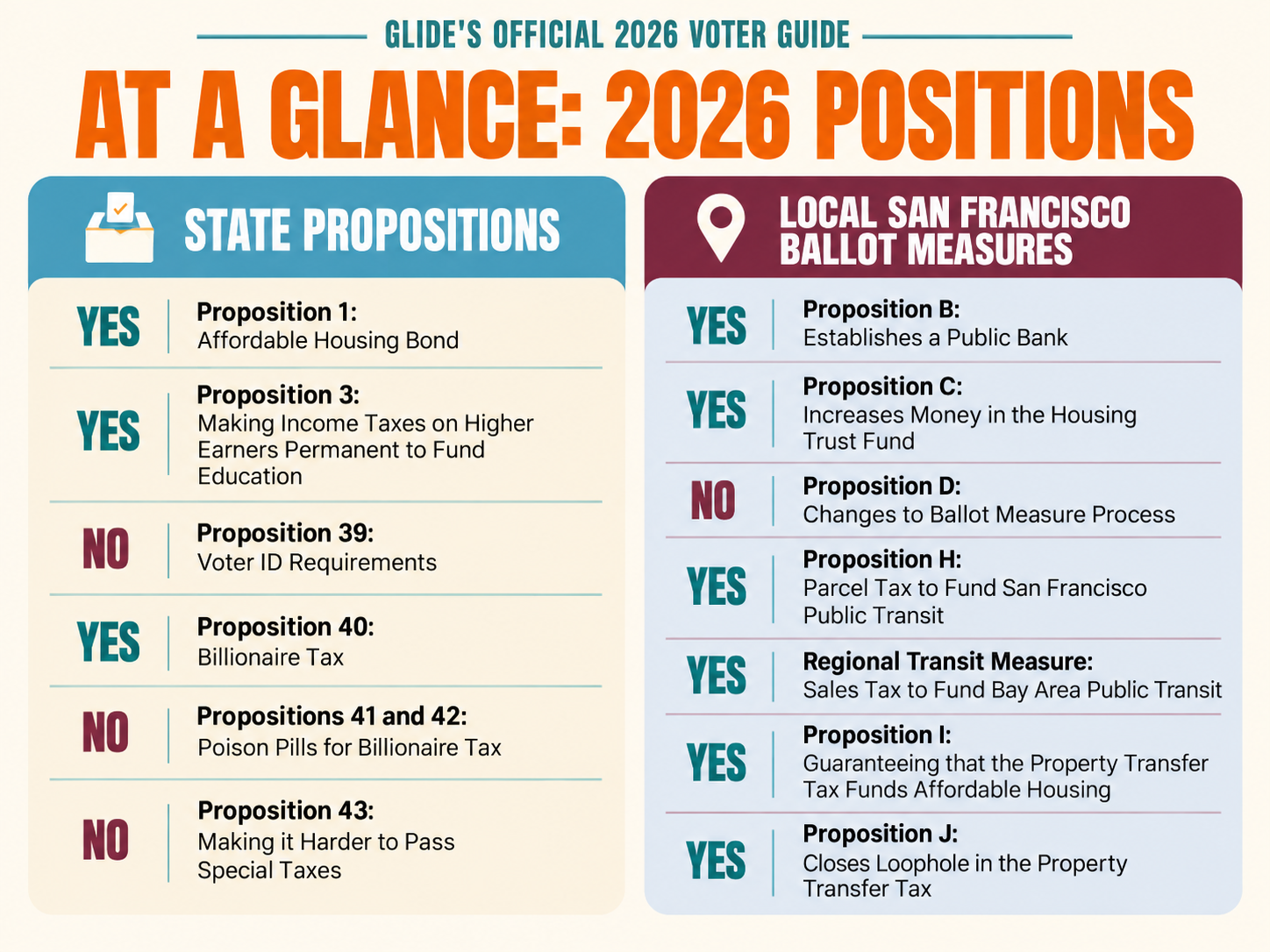
YES - Proposition 1: Affordable Housing Bond
Housing is a human right! This proposition would authorize $11.25 billion in bond funding that would fund programs that build and preserve affordable homes and expand homeownership opportunities. GLIDE community members need affordable housing, and right now there is not enough funding to create or preserve that housing. This funding will allow more affordable housing to be produced and preserved.
YES - Proposition 3: Making Income Taxes on Higher Earners Permanent to Fund Education
This proposition would make existing voter-approved tax rates for high-income Californians permanent, instead of letting the rates expire in 2031. The tax applies to people with incomes in the top 2% of California taxpayers. The tax usually raises $5 billion to $15 billion a year, and 89% of that money goes to K-12 public schools and 11% goes to community colleges. The continuation of this funding would benefit children across California, including children and families served by GLIDE.
NO - Proposition 39: Voter ID Requirements
At GLIDE we believe in making voting easier, not harder! This measure would require voters to present government issued identification when voting in person. Voters who vote by mail would need to give the last four digits of a government ID. This measure would make it much harder for community members to vote as it requires ID when voting, not just when registering to vote. GLIDE has never and will never support Voter ID laws that have historically targeted people of color. Given the barriers that GLIDE's community members already face to keep an up-to-date ID, these changes would unequally harm our community.
YES - Proposition 40: Billionaire Tax
Proposition 40 would require billionaires in California to pay a one-time 5% tax. Of the money raised by the tax, 90% would be spent on health care, and 10% would be spent on food assistance or education-related programs.
GLIDE community members and low-income Californians are being impacted by cuts to Medi-Cal and CalFresh. The funds from the billionaire tax would help replace the money lost from federal cuts to health care and food assistance, preserving health care and food access for our community.
NO - Propositions 41 and 42: Poison Pills for Billionaire Tax
Propositions 41 and 42 are poison pills put on the ballot to stop the billionaire tax if they receive more votes. In order for Proposition 40 to pass, Prop 41 and Prop 42 must fail.
N0 - Proposition 43: Making it Harder to Pass Special Taxes
This proposition would make it more difficult for local communities to pass special taxes to fund specific services. Currently, if community members gather signatures to get a special tax measure on the ballot, the measure only needs to receive a simple majority (51%) of the votes to pass. If this proposition passes, these types of measures will need two-thirds (67%) of the votes to pass.
Prop 43 would make it more challenging to pass local taxes to fund vital services that our community members need, such as transit and affordable housing. For example, if this proposition had been in place in the past, measures like San Francisco’s Baby Prop C (which funds childcare) would not have passed.
LOCAL SAN FRANCISCO MEASURES
YES - PROPOSITION B: ESTABLISHING A PUBLIC BANK
This measure would authorize the establishment of a Municipal Finance Corporation that will transition to a Public Bank. It would create the framework for how the Public Bank would operate, but it would not provide a source of money to fund the bank. The Public Bank will create financing tools and lending products to invest in San Francisco’s investment priorities like affordable housing, small business, and climate sustainability. It will only support socially beneficial projects located in or serving San Francisco and be restricted from lending to fossil fuels, weapons manufacturers, private prisons, and detention centers. Laying the groundwork for the Public Bank will allow GLIDE community members, and all of San Francisco, to benefit from investment in future affordable housing and climate justice projects.
YES - PROPOSITION C: HOUSING TRUST FUND
This measure would increase the amount of funding the City of San Francisco must put into the Housing Trust Fund each year, which would increase the amount of money to build, buy and preserve affordable housing. The amount of money put into the fund will grow about to about $125 - 160 million per year (currently about $50 million is put in every year). The measure would also make sure the Housing Trust Fund exists for longer by extending the sunset date from 2023 to 2058. Increased funding is necessary for increased affordable housing, which is vital for GLIDE clients and the broader community.
NO - PROPOSITION D: CHANGES TO BALLOT MEASURE PROCESS
This measure would increase the required number of voter signatures to place an initiative on the ballot. If this measure passed, in order to qualify for the ballot, organizers would have to collect approximately 42,500 signatures. The current requirement is about 10,600 signatures. This measure would also eliminate the ability of the Mayor or four or more members of the Board of Supervisors to place a measure on the ballot without a vote of the Board. This measure would make it more difficult for community members to engage in direct democracy by getting measures on the ballot. It would require more funding to gather more signatures, which would be challenging for community-led campaigns with small budgets.
YES - Proposition H & Regional Transit Measure: Taxes to Fund Public Transit
Proposition H is a San Francisco parcel tax, and the Regional Transit Measure is a sales tax in five Bay Area counties, including San Francisco, that would fund public transit. Without the money from these taxes, the Bay Area will likely see devastating cuts to public transportation, including BART stations closing, Muni bus lines cut, and transit hours reduced. GLIDE staff, clients and community members rely on public transit for work, school, errands, and more, and they would be severely harmed by a collapse of the Bay Area’s public transit system.
YES - Proposition I: Guarantee that the Property Transfer Tax Funds Affordable Housing
This measure would require that money from San Francisco’s transfer tax on real estate deals worth over $10 million must be spent on affordable housing and eviction prevention. Right now, the money from the transfer tax can be spent on anything, but this measure would require that at least 60% of the money be spent on affordable housing production programs, at least 25% on acquisition or rehabilitation of affordable housing, and at least 10% on tenant stabilization/homelessness prevention programs. Together, this investment would preserve, protect, and produce more affordable housing in San Francisco, which is a key need for GLIDE clients and staff unable to afford current rent.
YES - Proposition J: Closes Loophole in the Property Transfer Tax
Sellers of foreclosure properties currently do not pay San Francisco’s transfer taxes, which are imposed when real estate changes hands. This measure would undo that exemption/loophole to raise more funding for San Francisco. The foreclosure tax would still not impact single-family homes, condos, and small properties with fewer than five residential units. Closing this loophole would increase the funds available from the transfer tax. If Proposition I also passes, this will increase the dedicated funds for affordable housing, benefiting GLIDE’s community members.
VOTING INFORMATION FOR SF VOTERS
Register to vote online at RegisterToVote.ca.gov or at the Department of Elections office in City Hall (1 Dr. Carlton B. Goodlett Place), Room 48.
You can also register at GLIDE (330 Ellis St) the last Friday of every month from 11 AM – 1 PM with the Department of Elections.
WHEN?
October 5: Early voting starts at City Hall.
weekdays 8am–5pm (except October 12 holiday).
October 24: Weekend early voting starts at City Hall,
Saturdays and Sundays 10am–4pm.
November 3: Election Day! Polls open 7am–8pm.
WHERE TO VOTE
Everyone will get a ballot in the mail! Make sure yours is coming to the right place by checking your registration at sfelections.org/tools/portal/.
Mail your ballot if you can’t drop it off. You don’t need a stamp, but make sure you sign the envelope and mail it early so that it’s postmarked by November 3.
Drop off your ballot early at one of the 37 official ballot drop boxes across the city, from October 5 through 8pm on Election Day, November 3.
You can drop off your ballot at GLIDE (330 Ellis St) on November 3, from 7 AM to 8 PM.
Where’s your polling place? To vote in person, check sfelections.org/tools/map_poll_time/, call 311, or just go vote at City Hall.
If you have any additional questions about GLIDE’s voter guide or voting at GLIDE, please contact csjteam@glide.org.