
With a new mobile testing and outreach van, GLIDE joins the OPT-IN effort to connect the most vulnerable to services
On a remote stretch of road just west on the Third Street artery that runs through San Francisco’s Bayview neighborhood, a young man is about to receive life-saving treatment.
The setting is anything but residential and yet full of makeshift housing—weathered campers, trailers and other vehicles, tents and lean-tos, all situated in an abandoned industrial landscape decorated over in graffiti and sectioned by torn chainlink fencing topped with razor-wire.
GLIDE’s Harm Reduction Community Outreach van makes a bright addition to these surroundings, the iconic orange heart on the front acting as a beacon of support to the neighborhood.
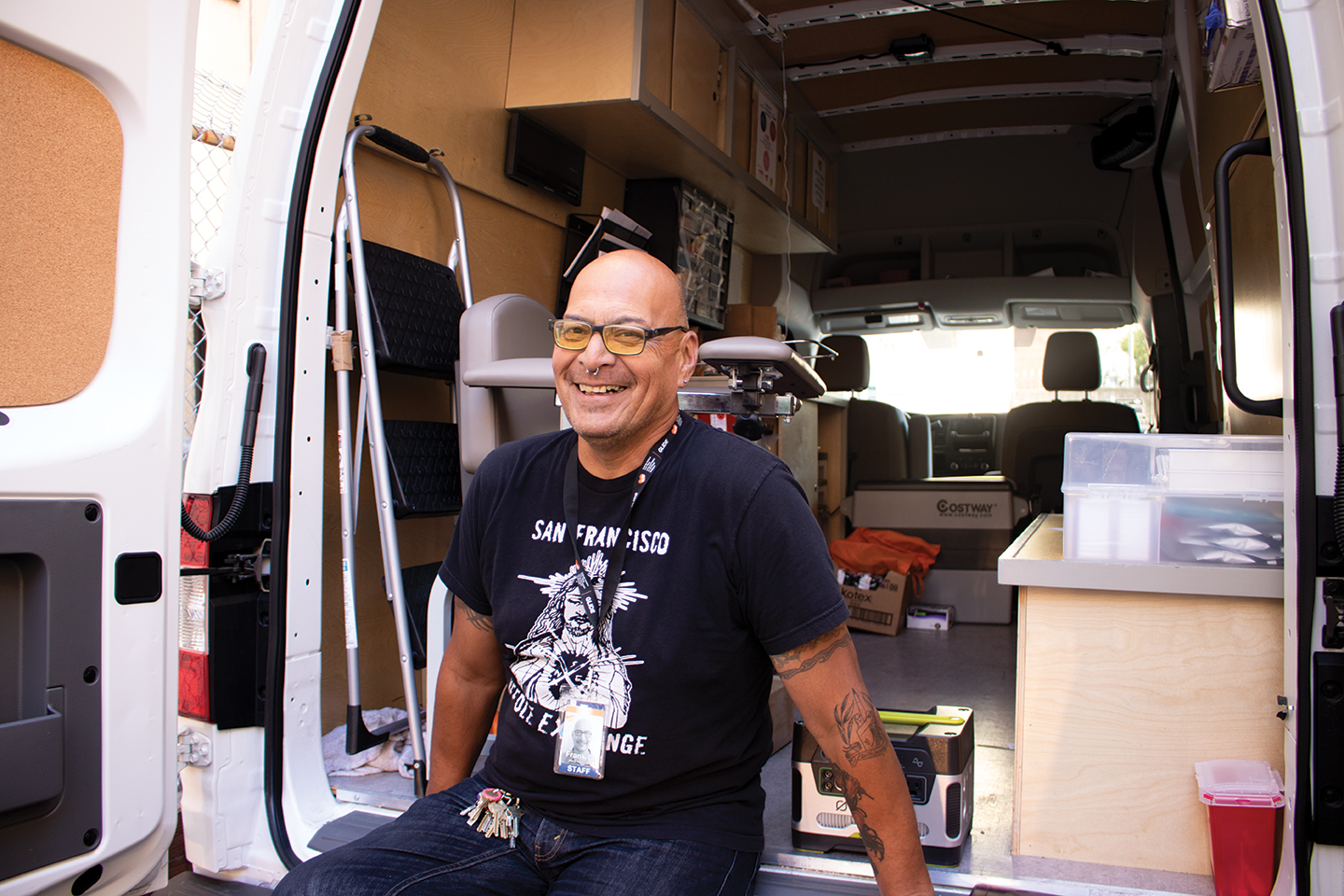
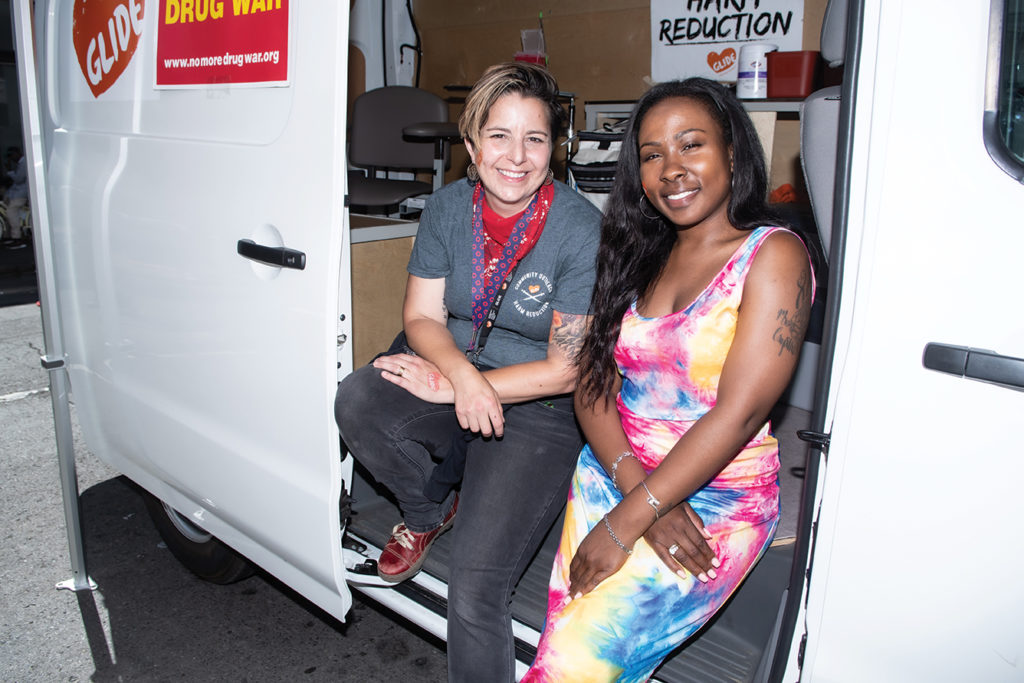
Frank Castro, GLIDE case manager and the van’s driver, has just pulled up in front of a slightly run-down mobile home with covered windows. Alix Strough, a nurse with the Department of Public Health’s Street Medicine unit, hops out of the GLIDE van and looks around. A moment later, the San Francisco AIDS Foundation (SFAF) outreach team pulls up, too, just in front of GLIDE. Roy and Damon step out of SFAF’s white cargo van, which sports a random assortment of stickers promoting harm reduction and decrying the war on drugs.
Greetings exchanged, the crew scans the area. The mid-September day is cloudless and unusually hot, already into the low 90s, and at first no one seems to be around. “Normally there would be more foot traffic,” says Frank, “lots more.”
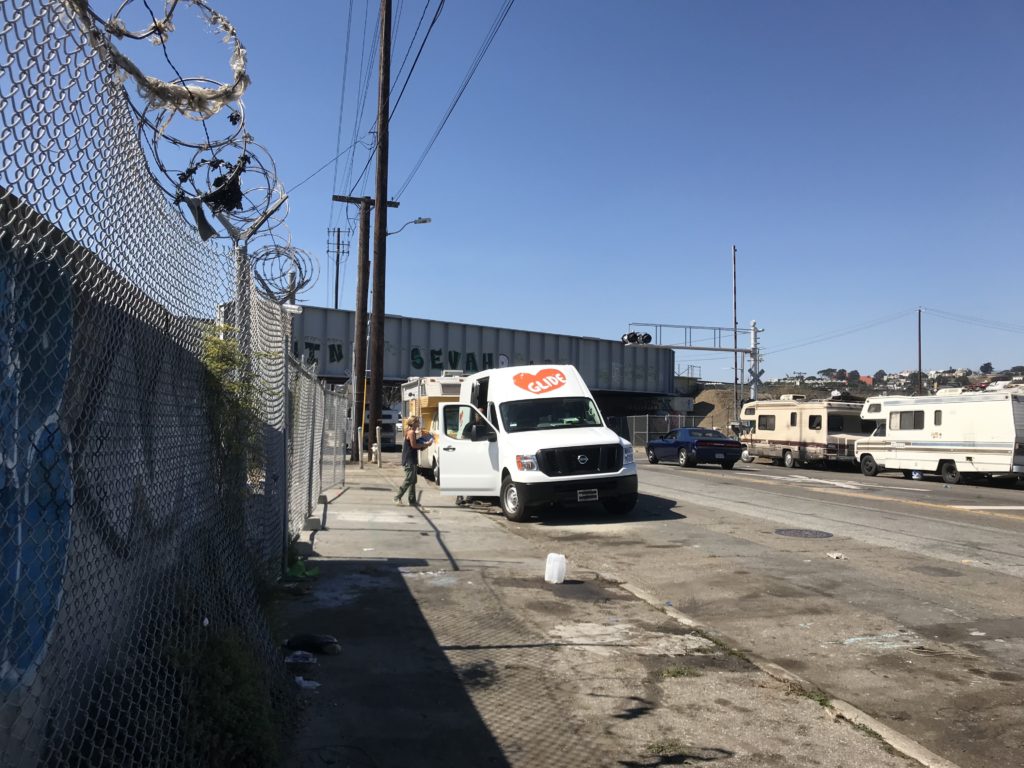
This is the team’s usual Friday stop. For the past several months, they have been spending several hours here each week, and been well received for the services and support they offer the homeless people living in the area. GLIDE and SFAF typically divide up the services to maximize their time here, with SFAF offering syringe access, Narcan training and distribution, and other harm reduction services while GLIDE’s specially equipped van allows the GLIDE team to concentrate on testing and linkages to care.
Frank, in cargo shorts and a black GLIDE tee, opens the van’s sliding door. He has decided to keep the engine on today in order to keep the air-conditioning running. Inside the van, GLIDE Health Systems Navigator Khaiya Croom is arranging equipment by the phlebotomy chair, preparing the space for testing.
The van is equipped to test for HIV, Hepatitis C and Sexually Transmitted Infections (STIs). HIV and Hep C test results can be had on-site in a matter of minutes. With Alix onboard, the van can also offer rapid testing for syphilis, which alarmingly has been on the rise among women of childbearing years. As a nurse, Alix can treat STIs on-site as well.
Today, Frank has test results for someone he has been engaging with in this area. “When we see this person, I’ll let him know. At that point I’ll ask him if he wants to be in the OPT-IN program,” he explains, referring to the collaborative street outreach effort managed by the City’s Department of Public Health. “At that point, I’m his case manager.”
Alix decides to venture around the area and let people know there are harm reduction and testing services available. She and Damon load up a backpack with bottles of water and head down the nearby railroad track, respectfully pausing by the tents and camps scattered along either side to offer water (gratefully accepted on this scorching day) and let people know the vans have arrived with services for those who want them.
Across the street from the GLIDE van, beside a camper with a boat on a trailer, two men and a woman express their appreciation for the outreach, not only for the material support but for the judgment-free way in which it is offered.
“It’s amazing how looked down upon you are just because you live on the street,” the young woman tells Roy. “You guys all talk to us just like we’re anyone else.”
Back at the van, meanwhile, Frank is speaking with a young man with a neatly cropped beard who has ridden over on a bicycle. Alix has returned from the railroad track and joins the interaction. Afterward, she takes her laptop into a patch of shade as Frank relates the successful result: The young man has learned his status, and has agreed to sign up for treatment for Hep C.
Alix registers him with the Department of Public Health and will ultimately be able to administer his medication here on-site. Frank, as his case manager, will coordinate regular contact, offer emotional support, help with related challenges, and generally work to mitigate factors that could impede successful treatment.
In a matter of months, the young man can expect to receive treatment and eradicate the virus, all without ever having to enter a clinic or hospital.
“This is what our hope was,” says Frank, referring to the days of outreach before OPT-IN, “but this is the piece we needed. We needed a nurse.”
Project OPT-IN
OPT-IN arose to meet the challenge of reaching the most marginalized populations with successful health interventions and services for addressing the HIV and Hep C epidemics and other harms among the city’s homeless residents.
Funded by a five-year grant to the city’s Department of Public Health (DPH) from the Centers for Disease Control and Prevention, the program joins DPH’s Street Medicine unit with two social service agencies with extensive experience working with the populations concerned: San Francisco AIDS Foundation and GLIDE.
It was GLIDE’s Director of Harm Reduction Services, Paul Harkin, who offered the name, which stands for “outreach, prevention, treatment and integration.” But the name also points to a fundamental approach, grounded in the harm reduction principle that health interventions must be invited and not coerced.
“We see our approach as meeting trauma-informed criteria with cultural competency and humility,” says Paul.
“Our staff genuinely get what’s going on in these populations and are respected by them for the way that they treat everyone. Any approach to the most vulnerable populations has to come with that perspective. The notion of using coercion or threats is a failing approach. It’s totally counterproductive. It scares people away from care. It adds to their trauma and it actually makes them more vulnerable and more at risk.”
For Paul, OPT-IN is the logical extension of the outreach GLIDE has long done in the Tenderloin and South of Market, and more recently in monthly visits to encampments across the city. Now, with the van, that citywide relationship-building runs five days a week in places like the Bayview, the Western Addition, and Haight Ashbury. This consistency, showing up regularly and reliably to build trust, is crucial.
“One of GLIDE’s strengths is our presence on the streets,” he explains. “That’s how you build up cred. You get to know people. We’ve only added to that with OPT-IN, by adding more outreaches, and increasing that engagement.”
Going where the need is
On the way back to GLIDE, Frank confers with Khaiya and Alix about an idea he has for maximizing floor space in the van to further improve the care they provide. Alix, in turn, updates Frank on the status of a pregnant young woman they know who had been living in a small RV. She’s at San Francisco General now, says Alix, and doing well.
The day invariably includes many such conversations, as well as the sharing of information with the public, distribution of harm reduction supplies, and other social interactions that increase trust, knowledge, solidarity and options between the outreach team and the people they serve. The hard stats for the afternoon: two people were tested, one person learned their health status, and one person was connected to treatment.
Treatment is a process, however. Increasing access for people on the margins to the range of available services, from clinics to pharmacies, is also a daily effort.
“That’s the other part of this job,” says Frank, “going to service providers, talking to the staff, letting them know the feedback I’ve gotten and seeing how receptive they are to a conversation about how we can make this situation better for our clients—how we can widen the margins for getting services.”
“We have a lot of resources in this city,” he says. “Our job here is being the grout between the tiles.”
Monday the van will be at another populated area in the Bayview, but each weekday the team makes a different regular stop across the city. These stops change only as populations move around. As that happens, the OPT-IN team adjusts its schedule accordingly.
That’s the mission, as Frank explains. “Paul told me: Go wherever our people are.” ♥
This story, by Robert Avila, Director of Communications, originally appeared in the Fall 2019 print edition of GLIDE’s Real Talk newsletter.