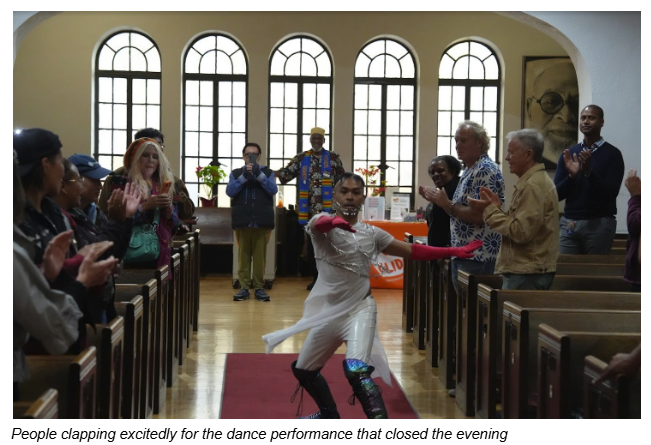

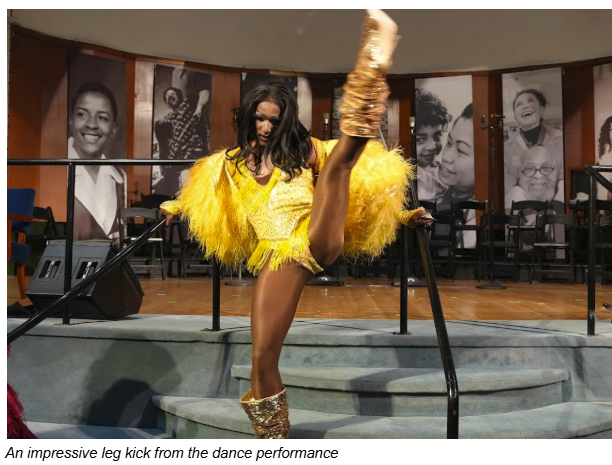
In celebration of Pride Month, GLIDE’s Center for Social Justice and the Sisters of Perpetual Indulgence co-hosted a powerful panel on queer history and futures, called “House of GLIDE.” The evening was also graced by a gorgeous dance performance from Sir JoQ and Crew.
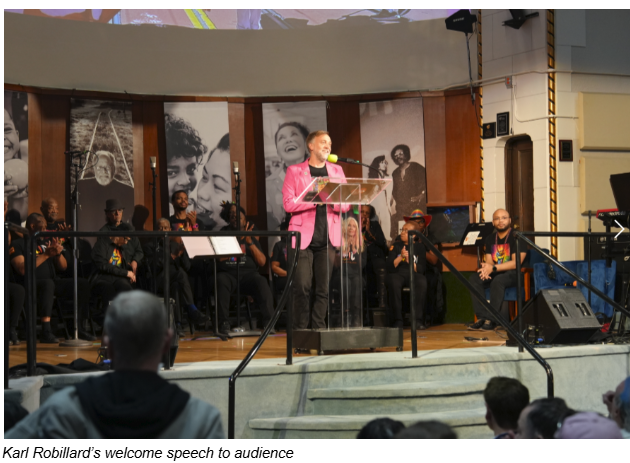
Karl Robillard, GLIDE’s Chief Communications and Public Affairs Officer, welcomed the audience with a powerful personal story. “My friend and I were just two gay boys traveling to San Francisco, sixteen hours before Matthew Shepard was brutally killed and murdered,” he said, referencing the homophobic murder in 1998 of a gay student in Wyoming that led to hate crimes prevention legislation.
“You can imagine how we felt when we heard the news,” said Karl. “But as soon as we arrived in San Francisco, we made a beeline to the Castro. And there, right in front of the Bank of America, there was an altar of flowers to Matthew Shepard piled so high. I saw that altar and immediately thought to myself, ‘I am home.’ And 28 years later, I still feel that.”
The role of joy in building community
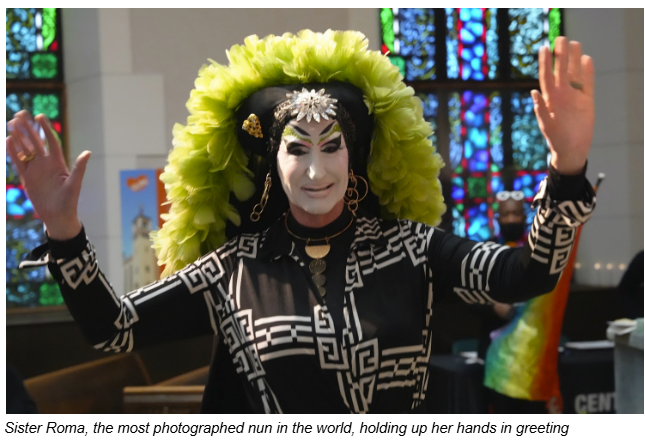
The Glide Ensemble sung “Unspeakable Joy,” and Minister Marvin K. White was applauded for his historic decision to permanently fly the Pride flag on Glide Memorial Church. The charismatic Sister Roma from the Sisters of Perpetual Indulgence commented, “Being with all of you and hearing unspeakable joy from choir really makes me think, ‘I need to go to church.’ There’s so much crap around us all the time. We need joy!”
Honey Mahogany, Director of the Office of Transgender Initiatives for the city of San Francisco, reminded the audience, “Pride has always been about more than celebration: it’s been about survival, resistance and chosen family.”
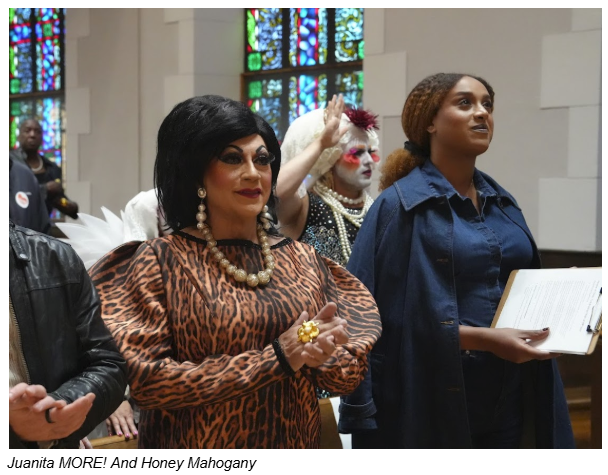
Juanita MORE!, gorgeous in a stunning dress reminiscent of a monarch butterfly, testified to the power of San Francisco’s queer community: “There’s a group of people I met at Booty Call Wednesday. We grew up together, came out together, transitioned together, and they are still my chosen family.”
The importance of queer solidarity
Honey Mahogany also reminded us, “It was not so long ago that we were not allowed to gather in spaces. That was the reason for the Compton’s Cafeteria and the Stonewall Riots. It used to be that when we gathered, we would be thrown in paddywagons, our names published in newspapers. Now they are trying to take us back to those times. So it is more important than ever that we gather together, shine together, be loud, proud, weird, queer and trans together.”
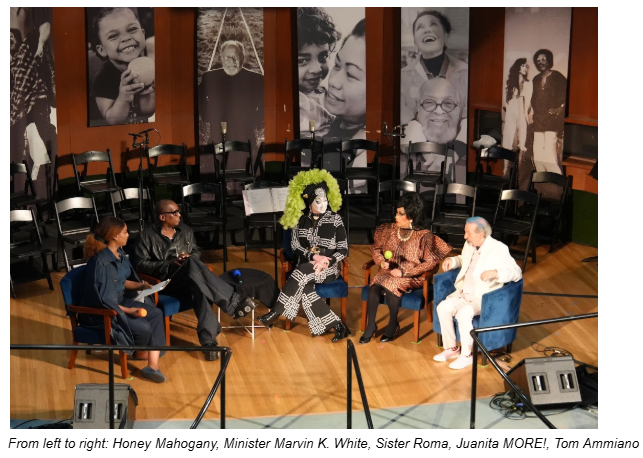
The panelists inspired us with reminders of how queer communities have triumphed over fear and hatred for centuries. Minister Marvin K. White said, “The project to run queer people out of church is because we are powerful… They run us out and tell us there’s no way back in because they are afraid of us! My faith is about getting people back to their power.”
How queer history informs our present
Sister Roma described how hate crimes around Dolores Park inspired her dive into politics in 1987. Flyers with a pink triangle (the symbol Nazis forced on gay people during the Holocaust) and the slogan, “Stop the violence,” went viral. 39 years later, the Stop the Violence campaign is still going strong, with safety whistles and mutual aid.
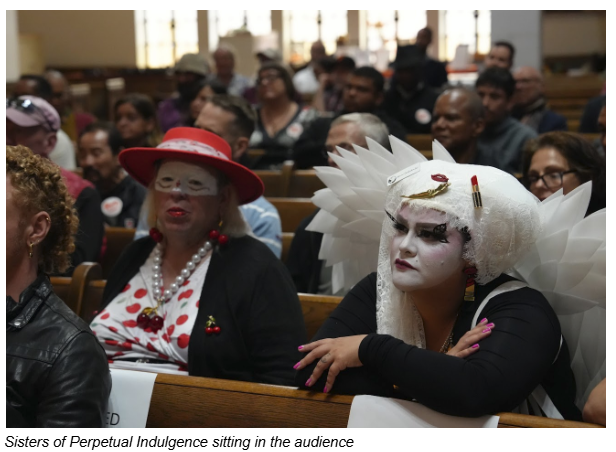
Another successful campaign initiated by Sister Roma was the #MyNameIs campaign, a protest of FB’s policy which forced use of legal names instead of real names. This was particularly harmful to trans people due to the emotional trauma caused by deadnaming, but it was also unsafe for others, such as domestic violence survivors whose abusers could suddenly find personal information about them by looking up their legal name.
Juanita MORE!, known for throwing fabulous parties that raised money for LGBT+ causes, talked about the importance of joyful activism during times of grief and struggle. “In 1992, I was living through the AIDS crisis,” she said. “I was grieving a boyfriend who had passed away four months ago. Drag gave me the freedom to reconnect with my community.”
Tom Ammiano reminisced about the years when Regan and the right wing wanted God in the classroom but were also cutting school funding. Engaging in political struggle helped him feel empowered during bad times.
He also spoke about the importance of making all struggle intersectional with class struggle. “What this church does addresses something that is missing from a lot of politics– even the gay politicos miss it. GLIDE looks at the class issue– at not letting the ruling class diminish the humanity we all feel. If that’s spiritual, then I’m spiritual!” He then described how the intersectional lens used by GLIDE’s co-founder Reverend Cecil Williams helped unite black and gay communities around the shared issue of police violence.
The power of hope in challenging facism
All panelists spoke about the fear and tension queer folks experience in the current political atmosphere. “The Sisters of Perpetual Indulgence have always been a litmus test for the First Amendment,” Sister Roma said. “In the past we have felt the Constitution was rock solid protection. Right now it feels more tenuous, it feels like there’s a very thin wall separating us from facism, it feels those rights and protections could be swept away with a stroke of a pen from an executive order.” But then she laughed and added that the Sisters of Perpetual Indulgence have always been committed to speaking their minds despite the risks.
Minister Marvin K. White urged people to find strength in spirituality, inside or outside traditional religion. “You might find your spirituality in the awe of the night sky, in walks by the ocean, in the affirmation that lives on your refrigerator, on the dance floor, or in love itself. Spirituality is inherent. Once you practice it, it expands. It takes up more room than your body once you pay attention to it. If you think about their hate more than you think about your love, then they win. It’s a distraction. Remember we have survived everything they have thrown at us. Inside or outside organized religion, we are powerful, and we are here to love.”
The panel closed with questions from the audience– a young activist seeking advice on how to navigate the balance between assimilation and resistance was the first to speak up.
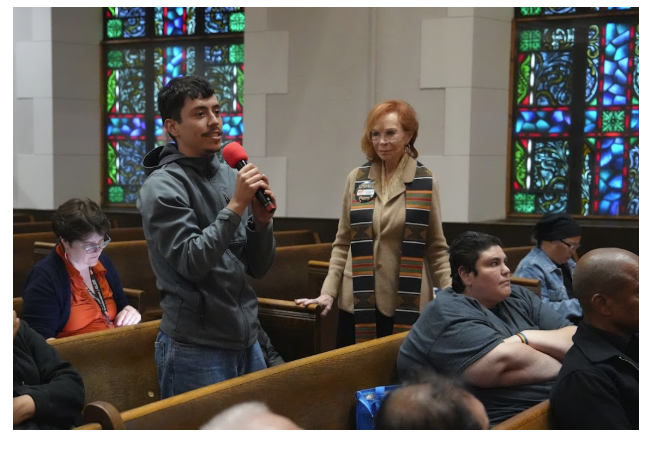
Tom Ammiano advised him to consider civil disobedience, to never shy from confrontation, for example, “take on the gay community when they are being racist.” The important thing, he clarified, was to have a group who thought the same as you on social justice issues. “Remember that even as you are searching for other people, they are searching for you!” Honey Mahogany advised the young activist to join many groups in order to receive a variety of perspectives. “Don’t be boxed in or defined by one specific group,” she advised.
We went away from the night with hope, inspiration, joy, energy, and delight for the struggle ahead.