

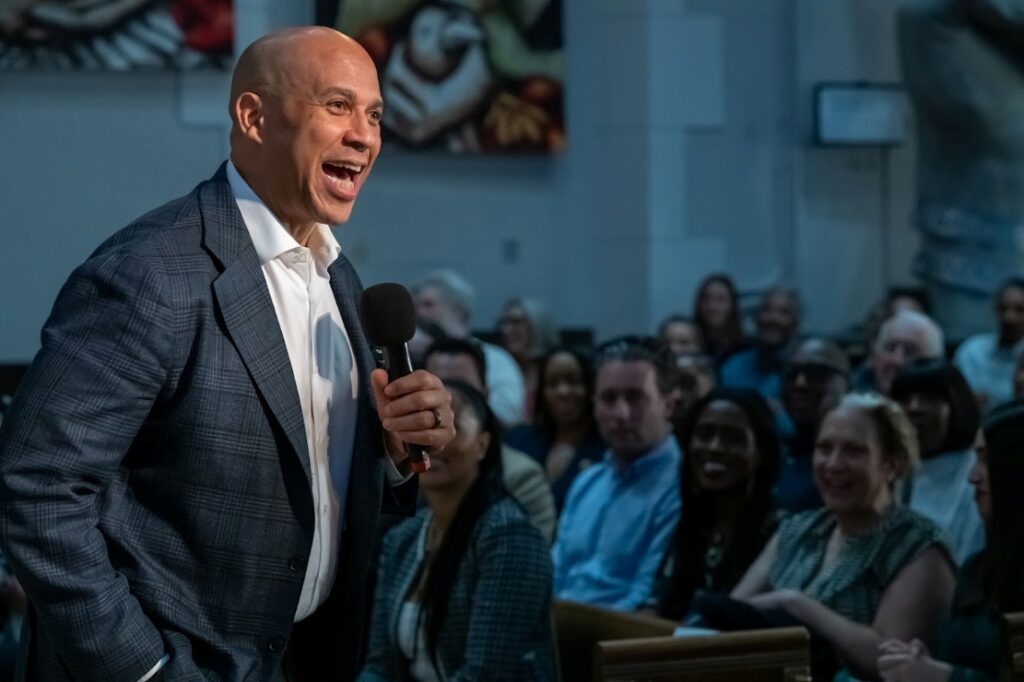
U.S. Senator Cory Booker grew up in a middle class suburb but chose to live in a housing project while governing Newark. So when Assemblymember Matt Haney welcomed Sen. Cory Booker to the GLIDE stage, he observed, “If Sen. Booker lived in San Francisco, he would probably live a couple blocks from here,” acknowledging the senator’s solidarity with those most in need.
Mentored and inspired by a tenant organizer
Sen. Booker opened with stories about the mentor who shaped him as a young man: Ms. Virginia Jones, a neighborhood elder, no more than five feet tall, but with an unforgettable presence. President of the local tenant organization, deeply respected in the low-income community he served, she rapidly deflated his savior complex.
When he described the neighborhood to her — the abandoned buildings, the drug use, the graffiti — she stopped him cold. “Boy, you need to understand something,” she told him. “The world you see outside of you is a reflection of what you have inside of you. If you’re one of those stubborn people who every time you open your eyes, you see love, you see hope, you see possibility, you see the face of God — then you could help me make a difference.”
That lesson became the foundation of Sen. Booker’s political life. “People like to say, ‘Thank you for what you did for Newark,'” he told the audience. “But I say you’ve got it backwards. Newark saved me. The community of people saved me, taught me lessons of meaning, dignity, courageous empathy, connectivity, and love.”
Watch our Cory Booker highlight reel!
“Stay faithful,” the secret to resilience in trauma
Then Sen. Booker shared one of the most harrowing moments of his life: two years after losing a closely contested mayoral race, a shooting broke out in his neighborhood. He ran toward it. He found a young man with bullet wounds in his chest, put his hands on the wound, and begged him to stay alive. The young man died.
Later, alone in his apartment, Sen. Booker stood in front of a bathroom mirror trying to scrub the blood from his hands — even after it was gone. “Something ruptured in me in a way that it’s never ruptured before,” he said. “I never felt my heart fill with such darkness. I felt rage and anger — that we are a nation that swears an oath of liberty and justice for all. But where is the justice when children in our communities are dying and it doesn’t even make the newspaper?”
The next morning, he stepped into the lobby of his building and found Ms. Jones. She opened her arms. He ran to her like a little boy and broke down crying.
“She held me and let me cry,” Sen. Booker said. “And then she started saying two words over and over again — words that I still say on the Senate floor when we’re banging our heads against implacable walls of resistance: ‘Stay faithful. Stay faithful. Stay faithful.'”
Those words, he told the crowd at GLIDE, belong to all of us — words of a people who, generation after generation, have worked to make a nation that did not love them, BECOME a nation truly of love.
“Hope is not a feeling — it’s an act of conviction”
Sen. Booker challenged the audience to refuse normalization of the crises around us. “We should not normalize people who fear calling an ambulance because of the cost,” he declared. “We should not normalize that people have to choose between paying their rent and paying for their prescription drugs. We should not normalize that daycare is more expensive than college tuition.”
He pushed back against those who try to dismiss social safety nets as radical policies. “Call me radical if I believe children should have food, great public schools, and housing over their heads. Call me radical if I believe there should be no homelessness in America — because we literally say in our national anthem that we’re the home of the brave.”
On the love agenda — a phrase Dr. Gina raised in the context of GLIDE’s values — Sen. Booker was emphatic: “A love agenda has sharp policy implications. Policies rooted in love for one another are more economically sound than policies that are not. The neglect and the lack of investment in loving our community costs us as a society so much more.”
Policy recommendations, from eviction prevention to tax fairness
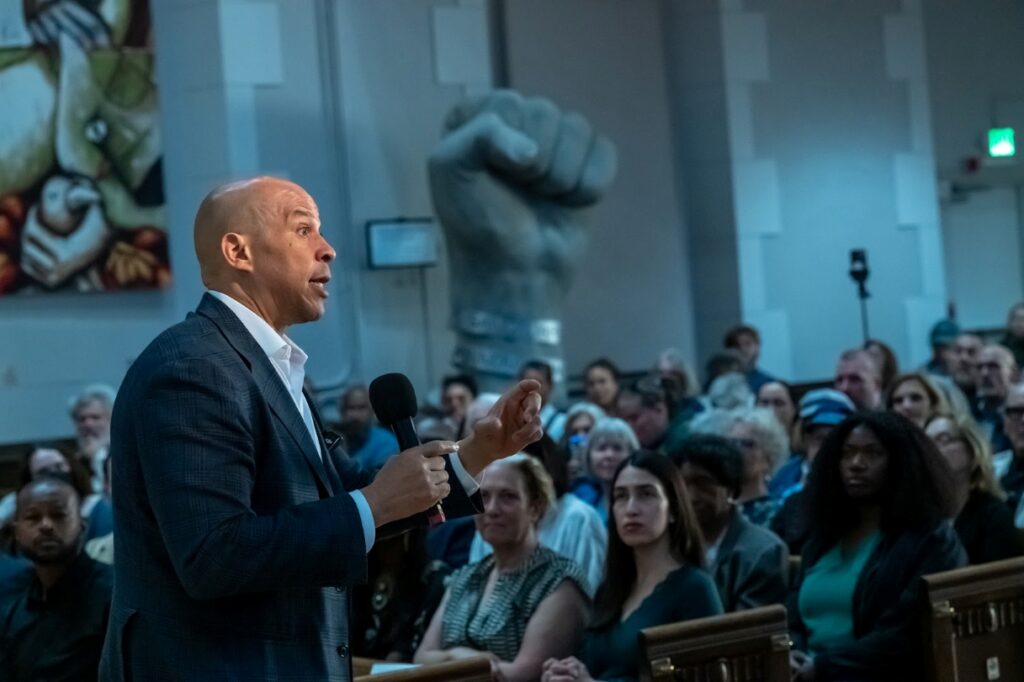
GLIDE President & CEO Dr. Gina Fromer asked Sen. Booker what he’s doing to support the unhoused, and he came prepared with specifics. He called for a national right to counsel in eviction proceedings, citing research showing that legal representation reduces eviction rates by 75%.
“Someone being evicted because they’re $1,000 behind on rent will cost a city far more than $1,000 once they’re unhoused,” he explained. “It is so much cheaper for a community to keep someone in a home than to deal with the consequences of homelessness.”
He also proposed a renter’s tax deduction modeled after the mortgage interest deduction, arguing that renters — who are disproportionately lower-income — deserve the same tax benefits that homeowners receive.
On the broader economy, he outlined a two-pronged vision: passing five anti-corruption laws to get corporate and billionaire money out of politics, and restructuring federal taxes so that no American earning under $75,000 pays federal income tax. “Make work pay again,” he said simply.
He also cited a striking statistic: 97% of federal agricultural subsidies go toward highly processed foods, while only about 7% support healthy options. “A Twinkie is cheaper than an apple not because of the free market, but because big food has rigged the system. We’ve created structures that build in the things that are more expensive for our health and our communities.”
You are not powerless: the story that made a Senator.
The event closed with an incredibly powerful story. Dr. Gina raised the issue of voting rights — something GLIDE engages with deeply through its annual Alabama Pilgrimage— and asked what people can do when the system feels rigged against them.
Sen. Booker answered with a story. On March 7th, 1965 — Bloody Sunday — a white lawyer in New Jersey named Marty Friedman was watching a protest in Selma, Alabama. He watched a protester who was trying to defend his mom from being beaten by police get shot to death. The lawyer saw the brutality and felt the pull to act. But he had just started a law firm– he couldn’t just hop on the plane to Alabama to defend protesters. So at first, he felt powerless.
But then he made a decision that Booker called one of the greatest decisions he’d ever heard of: “I’m not going to let my inability to do everything undermine my determination to do something.”
He started doing one extra hour of pro bono civil rights work each week in New Jersey. He partnered with Ms. Lee Porter of the Fair Housing Council. Together, they spent years documenting and fighting housing discrimination — placing Black families and white families at the same homes to expose the gap in treatment. In 1969, they helped a family from the South move into a New Jersey neighborhood that had turned them away. A mother, a father, a two-year-old, and a baby in a crib moved into that home.
“Forty-four years later,” Booker said, his voice rising, “the baby from that crib became America’s fourth Black person ever elected to the United States Senate. That baby was me. I am here because one man said: I AM NOT POWERLESS.”
The crowd erupted with applause, truly inspired. You can read more about this story in an excerpt from Cory Booker’s past book, or you can order his most recent book, Stand.
View more photos of Cory Booker at GLIDE!
GLIDE is honored to be a space where conversations like this happen — where political leaders, community members, and changemakers sit together and commit to a more just, loving, and courageous world. If you want to be part of that work, consider joining our Justice Warriors and staying connected to GLIDE’s advocacy.