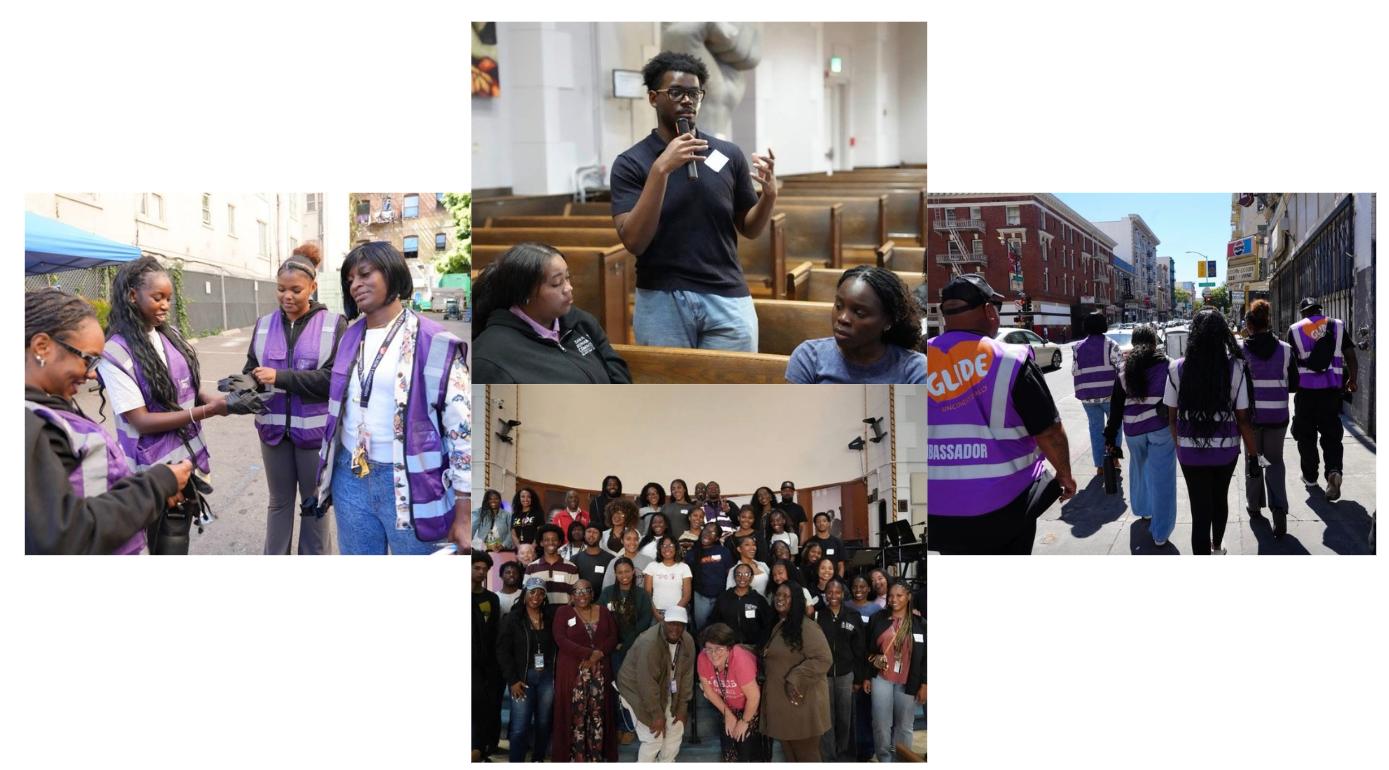

This summer, GLIDE welcomed a group of Black2SF interns for a day of community service and conversation. Black2SF is a summer program for undergraduates from Historically Black Colleges and Universities (HBCUs) to receive hands-on work experience and connect with the city’s cultural and civic life.
An educational panel for our HBCU visitors included GLIDE staff Naeemah Charles, Francesca Delgado-Jones, Je Ton Carey, Minister Marvin K. White, and Murtala Lanval, as well as Christopher Powell from Code Tenderloin and Arieann Harrison from The Marie Harrison Community Foundation. Each shared their approaches and strategies for making San Francisco a better place.
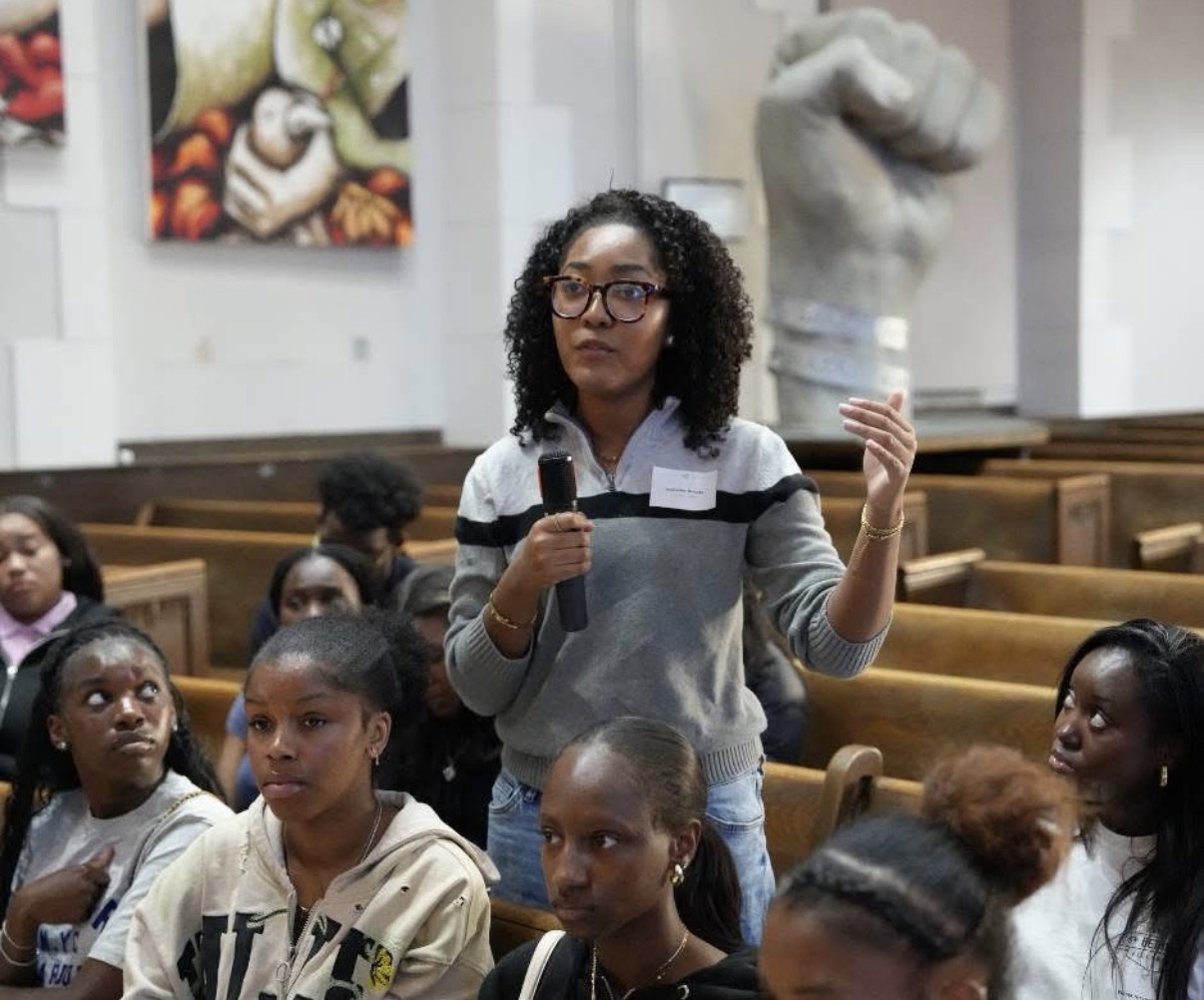
Then the floor opened for an extensive discussion about the students’ experiences in San Francisco, the conclusions they’d drawn, and the questions they’d been left holding.
San Francisco Felt Different — In a Good Way
Several students said their first impression of the city was how free people seemed to be themselves. One student, comparing it to home, put it simply:
“The DC area is pretty corporate, for lack of a better word—everything is monotone, monocolor, fits in a cookie cutter. But here everyone expresses who they are emotionally, in their clothes, their hairstyle, and how they talk.”
Another student connected that openness to her own family:
“I have a gay dad, and I come every year to San Francisco for Pride. I love how everyone can walk around and be whoever they are. I love how the policies are set up so people have room to give input in governmental systems.”
That student went on to ask the panel a question that would shape much of the conversation: whether religion—such a central part of Black cultural identity—has helped GLIDE’s community connect across differences and support one another.
Reverend Cecil Williams Built a Sanctuary for a Common Fight
Marvin K. White answered with a story from GLIDE’s history. When queer communities and Black communities were both being targeted by police, Reverend Cecil Williams invited both groups into the sanctuary at Glide Memorial Church. The two communities didn’t always see eye to eye—but Reverend Cecil understood that, for either group to survive, they needed a common fight.
“The inclusiveness of San Francisco, the rights that you see, the freedoms—those are hard-won by people, by movements,” Marvin told the students. “At Glide Memorial Church, we believe the more we can come together across difference—spiritual difference, racial difference, generational difference—the stronger we are together!”
Struggle Looks Different in Every City — But It’s Still There
Other students spoke candidly about how visible poverty and homelessness felt in San Francisco compared to home. A student from Atlanta admitted:
“My first impression of SF was seeing a lot of struggle—stuff I’m not used to seeing, like people all over the sides of the streets. I know that’s a common sight in cities, but here it looks different.”
Students from Atlanta and Washington, DC, compared notes on why homelessness looks so different from city to city.
“Atlanta is spread out, so the struggle is underground rather than in public spaces,” one student observed, while another noted that policy in DC had literally removed the unhoused population from public view.
A student placed at Zuckerberg San Francisco General Hospital, working in the psychiatric unit, asked the panel directly why the city has so many social services compared to what she’d seen elsewhere. Arieann Harrison answered that San Francisco’s programs have been built through decades of grassroots community effort. Then she offered the students something more than an answer—a charge:
“When times get hard, you need to pivot, bump your head, pivot, recover quickly, and run toward the future. When you go out into the world, how many of you are waiting for someone to pass you the torch? Don’t wait for someone to pass you the torch. Grab it, pick it up, and run with it.”
Build a Chair If There Isn’t a Seat at the Table
Freddy Martin told students that, in his experience, change always starts with a spark—one person, or a small group, deciding:
“This isn’t right. This is too much. There’s something else that needs to be done, and I’m going to do it.”
That kind of resolve takes grit and perseverance, he said, especially when funding is difficult to secure. GLIDE fights to secure funding every year. His advice:
“You have to say you’ve had enough, talk to other people who have also had enough, and just create waves. If there ain’t a seat at the table, build a chair.”
Je Ton built on that point, urging students not to be shy about naming what their community needs.
“You have to be able to toot your own horn, offer the proof: this is why we need it, this is the impact. The worst thing to do is take up a seat and do nothing. If you’ve chosen to be in a seat, it requires you to do work on behalf of all of us.”
Naeemah Charles reminded students that no single person has to carry the whole struggle alone.
“In coalition spaces, not everybody should be doing the same thing—divide up the work. Sometimes people miss that when they get into this work, thinking they have to be everything or do everything. Not everyone has to be Martin Luther King Jr. or Angela Davis giving speeches. You need everyday organizers—people scheduling, doing logistics, making flyers, and making calls.”
The Struggle Is a Marathon — And These Students Are Ready to Run
By the end of the day, the students who arrived unsure of what to expect from the Tenderloin left with something to carry home to their own campuses and communities: a reminder that nobody has to wait for permission to pick up the torch.
GLIDE is proud to partner with programs like Black2SF that connect the next generation of Black leaders to our community.