
How Hiring Relatable People Inspires Hope in Client Populations
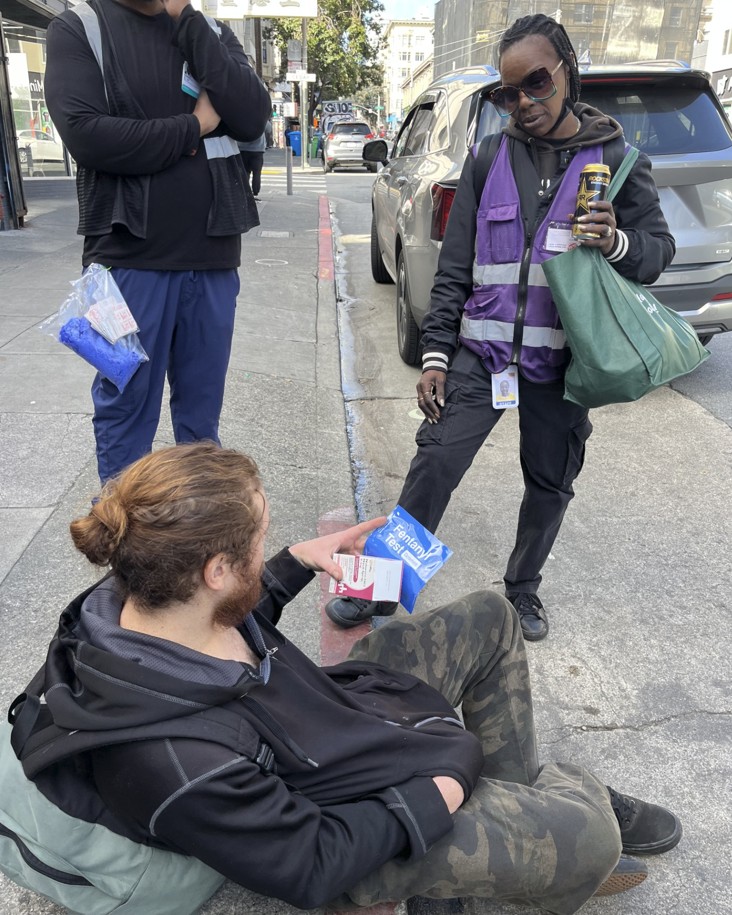
Myravanni Alefosio works on the front lines, providing low threshold case management on the streets around GLIDE. She says, “I want all my clients to know and believe: I’m just like you, I’m not better than you.” People are willing to trust her when they know that she can relate to their struggles. “I used to be homeless,” said Myra. “I’ve dealt with addiction, and my family deals with it. So helping people is a passion for me. I’m a walking testimony that things can get better: seeing is believing.”
Myra says, “Being a walking testimony means demonstrating by example: I made my life better, and you can too!” Hiring from the populations we serve closes the cultural distance between the people in need and the workers who support them– and more. It gives people a goal to visualize. They see how easily those being helped transform into helpers.
Myra has close relationships with many of her clients– they don’t just look up to her– she looks up to them, too! This blog post is a story of three clients whose personal qualities Myra particularly admires.
“Consistency and Grit”
“Part of being a community ambassador is texting people every day, motivating them,” said Myra. “The most important thing is to prevent people from giving up.” Her client James stands out as someone who was motivated from start to finish– who never gave in to the temptation to give up.
When a man we will call James (which is a pseudonym chosen to protect his privacy) got out of prison at Modesto, someone told him to go to GLIDE. Myra found him sitting on the floor next to her Resource Table, so she engaged him in a motivational interview (a technique used by many social services workers to uncover a client’s intrinsic motivation and goals). Myra discovered that James was eager to get into recovery and have a clean start. So she connected him to Soma Rise, a four-day detox program, but that was just the first step. “Come back when you get out of detox and we’ll move you on to the next step!” Myra told James.
When he returned, she helped him get into a long-term rehab treatment program. After graduating from that program, he came back to look for housing, and the community ambassadors referred him to the Street Crisis Team, who found him a Single Resident Occupancy room to live in. Now that he has a place to live, he volunteers every Friday with GLIDE.
“I admire James’s consistency,” said Myra. “Once he completed detox, he came back. He stuck with his recovery, and he trusted me. A lot of people struggle to trust because of all the times people have given up on them– or the system has failed them. Turning your life around takes consistency and grit.”
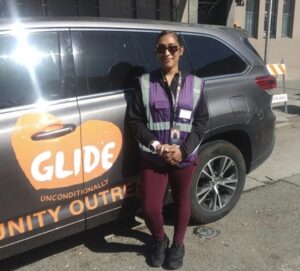
Myravanni Alefosio
She’s a fighter.
Myra glows when she talks about her client Sonya, who gave us permission to use her true first name, and will be featured in a later episode of the GLIDE podcast; make sure you subscribe to be notified when Sonya’s episode comes out.
“The first time we met, we just clicked! We have so much in common!” Myra says. They had so much in common that they started affectionately calling each other by the nickname “twin twin.” Sonya comes to see her nearly every day at GLIDE’s outdoor Resource Table. This deep support makes a difference– and it goes both ways, with Sonya expressing care for Myra in return, asking about her day.
“I want her to know, we’re both in the struggle, I’m in process too,” Myra explained. “Long-term case management is important: it’s not just finding shelter for someone in an emergency. It’s not about checking the box. It’s about the follow-up. It’s about building a relationship that motivates them to succeed. They don’t need a service: they need someone to believe in them!”
Myra met Sonya several months ago, when she was mourning the death of her husband from an overdose. Today, Sonya has found a job with a small nonprofit supporting under-served and re-entry fathers, where she does low threshold case management just like Myra. Myra is incredibly proud of Sonya for finding a job and maintaining her SRO (Single Room Occupancy) housing status.
“Sonya’s still a fighter, despite everything she’s been through,” says Myra. “She’s always being productive, always on the go. Listening to her is like– ‘I have an interview– I gotta do this– I gotta do that!’ She has that spark. We help keep the spark alive in each other: we hold each other accountable.”
“I Know Someone’s Going to Help Us.”
When a young man’s auntie saw GLIDE’s logo, she flagged the ambassadors down. (We will call this young man by the pseudonym of Ivan in this article to protect his privacy.) Ivan was a twenty-two year old young man, and his auntie advocated for him, saying, “My nephew is homeless! He needs your help!” Myra made an appointment with him at GLIDE and took him to Larkin Street, where she advocated for him and hooked him up with his case manager.
His case manager was able to tell him his “score” within the city’s rapid rehousing system– your score determines how many people are ahead of you on the waitlist. Of course, Ivan immediately asked, “Where can I stay while I’m waiting for my spot?” So the ambassadors called the Homeless Youth Alliance and explained that Ivan needed a long-term bed, not just an overnight shelter. An hour later, they received a call-back with a bed opportunity at Transitional Age Youth Navigation. Then the Cecil Williams Community Ambassadors escorted him to shelter.
Myra admired Ivan’s refusal to give up. While they were bouncing from one program to another, dealing with closed doors and red tape, he kept saying, “It’s okay, Myra. I know someone’s going to help us.” She said, “His attitude made me not want to give up on him.”
When Ivan finally got to his turn on the waitlist, he called Myra to let her know he was apartment searching with his case manager. The rapid rehousing program would be funding his housing stability. These systems are not easy to navigate, so it was a big win for Ivan and Myra.
What Really Makes a Difference for Unhoused Clients
We asked Myra what would make things easier on her clients. “More low barrier services,” she said “More trauma-informed services.” She also explained why long-term case management can be so much more effective than on-the-spot emergency services.
Everyone benefits from consistency and compassion: they need relationship-oriented care. When you’re in relationship with someone who’s rooting for you to succeed, it’s easier to be persistent and resilient. The relationships Myra was able to form with Sonya, James, and Ivan helped them remain emotionally resilient as they battled for the changes they needed in their lives.
Social service workers in programs are not interchangeable cogs– each has a unique network of relationships with people who count on them as individuals. The importance of relational care is vital to consider in any social services strategy.
If you want to see how we build relationships at GLIDE, we encourage you to sign up for community ambassador walk-alongs or meal services on our volunteer page.
“Volunteering will give you a personal perspective on how we help our clients,” Myra said. “You’ll see the relationships we’ve formed. It’s not just a one day thing. Every day we greet them and get to know them better is part of their journey towards a better life. Community ambassadors may pick up garbage; but no one should see us as glorified janitors. What we’re doing is spreading hope.”