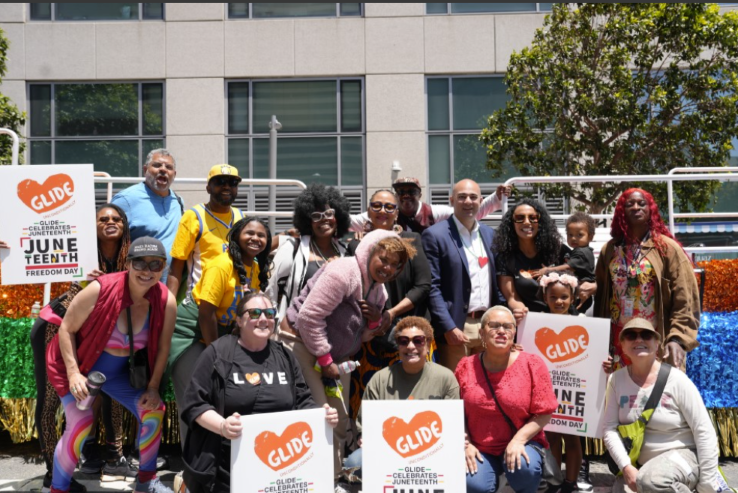
We kicked off this year’s San Francisco Juneteenth Parade right at Spear and Market streets. The beat of music filled the air, a parade of sounds that celebrated Black joy in every note. Classic muscle cars rolled by, polished and gleaming under the morning sun, as families lined the sidewalks smiling and dancing.
As we made our way down Market Street toward Civic Center, the energy grew. Block parties sprang up along the route, full of children laughing, people lined up dancing, games being played, and live performances echoing the spirit of freedom. Every part of the celebration carried the weight of history and the lightness of joy.
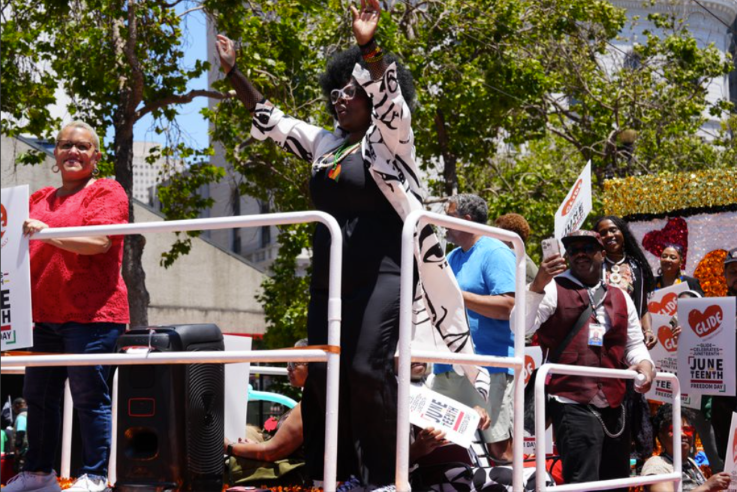
We are proud to be in the heart of it all. Our President and CEO Dr. Gina Fromer rode with Supervisor Bilal Mahmood, standing side by side with us as we celebrated the legacy of Juneteenth.
At one point during the parade, Dr. Fromer was praised over the loudspeaker for her leadership in San Francisco and for guiding GLIDE into its future. Hearing the crowd cheer as her name was called reminded us how deeply this city values the work happening at GLIDE and the people who lead it.
This day marks the moment in 1865 when enslaved people in Galveston, Texas, learned they were free, years after the Emancipation Proclamation had been signed. Being part of this parade means something real for us at GLIDE. It is not just a moment to celebrate, but a reminder of the work we do every day. We stand with our community as we push for justice, dignity, and true liberation for all. This is not just history. It is now.
As we celebrate, we also continue to charge ahead. Liberation is not a day, it’s a movement, and we invite everyone to stand with us as we keep pushing forward.
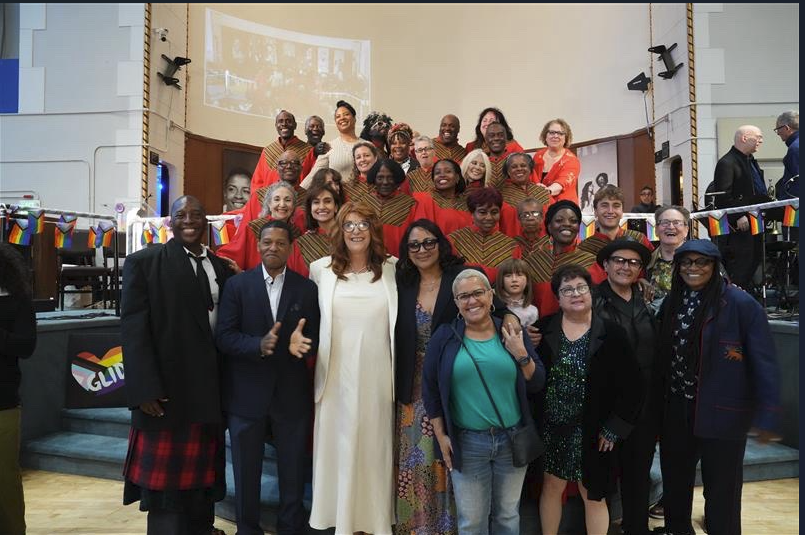
2nd from L, SFPD Chief Bill Scott and SF Executive Pride Director Suzanne Ford
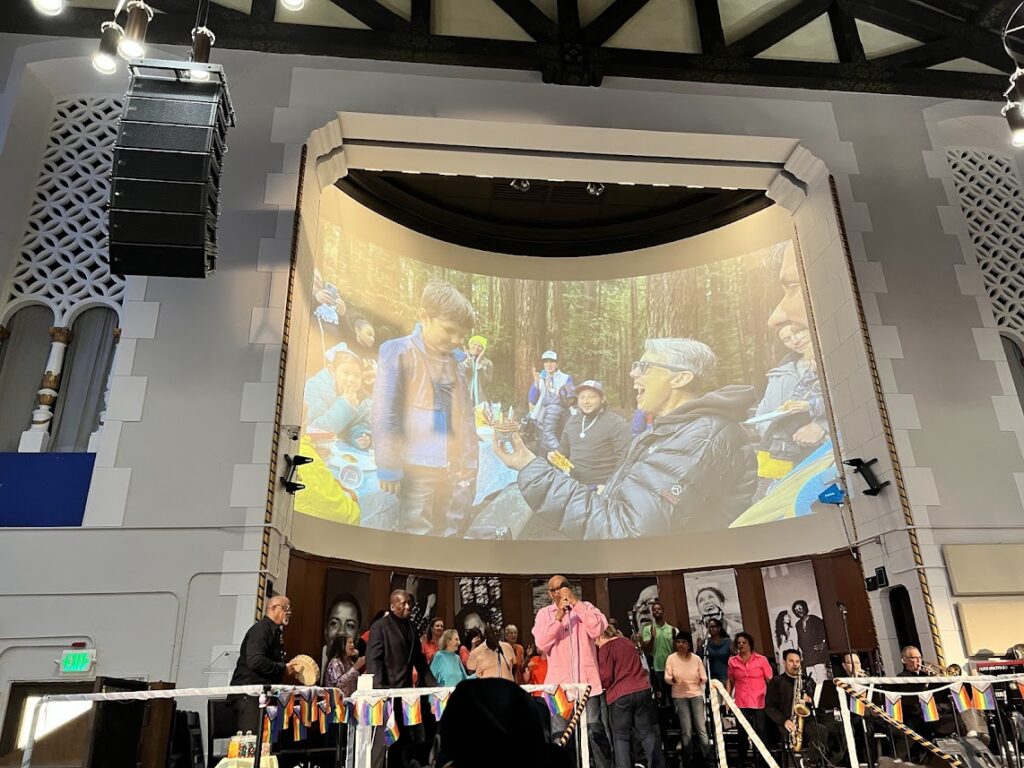
Pride is not just a parade; it is an entire month dedicated to the celebration of identity, resilience, and love. To kick off the month of Pride on June 1st at 11 AM, Glide Memorial Church hosted a powerful ceremony with SF Pride’s Executive Director, Suzanne Ford. She began her sermon with these words: “I have learned this morning what church is supposed to be like.” A profound statement that set the tone for a special celebration.
Glide Memorial Church also honored San Francisco Police Department (SFPD) Chief Bill Scott, who was transitioning from his role as one of San Francisco’s longest-serving chiefs of police. It’s rare to witness a chief of police being celebrated alongside the Executive Director of San Francisco Pride, but that’s the heart of Glide Memorial Church—an unwavering commitment to bridging communities and embracing all people.
On Chief Scott’s last Sunday in his position, after eight years of service, GLIDE honored him for his service and dedication. Del Seymour, Glide Foundation board member and de facto Mayor of the Tenderloin, paid a heartfelt tribute to the Chief. Every holiday season, Chief Scott volunteered by serving meals to those in need. To honor him, Glide presented him with his chef coat—symbolizing the legacy of compassion he’s leaving behind as he embarks on a new chapter in Los Angeles, leading a public safety division of the transit system.
Ironically, as Glide honored him, Chief Scott reflected on how Glide has been a beacon for the community. “GLIDE is the lifeblood of the city,” he said, “When times are tough, whether it’s an officer-involved shooting or reckoning with our past mistakes, we come here. We come to GLIDE.”
Suzanne Ford, the first trans Executive Director of SF Pride, boldly declared that SF Pride is “the most iconic queer organization in the world.” She shared her powerful journey, one shaped by mental health struggles, addiction, deep shame, and the radical grace that helped her heal.
She spoke passionately about transformation—both personal and collective—declaring, “It is not only possible, it is holy.” Suzanne then drew an inspiring connection between SF Pride and GLIDE’s shared mission: to embrace those who have been persecuted for who they are and who they love. But at GLIDE, she emphasized, “You are not just tolerated—you are celebrated!”
As Suzanne shared her story of overcoming adversity, she ignited a fire of hope and self-empowerment, reminding us all that we can love ourselves fully, embrace our authentic selves, and rise stronger after every trial. Good people are drawn to those who live true to themselves.
The theme for 2025 Pride is “Queer Joy is Resistance”—a powerful reminder that joy, in all its forms, is a radical act of defiance. It’s a celebration of resilience, love, and freedom. Join us on Sunday, June 29th at the Pride Parade and stand with us in the joyful resistance that defines Pride!
“Freedom delayed is not freedom denied,” proclaimed Eric McDonnell, Chair of the African American Reparations Advisory Committee and guest speaker at Glide Memorial Church on Father’s Day. “Even when the world tries to leave us behind, God says, ‘I see you. I love you. I care for you.’”
This Father’s Day at Glide, everyone felt free—free from incarceration, free from trauma, and free in identity, including our queer brothers and sisters (some of whom are fathers) still fighting for full liberation.
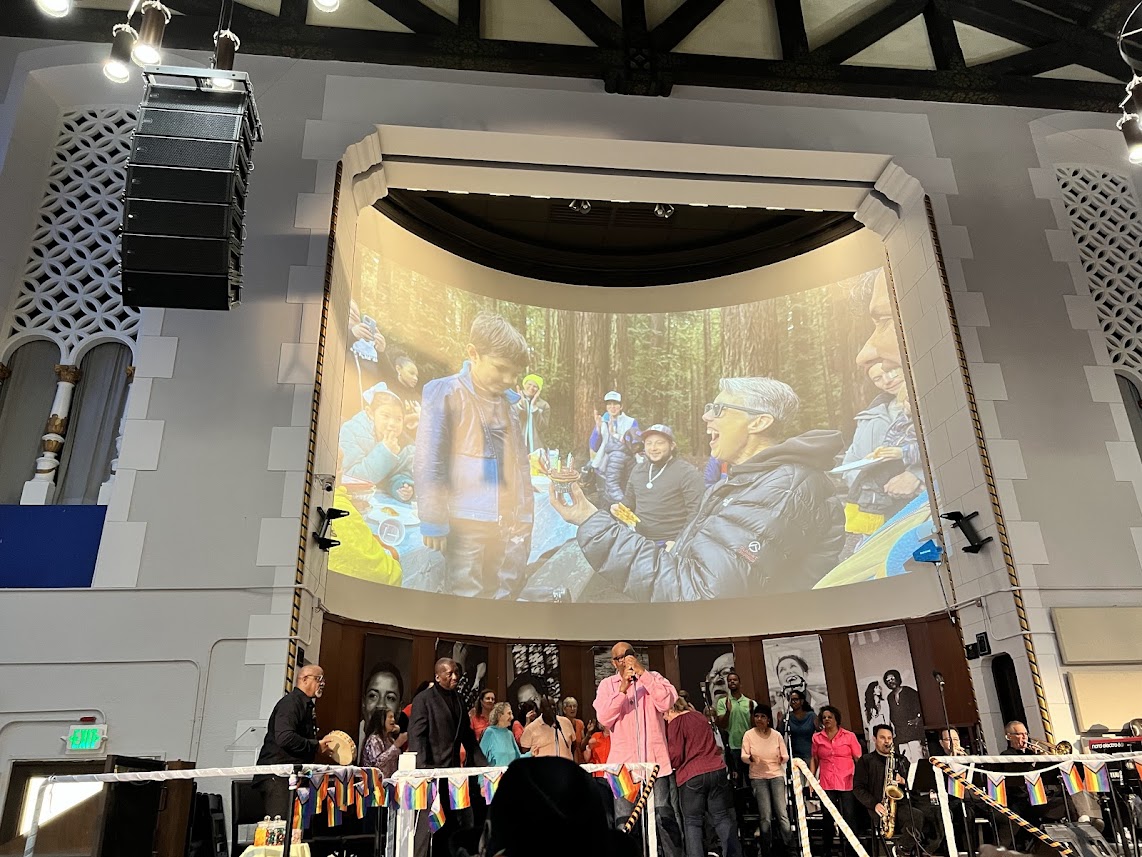
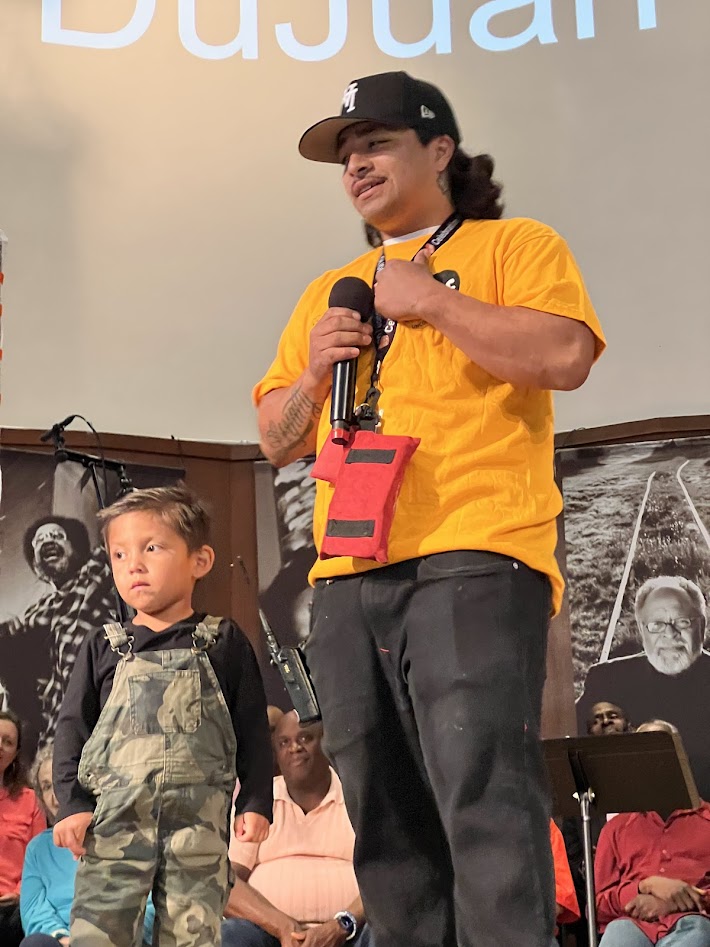
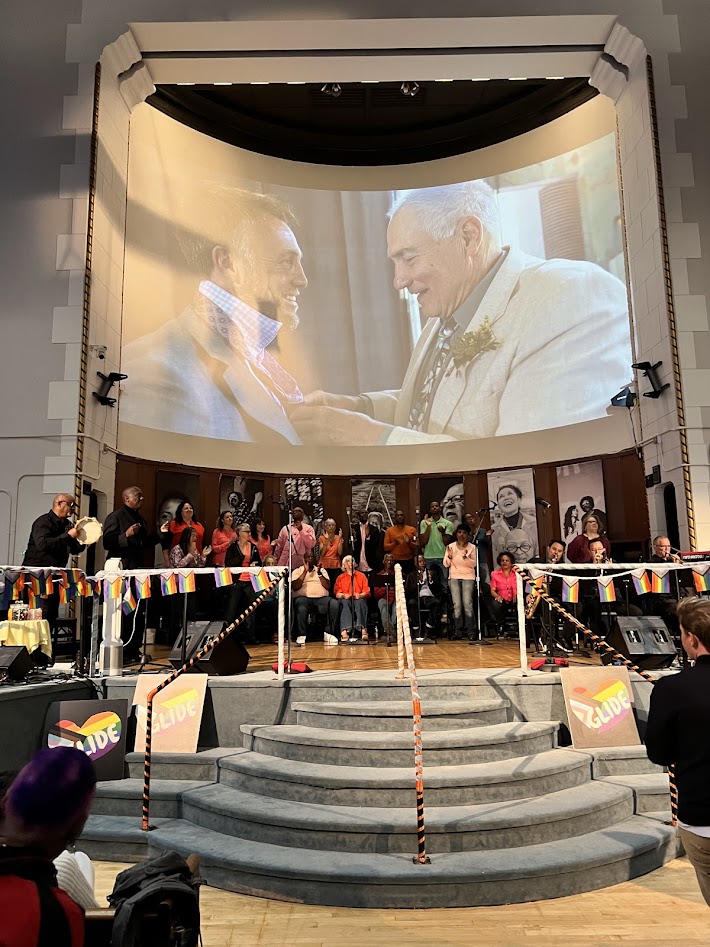
Photos of generations of fathers and father-figures lit up the giant screen on stage as Minister Marvin K. White, Eric McDonnell, and fathers from across the community gathered to honor a powerful trifecta: Father’s Day, Juneteenth, and Pride.
The spirit of freedom filled every pew. We remembered the excruciating delay between the Emancipation Proclamation—issued on January 1, 1863, declaring an end to slavery—and the moment that freedom finally reached enslaved Black Americans in the fields of West Texas on June 19, 1865.
That delay was real. That pain was deep. But still, we celebrate. Because freedom delayed is not freedom denied.
McDonnell’s booming voice echoed through the sanctuary and into the streets: “True freedom doesn’t come from paper or proclamation. It comes from the power of persistence—and from God.”
“Healing is possible,” he declared. “Deliverance is possible.”
He then invited the congregation to celebrate five ways to live free:
Tell your truth.
Serve your community.
Worship boldly.
Build something.
Love radically.
With that, he transformed the moment of Father’s Day and Juneteenth into a call to action—a living movement rooted in freedom and hope.
A movement that sets us free—today and every day.
Social Service Providers As Pioneers in Transformative and Restorative Justice
Restorative and transformative justice are ways of dealing with harm that focus on healing instead of punishment. Our mainstream justice system is frequently punitive, which can trap people in cycles where they repeat their mistakes instead of transforming their lives.
When service providers like GLIDE respond to infractions of rules by clients in a way that’s grounded in grace and community care, they light a way forward to a better world– one where everyone has the opportunity to grow from second chances.
What is restorative justice?
Restorative justice is about bringing people together—those who were hurt and those who caused harm—to talk honestly, take responsibility, and try to make things right.
What is transformative justice?
Transformative justice looks even deeper and asks, what needs to change in our community or society so this kind of harm doesn’t keep happening?
What is GLIDE’s Return to Care Program?
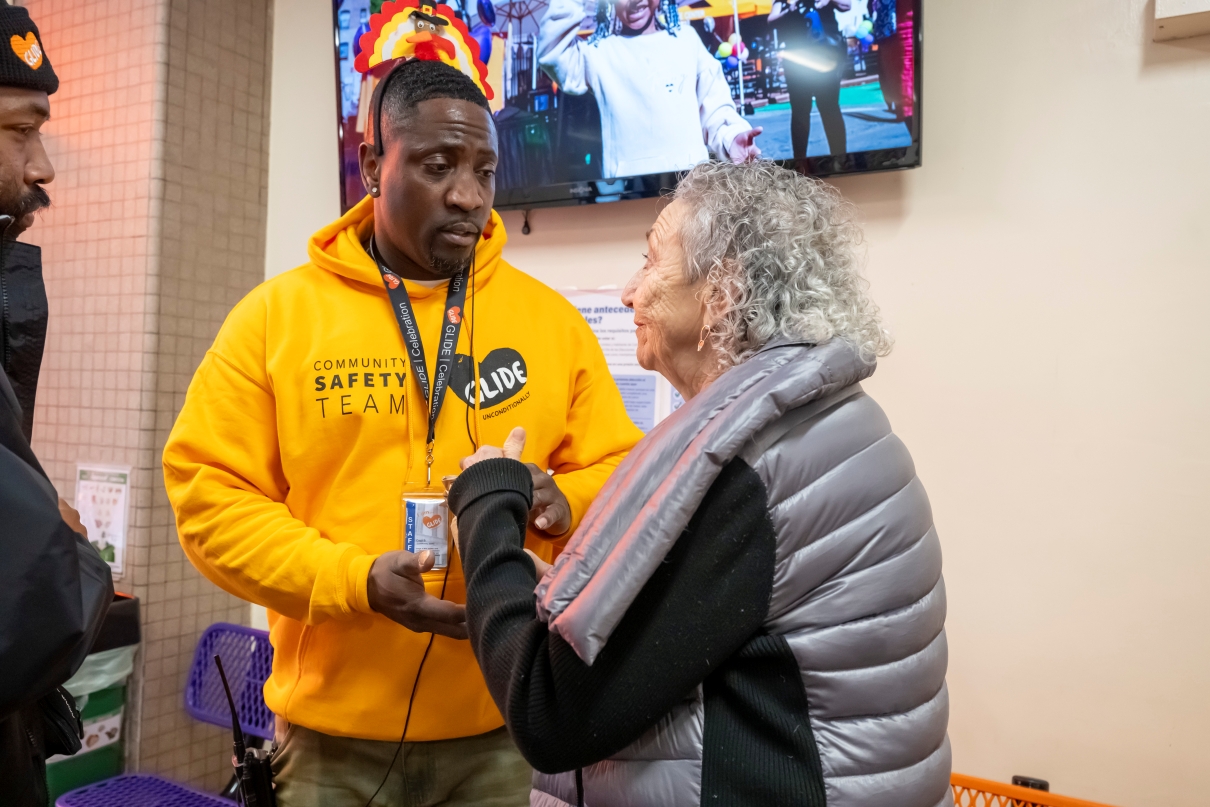
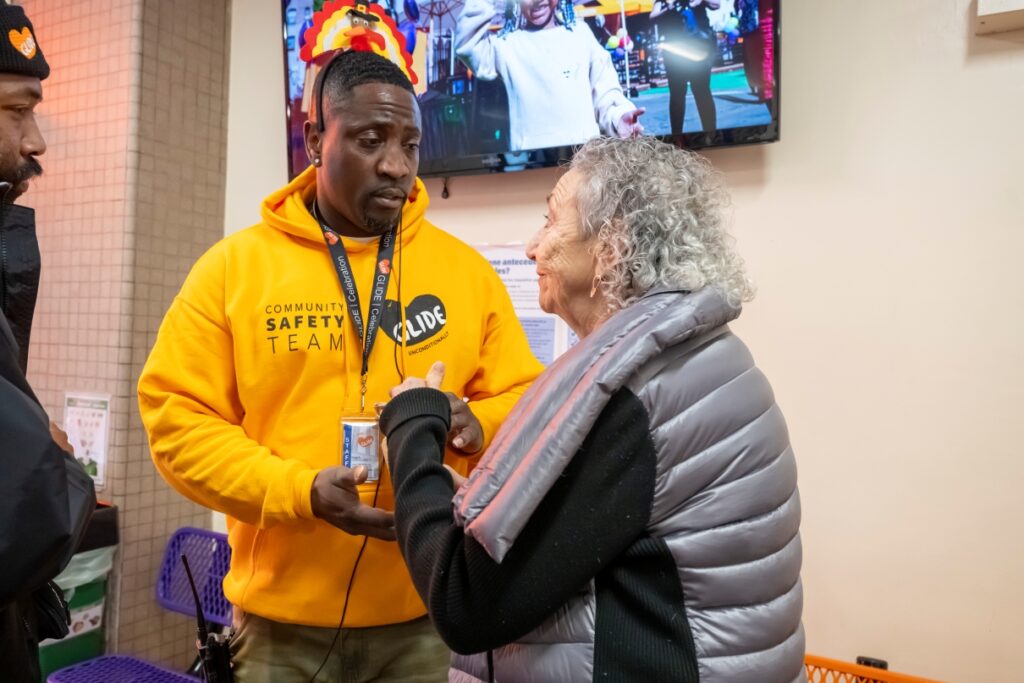
Every social service provider has clients who break the rules. People experiencing extreme poverty are under all kinds of physical and mental stress, and often have mental health problems or understandable difficulties with emotional regulation. GLIDE’s values of radical inclusion and unconditional love deeply inform the way we approach rule-breakers. We interviewed Lando Del Rio, our Community Safety and Training Assistant Manager, to get deeper insight into how our approach works day-today.
“Our clients come to us with a variety of complex situations: but we know them, we talk to them, we have a rapport with them. We code-switch with them and meet them where they’re at. We don’t use inaccessible professional language if we know they won’t understand it; we talk to them in the same way that talks to us.”
This includes hiring staff of many different backgrounds and trying to learn phrases of your client’s languages. “It’s about cultural competency and interpersonal skills,” Lando adds. “You need to have a great memory for names and faces.”
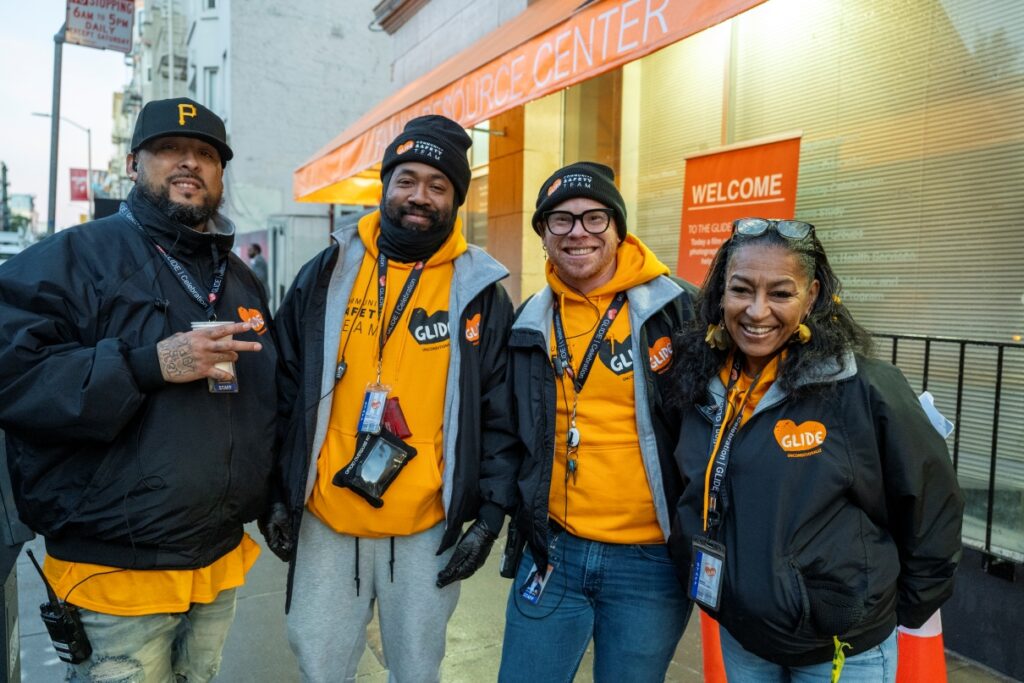
It’s easier to de-escalate someone who’s upset or breaking the rules if you have a pre-established relationship or call them by their name. Our community safety team members have a wide range of safety-related skills in addition to de-escalation: training in first aid, CPR, narcan administration, and mental health first aid.
What governments can learn from social service nonprofits
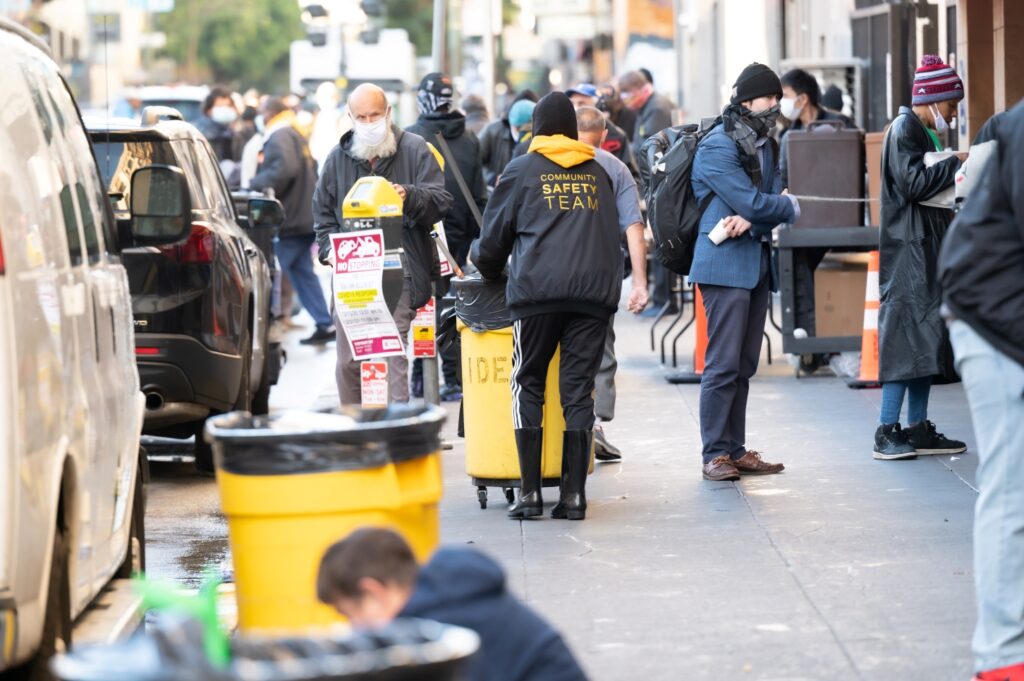
“City leaders should approach unhoused people like people: like individuals,” says Lando. He shared his discomfort with the tactics that sometimes get used in encampment sweeps across the country: “Unhoused people are treated like animals sometimes: kicking them out, rushing them, grabbing their belongings. That’s not the way we do things in the morning. Of course, people camp on our doorstep overnight, after closing hours.”
“When it comes to morning time, we have a system. Our announcements often include a friendly ‘Good morning!’ or ‘Top of the morning, everyone!’ gently signaling that it’s time to rise and shine. If they don’t hear that, we will individually greet them, and politely let them know it’s time to start gathering their things. We give them time. They’re regulars, they know the system. They know we’re going to come out there and greet them and be nice to them, so they’re okay with being woken up– they know breakfast is coming soon.”
“Every now and then, we’ll have a couple of issues in the morning, maybe because we woke them up after we just got to sleep. In those cases, we just give them a few minutes. If cities approached unhoused people with that kindness and humanity, we’d be in a better place. No one should ever talk to unhoused people like they are in the way. They’re just trying to live; they’re trying to get by.”
Transformative justice in action
One core tenant of the philosophy of our Return to Care Program is that someone’s actions don’t define who they are. When people make mistakes, our priority is still ensuring they are never lost to care. We hire staff who are formerly unhoused, formerly incarcerated. So many people at GLIDE understand on a deep level what it’s like to be on the streets and making unwise decisions. They know better than anyone– the person you are today, isn’t the person you have to be tomorrow.
A committee of safety and program staff meets every Thursday to discuss incident reports from the week and choose a way to handle each situation individually. Often the solution is a cool-down period, the length of the cool-down period depending on the severity of the rules infraction. We also consider whether it’s a repeat or a first-time infraction. No one is ever kicked out of GLIDE forever; it’s against our values. But often, a cool-down period to reconsider can help a person be restored to their community.
We still feed them during their cool down period; we give them a to-go meal and ask them to eat it outside the building. And we have a conversation with them about why the decision was made to institute the cool-down period. Usually, they’re very very understanding about it. They generally understand they’ve done something wrong and feel the consequence is fair.
Justice means solving root causes, not just punishing behaviors
“Sometimes when people get into fights inside the building, they’re continuing conflicts that have been occuring outside the building,” Lando explained. “People have lots of personal drama. They’re in survival mode. I get it. We have to put ourselves in their shoes so we can respond with compassion– and also be clear with them about what we won’t tolerate at GLIDE. I don’t always agree with the choices and actions people take, but I keep on reminding myself, I’m not them, I haven’t gone through what they’ve endured.”
The most important thing, more important than imposing consequences, is attempting to solve the underlying issue causing the behavioral issues. For example, a client who’s underlying problem is dementia doesn’t need a cool-off period, they need medical assistance. Our Safety Team might problem-solve that situation by doing handoffs to the client’s caseworkers, or particular cases can be handled by a licensed clinician on GLIDE’s staff.
Compassionate problem-solving in complex situations is what our safety team does– their work is so much more advanced and intensive than that of a “security” worker. Ensuring the safety of people is much more labor-intensive and vital than ensuring the safety of property– and much more important!
What to do when restorative justice doesn’t work at first
On the rare occasions when our restorative justice conversations don’t go well, and people don’t appear to understand the gravity of what they’ve done, the Return to Care committee discusses the next steps and strategy as a group, considering many factors, including the urgency of the care.
People who are on a timeout from Meals Service are still welcome to see their health access workers at the Health Hub beside the building, so no one is ever removed from care entirely. We will also sometimes bring their services to the sidewalk and see if we can help them there. That way they can be cared for without negatively impacting others trying to enjoy services within the building. Our first priority is always the safety of everyone, including staff!
Violence and physical restraints are not necessary to ensure safety
We have a Hands Off Policy which is rare among social services agencies– meaning that our staff is never allowed to lay hands on a client to physically restrain them– not even if the client is initiating a fight. This policy increases the overall safety of staff. The policy helps people feel safe– it makes them more relaxed and less inclined to escalate in the first place.
A safety staff is different from a security staff: we remove ourselves from violent situations instead of trying to “vanquish” the “enemy.” In a world of unconditional love, no one is an enemy. There are some situations where calling 9-11 is called for, but it’s neve a first resort!
Using these policies, we’ve been able to keep our guests safe. Lando says, “We’ve found that even after a withdrawal, most individuals show significant improvement in their attitudes and behaviors. While we do occasionally see repeat offenders, the overall trend is positive change.”
De-escalation tips
Gwen McDade, our Community Safety and Training Manager, is fond of telling staff she trains, “Do not match their energy. If they’re at 100, we stay at 50.” We can’t outdo an escalated client when it comes to energy, so we use calm and teamwork to handle the situation.
Our Safety Team also does tag-in and tag-out. Lando says, “If I am having a confrontation and it’s not going well, someone else will be like ‘I got this,’ and I will leave.” Basically, sometimes clients get triggered because a particular person rubs them the wrong way– so switching out can de-escalate. We also always respect a client’s bubble and make sure they don’t feel crowded. Crowding someone can escalate them. They will feel threatened if five people are all crowded around them!
The most important de-escalation tactic, Lando says with great conviction, is LISTENING. “You don’t want them to feel scared or defensive, so we do lots of listening, we say, ‘Let me hear your side of the story.’ We offer them help, we ask them how we can make this better. And we let them walk away. If there are two people fighting and we’re separating a fight, we always ask them to please walk in opposite directions.”
A rewarding practice
One of the most rewarding aspects of our justice approach is we get to see the magic of people growing and changing, “People often come back and say , ‘I’m so sorry!’” says Lando. He described a client with multiple infractions who was so touched that the team allowed him back into care, he eventually became infraction-free.
When you approach justice with a mindset of radical inclusion and unconditional love, everything changes. You are able to keep the community safe– and keep those who violate community norms safe and cared for as well. It’s all about hearing people out, and giving them a chance to change.
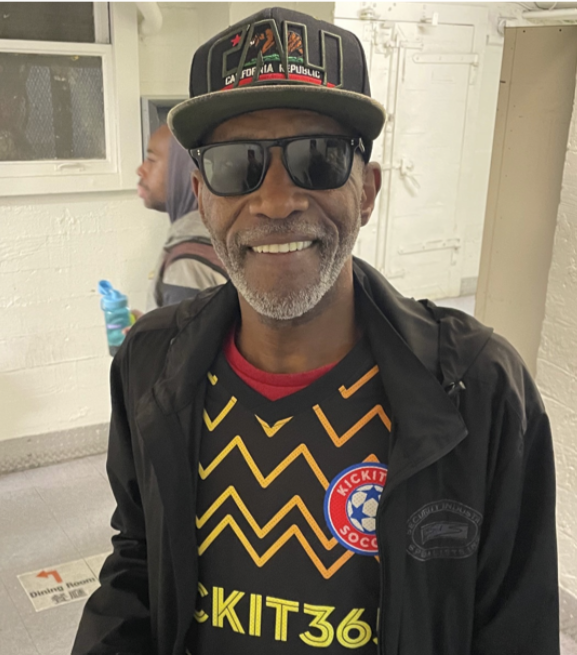
My name is Vincent Smith. I’m 61. I’ve been coming to GLIDE since 1993. I’m originally from Richmond, Virgina. My 12-year-old daughter was killed by a drunk driver. I knew the person who did it, but did not want to take any action for fear of any repercussions. Frankly, I was just too scared to go back home. So, I moved to California.
Her passing is a part of me that’s gone. It’s never coming back. But when I arrived in San Francisco, I heard about GLIDE. And I’ve been coming to ever since to the meal services. I used to make use of GLIDE’s health clinic, where I received assistance for my mental health.
I also worked part-time for the city and would come to GLIDE on Wednesdays and Thursdays for lunch. But I’ve been a Thanksgiving regular for a while now, including Christmas. Thanksgiving is family time, and I normally would have been with my family back in Virginia.
But since I can’t, GLIDE is my number two, and I consider it my adopted family. And all of the volunteers who come here to serve on Thanksgiving, I’m so grateful for all of them. These are the people I know. Most of the people I know on the streets are doing drugs like Cocaine and Fentanyl. I’ve seen too many of them die, as a result. But GLIDE is like a brother to me.
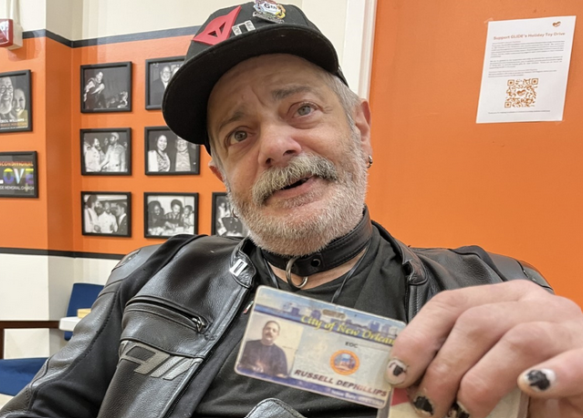
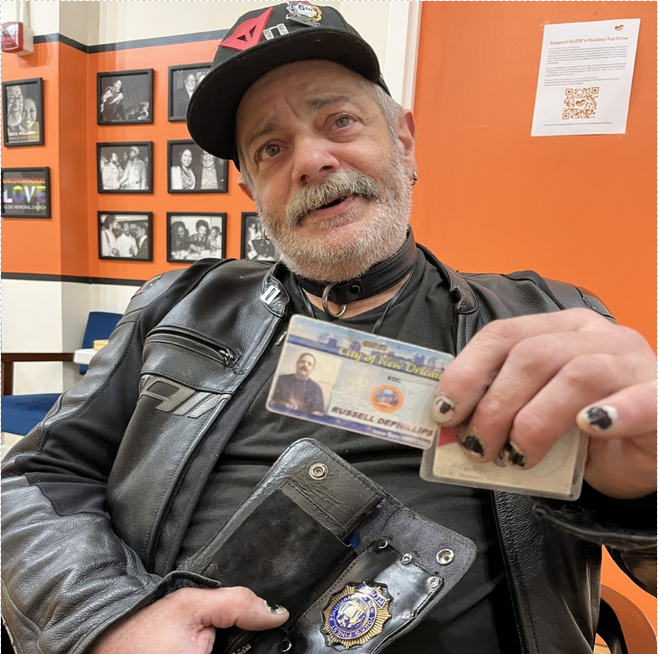
Robert (Russell) R. DePhillips in his own words
“I was born and raised in Brooklyn, New York. I’m 58 years old. I’ve been coming to GLIDE to get my meals for nearly eleven years. I was a former police officer for the NYPD. I later worked for the movie and TV industry in Hollywood. I was at the Trade Center on 9/11 when the planes hit. Hurricane Sandy flooded my home while I was living in New York. This was back in 2012.
I lost everything. FEMA screwed me. I lived off my savings for a year in a hotel while trying to clear things up, but wound up on the streets homeless, just before Thanksgiving. A friend of mine who was living in the Bay Area, at the time, suggested I move out to California and purchased a train ticket for me. But I struggled to find work and wound up homeless. I lived on the streets for about ten years before I could finally get some assistance from the city. I now live in an SRO.
During that time, I found out about GLIDE’s meal services, and I’ve been coming here ever since, at least five days a week for breakfast, and sometimes for lunch and dinner. The food is good and the staff are wonderful. They are so welcoming. They know me by name now. It’s like family. I feel I’m treated like a human being.
If I had money in my pocket, I’d be donating to GLIDE every month. When I had money back in New York, I would donate money to organizations like Covenant House. But in all honesty, I don’t know where I’d be without GLIDE.
I’m currently waiting for my SSI benefits to start. I’ve been suffering, but I am being patient. “
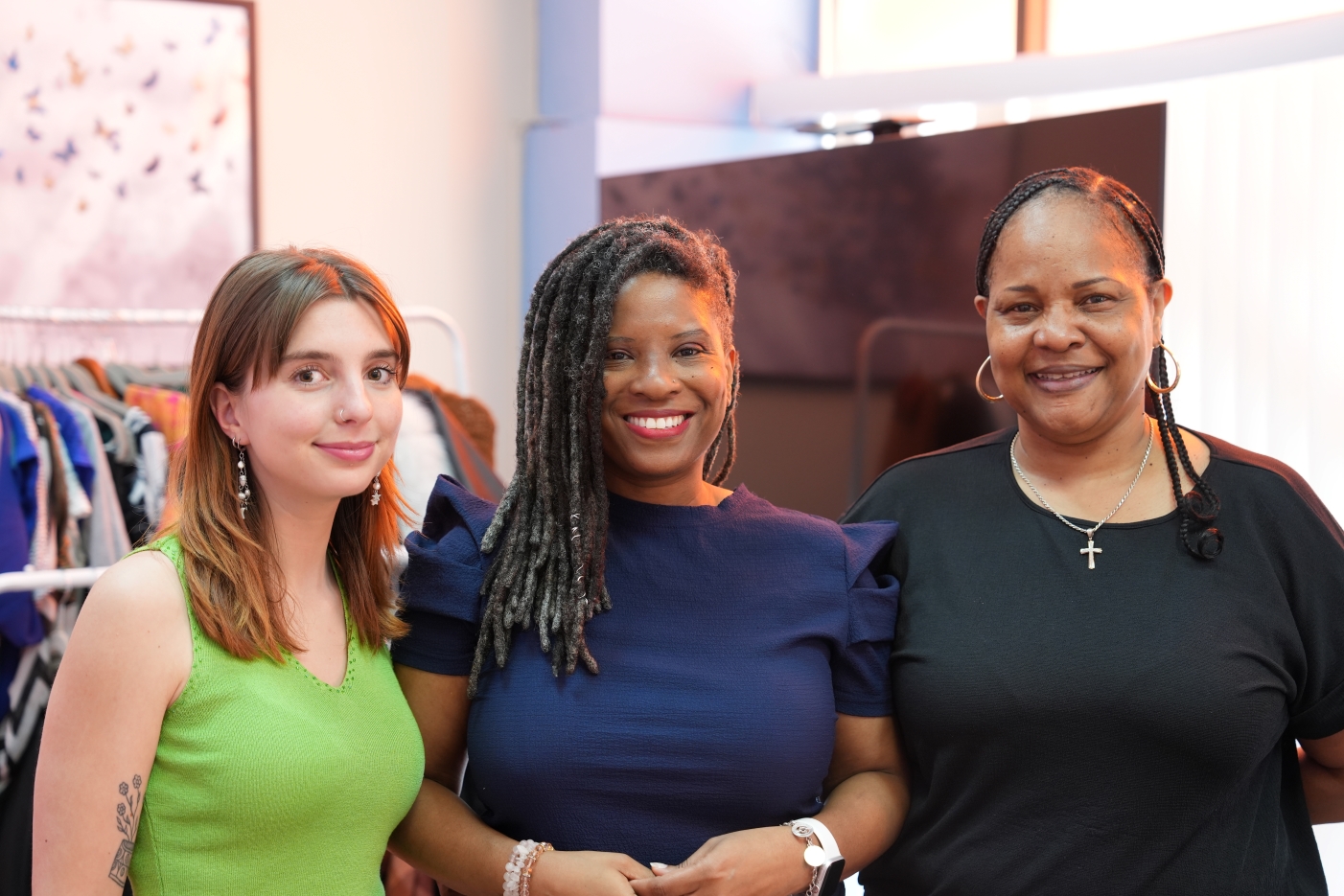
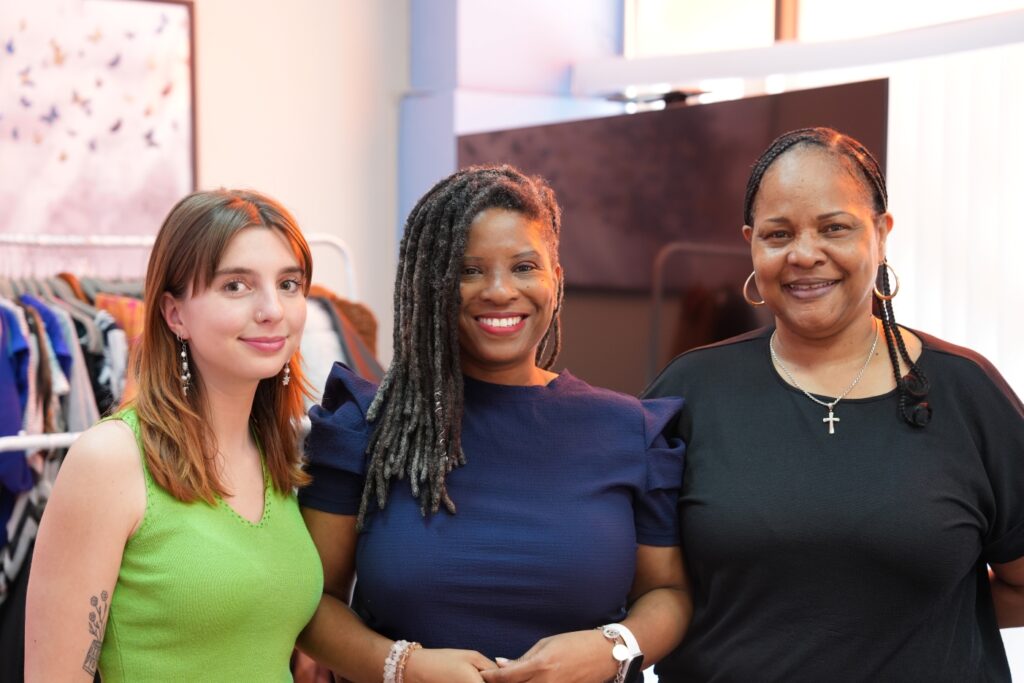
GLIDE’s Women’s Center recently re-opened stronger than ever with an amazing new team: (R) Loria Price and (L) Olivia Onek under the leadership of (C) JeTon Carey. We interviewed Loria and Olivia about their experiences serving the women of our neighborhood, and their hopes and dreams for the center’s future.
Meet the staff building community and support for vulnerable women
JeTon Carey (Senior Director of Women, Children, and Family Services): “It was always the vision of Janice Mirikitani for GLIDE to serve women and families. So I want our Women’s Center to be a hub where every woman who walks through the door of GLIDE can access services in a safe, supportive way. I don’t want to bog them down in bureaucracy: I want it to feel like the service referral is coming from a friend. We won’t just say ‘go over there,’ we’ll do the warmest of warm hand-offs. We’ll make sure they have transportation to the service provider, we’ll ask them, ‘Have you eaten today?’ and all those kinds of questions. Seeing the resilience and strength of the women we support inspires me every day.”
Loria Price (Case Manager): “I’ve been in the community, serving the most marginalized people for over twenty years. I’ve worked for special education, for Children’s Council, and I see how many people are being under-served– especially people of color! People are afraid out there. Just being in a place where they have a voice and an understanding ear can make a difference. I keep in mind that I’m no better than them. I don’t care where they came from– we come from the same place. Sometimes people just drop in and say, ‘Hey, can I get a jacket? I was on the street and my jacket was stolen today.’”
Olivia Onek (Program Coordinator): “I volunteered in high school for GLIDE, and I’m so glad to be back. What I love about GLIDE is you walk in and you can immediately feel the love and acceptance here. I really want to help the community. Women are often overlooked when it comes to services, so we wanted to have a specific space for them, where they can feel safe and comfortable– where they can feel like a human being! We help them with basic needs (like clothes and hygiene kits) and they can also talk to us about what’s going on in their lives.”
Services provided at our Women’s Center in the heart of the Tenderloin
Who We Service
Experienced domestic violence, sexual assault, or other forms of trauma
Faced housing instability, including living on the streets or in shelters
Struggled with substance use or mental health challenges
Felt isolated and in need of a strong, caring support network
What We Offer
Support Groups & Healing Circles – A safe space to share experiences, build resilience, and find community.
Case Management & Advocacy – Personalized support to connect you with resources including housing, childcare, and legal resources.
Trauma-Informed Counseling & Peer Support – Compassionate care from staff who understand your journey.
Workshops & Life Skills Training – Tools for self-sufficiency, empowerment, and personal growth.
Emergency Assistance & Referrals – Help with immediate needs like food, hygiene products, and crisis intervention.
The Women’s Center is a hub of healing, empowerment, and connection for women in San Francisco’s Tenderloin neighborhood. Grounded in trauma-informed care and cultural humility, the Center provides a safe, welcoming space where women, especially those impacted by violence, housing instability, poverty, and discrimination, can access comprehensive support to stabilize their lives and thrive. Its mission is to uplift and empower women by providing access to resources, community, and care that nurture healing, resilience, and long-term self-sufficiency.
The Women’s Center is stocked with a variety of supplies that women on the streets commonly need– feminine hygiene products, deodorant, socks, toothpaste, clothing, and more.
Loria and Olivia refer women to a variety of services within GLIDE (we’ve got everything from rental assistance to free diapers) and also help women find services outside GLIDE. They operate with sensitivity to women’s unique needs, for example helping women who have experienced domestic violence find shelter where they aren’t sharing space with men. Even if they don’t have exactly what a particular woman is looking for, they make sure no one walks out empty-handed.
Our Women’s Center also has peer support groups and Fun Friday events to help women build community. One of the groups, The Auntie Wisdom Support Group, draws on a rich and culturally sensitive curriculum. Its goal is to provide a warm, nurturing space led by a wise, supportive Auntie figure, drawing from the rich tradition of Black Aunties who offer guidance, strength, and unconditional acceptance.
The curriculum supports women experiencing trauma in fostering healing, resilience, and joy. In the group, we ask questions that encourage hope, like, “Where do you see yourself in the future?” An example answer? “I see myself in a safe place.”
One of the Women Center’s important program goals is ending the isolation of women who experience trauma and domestic violence. We know that it takes most women at least seven attempts to leave an abusive relationship, and community support helps them leave. We affirm them wherever they are on their journey, and let them know we’re here to support them whenever they’re ready to take the next step.
During times when domestic violence is in the news (for example, the Cassie Ventura and Sean “Diddy” Combs story) we see a huge uptick in the number of women coming to the Women’s Center and asking themselves hard questions about their own relationships, seeking support to change their lives. We walk them through it: “Are you safe? What does it look like when you think about leaving? Who could you stay with right now?” Just having someone to talk it all through with can make a difference.
One in seven women in San Francisco are experiencing trauma, and there are cuts to women’s services happening right now. That means so many women will not get the care we need or remain in unsafe situations. It’s like the country is turning the clock back to the 1950’s: we can’t let that happen in San Francisco, one of the world’s most progressive cities!
It’s about more than survival; it’s about dignity and joy
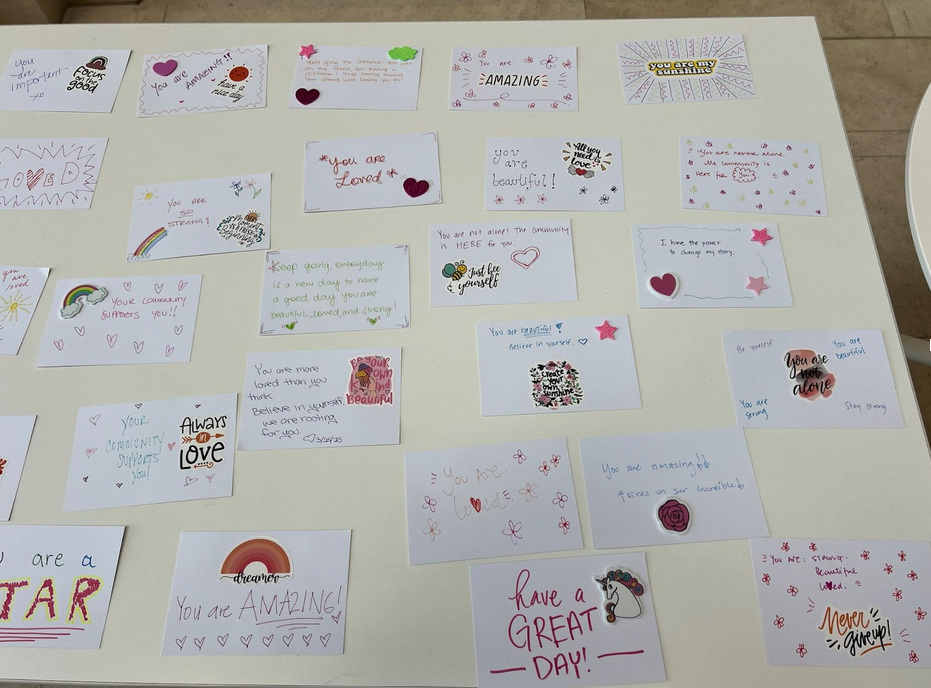
Women deserve not just safety, but also joy. At GLIDE, we recognize joy is important– even a basic human need. So the welcome kits distributed by Women’s Center staff include some joyful items. There are cards handcrafted by our loving volunteers that say things like, “you are so strong,” “you are so beautiful,” and “your community cares about you.”
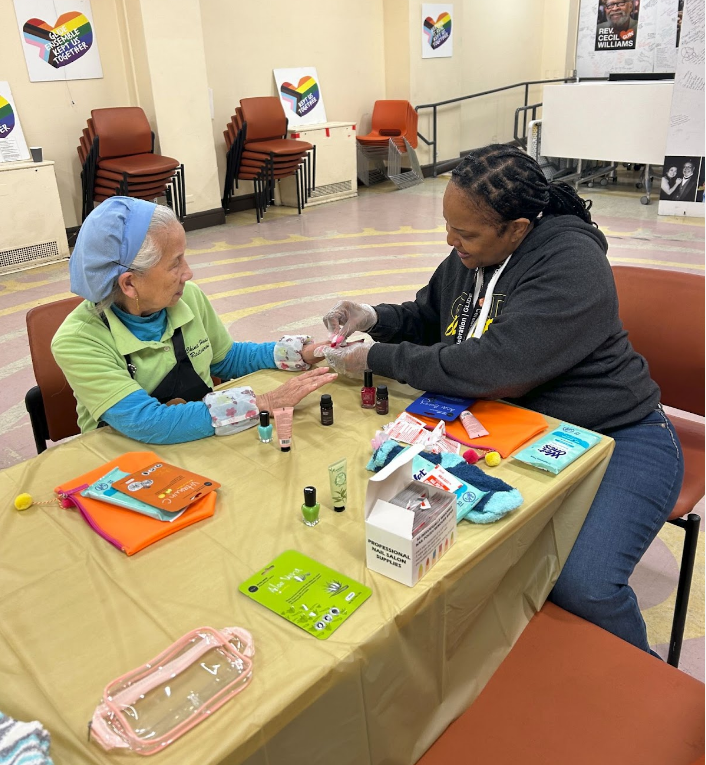
We also include beauty supplies like nail polish. Living on the street can be a terrible and dehumanizing experience, and feeling beautiful is one way to feel human again. Nice clothes are also important for women going to job interviews.
Spending time in community is another way we foster dignity and joy. That’s why our Women’s Center staff are passionate about arranging Fun Friday events. They come up with different creative options every time– one recent event was a mini spa da, featuring nail polish, essential oils, body lotion, face masks, and little fuzzy socks.
They have also done Bingo Night and a Paint & Snack. Future Fun Friday events may have some future open volunteer opportunities, so keep your eye out! Our partners like Seismic Sisters also put on events that raise awareness for the Women’s Centers.
The newly rebooted Women’s Center already has some wins
Loria was so happy when she was able to refer an unhoused client to prenatal care. The client got all the services she needed, a two week housing voucher, services for her unborn child, diapers for her older child, a spot on the list for housing, and a support group to help her feel less alone.
Loria also finds it incredibly meaningful to do grief work in the support groups. One woman, processing the loss of someone close to her, expressed relief that her departed loved one was no longer suffering through a terribly difficult life. Her sense of grief was combined with a sense of achievement: that in his final months, she did absolutely everything she could for him, she made him smile. Tenderloin is full of grief stories like this one. So many of them go unwitnessed. Much of the important work we do here at GLIDE is the work of witnessing.
JeTon notes that the most common need for the women we serve is wanting long-term and stable housing for themselves and their families. In theory, SF has a Housing First strategy, but in practice, it’s not happening. An increasing number of women and families are sleeping in their vehicles because shelters just aren’t safe enough for them. That’s why having a Women’s Center is so vital– and why we need to dream big about how we can expand the services we offer families and women.
Dreams for the Women Center’s future
In the future, JeTon, Loria and Olivia wish for a larger space, more staff, and even more exciting events for women to build community– perhaps a fashion show! Already women are delighted with the clothing the women’s center provides. They say, “Look at my outfit, y’all!” Looking good and being the center of positive attention builds self-esteem; it is key to gaining the confidence to transform your life.
“The more case managers you have, the more resources you can give people,” observed Loria. JeTon dreams in particular of expanding the number of languages the Women’s Center can speak to better serve the diverse population of the Tenderloin. Olivia adds, “My dream is that our clients will be able to befriend each other and form a real community, where women are excited to come to our events just to catch up.” We also hope to eventually start giving classes on job readiness and behavior health skills.
“I know we’re going to excel,” Loria concluded with great firmness. “We’re just re-opening right now, and we’re small right now. But we have the ideas, we have the passion. I know we can expand our impact on this community.” If you want to help the Women’s Center grow, please go to our donate page and select “Women’s Center” in the drop-down menu under “Designation.”
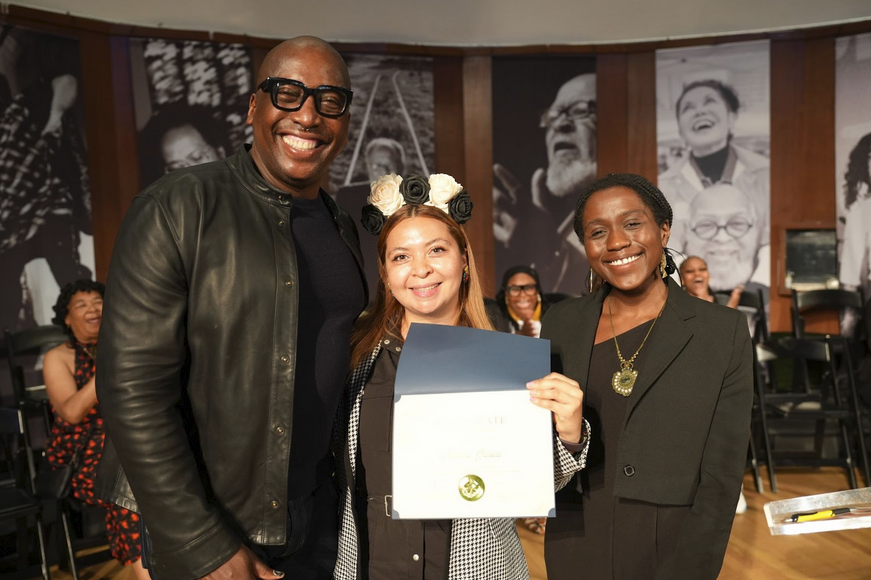
Social Justice Academy graduate Claudia Garcia at her graduation ceremony, alongside GLIDE’s Minister Marvin and Senior Director of the Center for Social Justice, Naeemah Charles
Our Social Justice Academy trains people impacted by systemic inequities in advocacy skills and introduces them to lawmakers. One of the goals of the program is for our graduates to continue pursuing advocacy projects long after the Academy is over.
The program’s mission is to support people from marginalized communities in becoming powerful leaders. So we followed up with last year’s Social Justice Academy (SJA) graduate, Claudia Garcia, to see how she’s been putting her social justice skills to work since graduation. What we heard was inspiring.
The Background of San Francisco’s Successful Latina Activist
Claudia immigrated to the United States from El Salvador when she was just eighteen years old, because her father told her, “It’s safer in the United States.” She said, “It was hard at first. You don’t have anyone, you don’t have any family, you don’t know the language or understand the programs. But I started working and going to city college. I learned English, and I worked on my G.E.D.”
Despite Claudia’s now-fluent English, she often experiences anxiety about her language skills. GLIDE staff member Ian James worked with her to help her recognize that her lived experience and language background were assets to the Social Justice Academy. Today, her analysis of the power dynamics of language is astute.
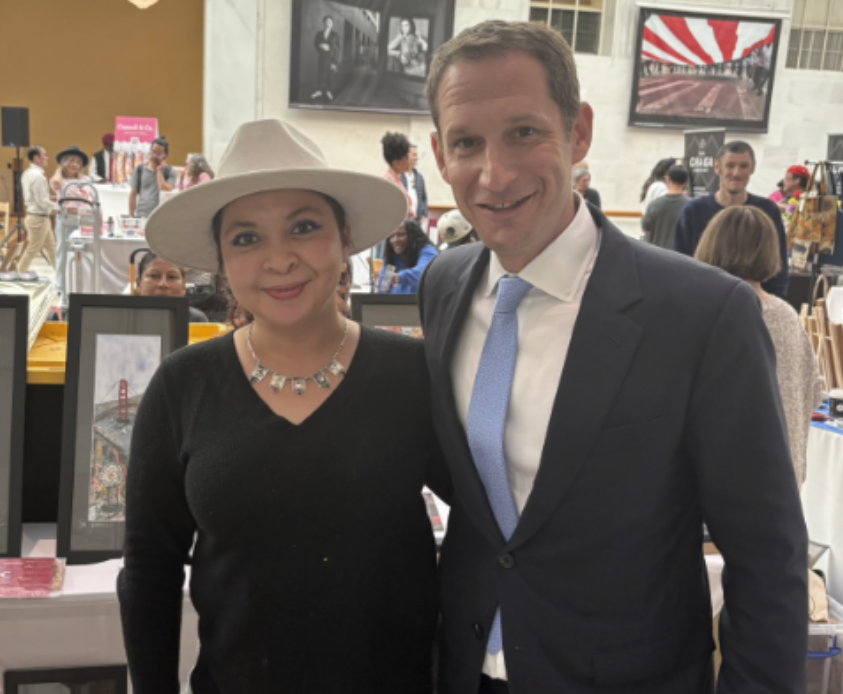
Social Justice Academy graduate Claudia Garcia standing next to San Francisco Mayor Lurie the month this article was published
The Importance of Empowering Immigrant Communities
“It’s so important for me to be an advocate,” Claudia said, “because so often, immigrant communities don’t have anyone speaking up for them. The people speaking up are often first-generation U.S. citizens—people whose parents are immigrants. They don’t have the same struggles with language and belonging. I’ve often felt like I’m not strong enough because I’m not from here. We need advocates speaking up for our immigrant communities who know what that feels like!”
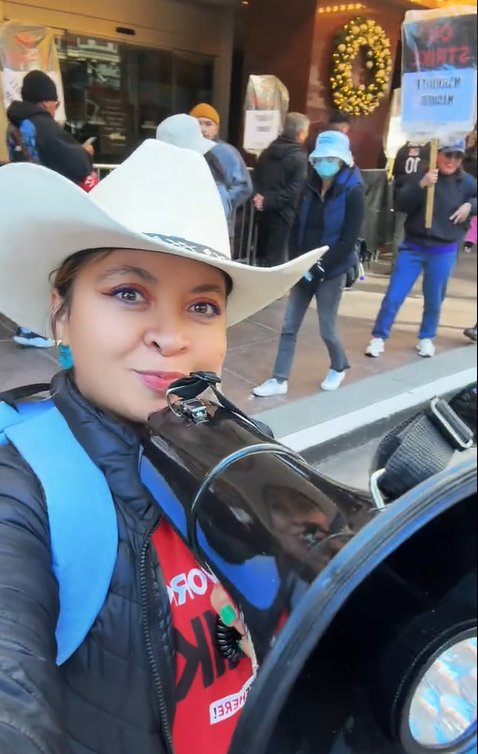
Claudia has been working her way up in the hospitality industry since immigrating. When she started working for the Hotel Marriott, she joined the Unite Here Local 2 union. Claudia’s time in the Social Justice Academy prepared her to participate confidently in Local 2’s extended strike last winter.
“When I did the strike, it opened my eyes,” Claudia said. “I saw how unfairly they treated the employees. They just wanted to make money. They didn’t think about us or our families.”
Claudia striking for better wages
A political awakening: “People are tired of being treated like garbage”
Claudia’s political activism extends beyond union activity. “I got involved with the Mission community. I started volunteering with DAHLIA to help people apply for low-income housing. I got involved with the Mission Neighborhood Center Children’s Services—I started helping them too. I was on the Board of Directors for Mission Neighborhood Center for two years. I learned a lot.” All of that gave her the confidence to apply for the Social Justice Academy.
Claudia loved participating in the Academy, particularly the Alabama Justice Pilgrimage. “It was so powerful for me when we went to the Selma bridge,” she said. “I got to feel the energy of Martin Luther King’s marchers. I felt the power of people who were tired of being treated like garbage, honestly. To cross that bridge felt like I was joining them.”
She also valued the relationships she built in the Academy. “I just loved it. People were so nice and welcoming to me—so patient with me too. We made really good connections!
In the Face of Anti-Immigrant Rhetoric, Cultivate Internal Power
When asked what she thought of today’s national politics, Claudia said, “It’s scary. I don’t know what to say. It’s scary for all the communities that Trump is trying to terrorize. He says that Latinos are terrorists, but that’s not true. We are not the problem. Latinos are singled out—there are immigrants from other countries too, but they don’t receive the same attention.”
“I fear for my kids,” she added. “But I want my kids to do the same things I’m doing. I don’t want them to give up or feel they aren’t good enough. I want them to fight for what they think is fair. That’s my motivation—to be strong for them.”
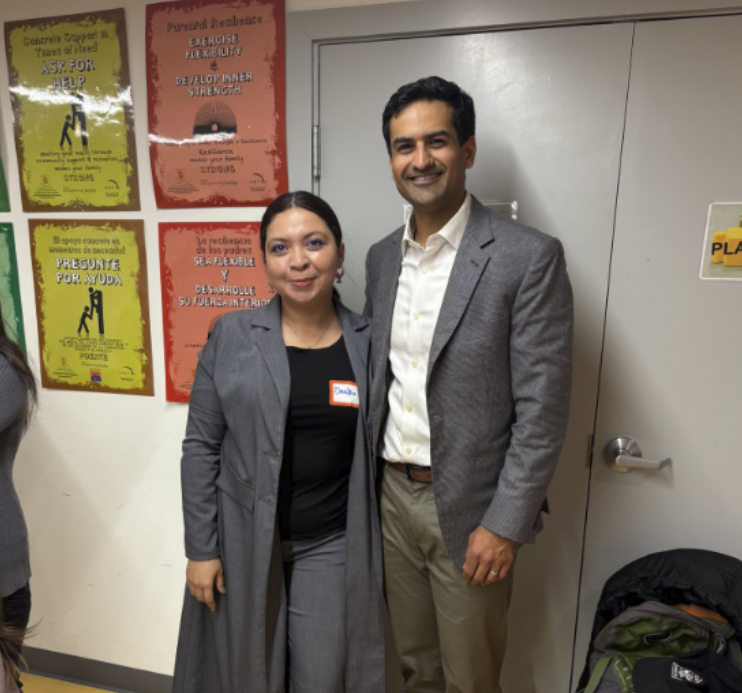
Claudia standing next to Kunal Modi, San Francisco’s Chief of Health, Homelessness, and Family Services
“People Need to Understand They Can’t Push Immigrants Around”
Claudia’s current work focuses on affordable housing, labor rights, and bullying in schools. “Housing is super hard,” she said. “We can do our best, but everything is designed for people who can pay—for rich people. For low-income people, it’s extra, extra hard, because the waiting list is really, really long.”
Claudia’s understanding of economic injustice is incisive. “When my coworkers and I were fighting for good benefits, I thought, ‘We deserve it.’ Rich companies always want to be more rich, but they want us to always be poor?! How is that fair?” She added, with great sincerity and emphasis, “ONE JOB SHOULD BE ENOUGH.” San Francisco is one of the nation’s most overworked cities. Claudia’s union won a victory for health insurance and wages through their strike.
Standing Up for Disability Rights in Schools
However, Claudia’s biggest focus right now is bullying in schools. “Many schools that serve immigrant communities don’t provide parents and children the quality services that our kids need. They believe because we’re immigrants, we’re stupid. We don’t know how to work the system. So they can do whatever they want with our kids. So I educate my community! I teach them that they have the right to I.L.P.s!”
I.L.P.s—Individual Learning Plans—are accommodations for students with special needs.
“I had a problem in my daughter’s school,” Claudia confided. “The principal retaliated against me for standing up for my daughter and her mental health after she was bullied. She expelled me from the school and threatened to send me to prison for three years if I didn’t do what she wanted — just to terrorize me so I’d leave. It’s a tactic she uses to scare immigrant families, and most of the time, she gets what she wants: to push them out. It made me cry. They were treating me like garbage. They tried to scare me– but I stood up to say, I think I’m doing the right things, and that’s why you guys are scared of ME. That made me feel strong. Standing up for disability rights helps me feel strong. Kids deserve a quality education
Never Give Up—People Are Counting on You
When asked if she had any words of inspiration, Claudia said: “Don’t give up. Even if you don’t speak the language, even if you don’t feel you are good enough—don’t give up. Your kids and your community are watching what you are doing.”
Claudia’s experience is echoed by other Social Justice Academy graduates. Research by Madeleine Smith showed, “The majority of our Social Justice Academy survey respondents felt confident advocating for their community at San Francisco City Hall, and the program helped them build a network of peers to lean on as community advocates, and to rely on the support they felt from the GLIDE community.”
You can follow Claudia’s small business and stay up to date on her advocacy work at @chula_sf—and help keep the love from GLIDE coming her way!
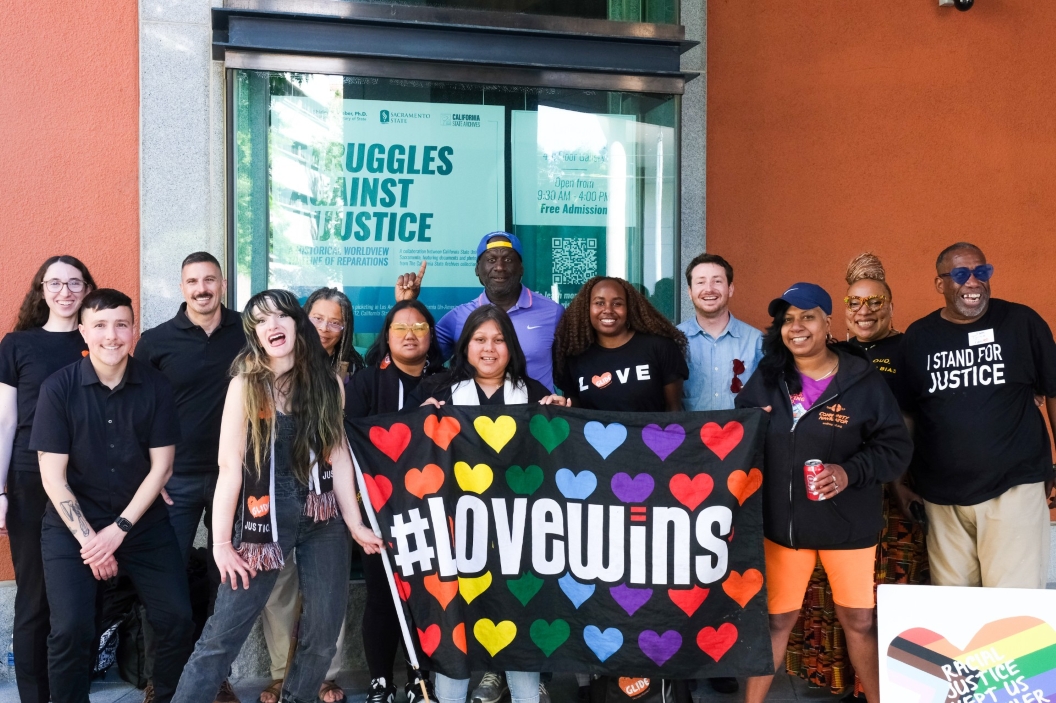
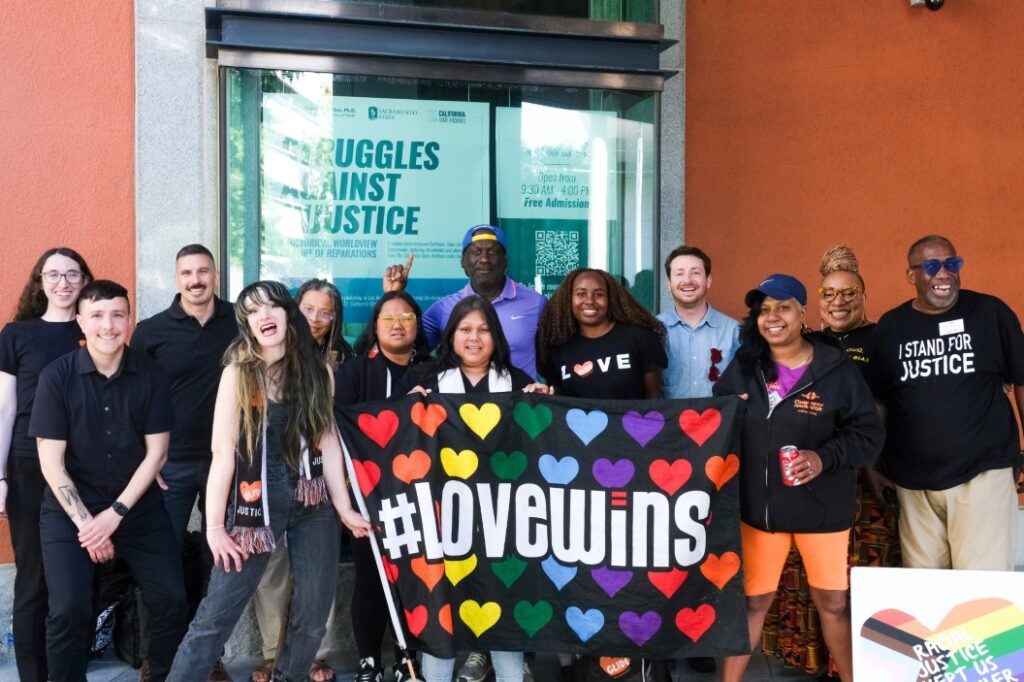
Dudley (wearing a purple shirt) with members of the SJA at the End the Epidemics Day of Action up in Sacramento
My recent trip to Sacramento, California, to advocate for the End the Epidemics Day of Action with GLIDE, the San Francisco AIDS Foundation, and the Shanti Project was an experience that profoundly transformed me.As a young African American man cured of Hepatitis C, I felt empowered and inspired throughout the week. From meeting with lawmakers to discussing the importance of the 2025 legislative budget process, every moment was filled with purpose and fulfillment.
It all began with a single email from the GLIDE Social Justice Academy (SJA)Team, inviting me to participate in the 2025 SJA 2nd Cohort—a community learning center that harnesses the wisdom and expertise of those impacted by systemic inequities. Less than six months later, I found myself at the State Capitol, equipped with the tools, resources, and confidence to advocate for the San Francisco community alongside state representatives and senators, pushing for legislation that would improve the lives of people across our Golden State of California.
After months of training in advocacy and legislation, the day finally arrived. As I walked through the halls of the Capitol building—dressed in my purple Nike polo, favorite Levi’s jeans, a fresh haircut, and my GLIDE Center for Social Justicescarf—I felt energized and ready to make a difference.
My first congressional meeting, with Senator Scott Wiener’s office, was nerve-wracking. However, as I introduced myself as a third-generation native San Franciscan and emphasized the critical importance of protecting the California Overdose Prevention and Harm Reduction Initiative (COPHRI), my confidence grew. The meeting went exceptionally well, and I left feeling prepared for the day ahead.
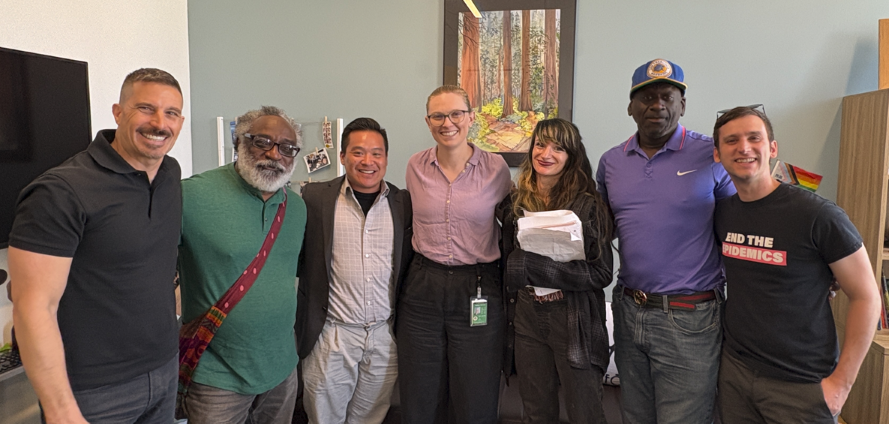
Dudley in Sacramento with members of SJA and GLIDE staff, including Michael Discepola, GLIDE’s Senior Director of Health access (first person on the L)
In my second meeting, I put my sharpened advocacy skills and growing confidence to work, educating a staffer from Assembly Member Gail Pellerin’s office (Santa Cruz County) about the challenges facing my community and how the legislation we were supporting could create meaningful change. She was receptive and compassionate—a response I deeply appreciated and hadn’t expected.
The day was a whirlwind of meetings, each offering a unique experience. Some staffers were receptive; others, more resistant. But I remained determined, using my voice to champion the End the Epidemics Day of Action 2025 policy agenda. This was bigger than me—my community’s well-being was on the line. We were fighting to protect funding for critical services that so many rely on.
As the day unfolded, I realized I never would have dreamed of such an opportunity—it was truly a once-in-a-lifetime experience. Being part of the democratic process in this way felt surreal and deeply humbling.
At the end of the day, I felt a profound sense of accomplishment. I had met with lawmakers, raised awareness about vital issues, and collaborated with fellow advocates to ensure our voices were heard. The experience transformed me, instilling a deeper sense of purpose and newfound confidence.
Since returning from Sacramento, I’ve been excited to follow the progress of the GLIDE SJA Cohort and the developments I hope to see in the coming weeks. It was a rewarding, empowering experience, and I am confident that we’ve made a tangible difference in the lives of others.
In Wellness,
Dudley A. Burns, IV💫
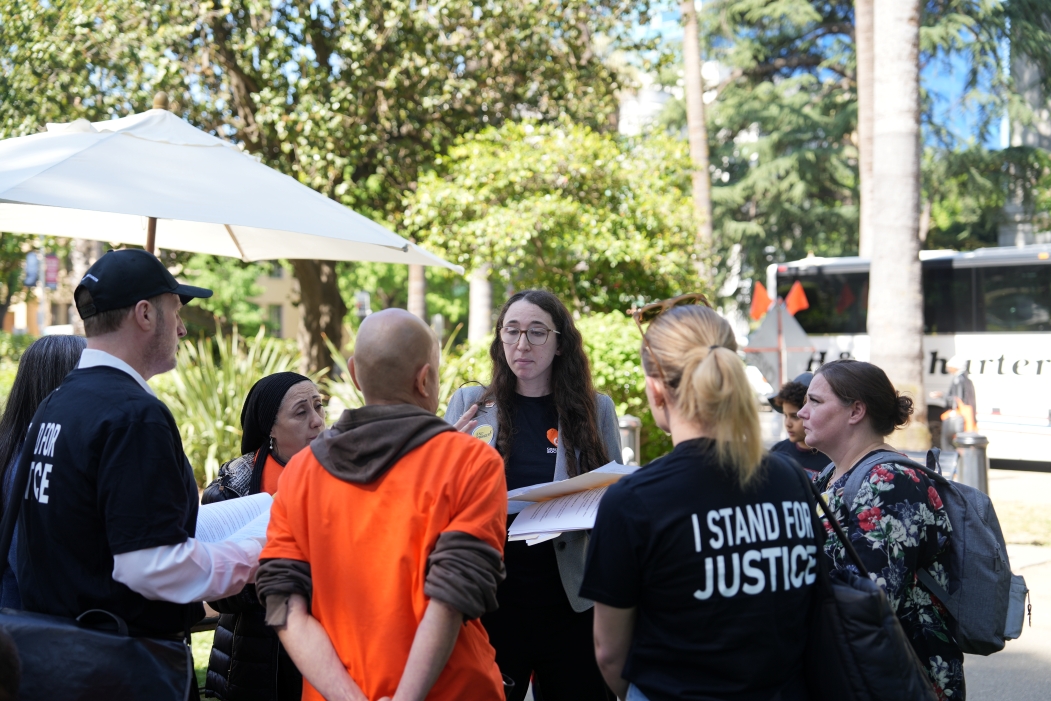
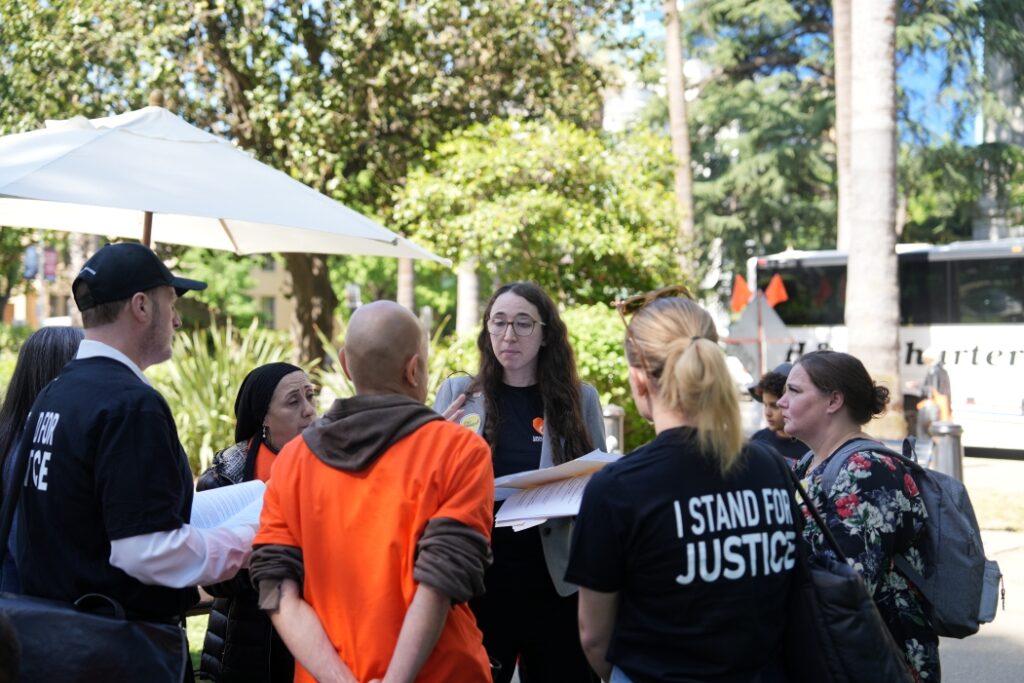
On April 29, for California Hunger Action Coalition’s Hunger Action Day, Social Justice Academy (SJA) fellows from GLIDE’s Center for Social Justice (CSJ) and GLIDE staff joined community members from San Francisco and across the state to advocate for expanded access to nutritious, affordable food.
We joined TNDC and the San Francisco-Marin Food Bank on two buses up to Sacramento to uplift the needs of San Francisco community members at the State Capitol.
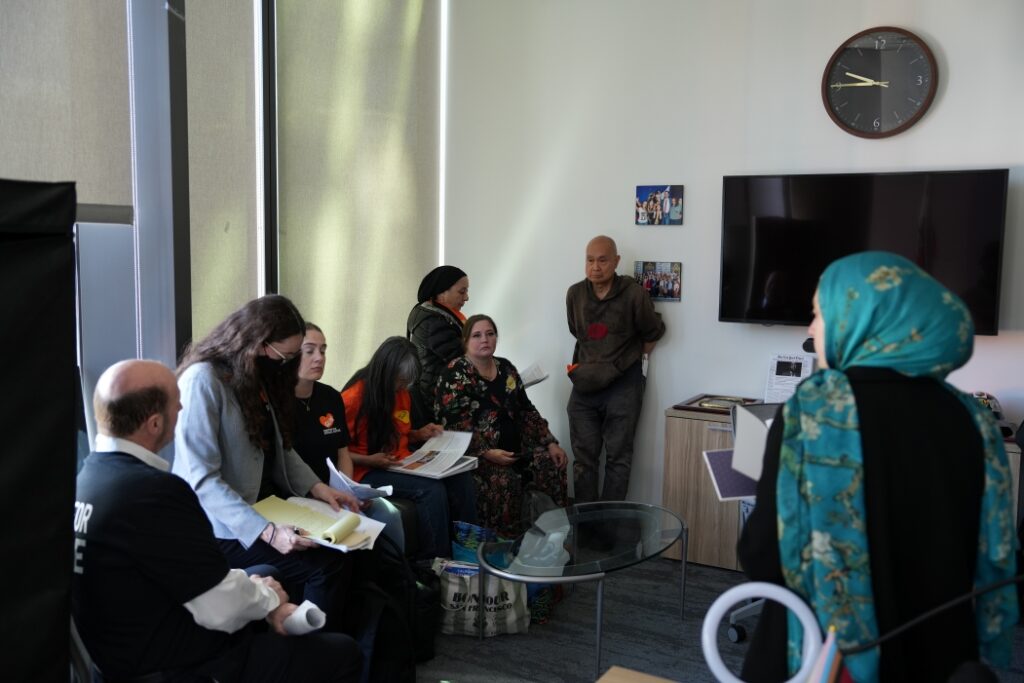
GLIDE’s Center for Social Justice led legislative visits with all of San Francisco’s legislators’ offices: Assemblymember Matt Haney, Assemblymember Catherine Stefani, and Senator Scott Wiener. GLIDE’s staff and Social Justice Academy fellows joined these meetings, as well as meetings with two Marin County legislators organized by the San Francisco-Marin Food Bank, to tell their stories about hunger.
GLIDE staff from CSJ, Fund Development, and SJA fellows meet with the staff of State Assemblymember Matt Haney
GLIDE is advocating for protecting and investing in food access and hunger prevention programs in San Francisco and at the state and federal levels. Potential cuts from the federal level to SNAP (otherwise known as EBT or food stamps) and school meals would be devastating to Californians and San Franciscans. Investments at the state level can support community members across California, including in San Francisco.
If you want to join us in this fight, please click to send a quick email to state legislative leaders here and to federal Congressional representatives here.
GLIDE is proud to be lifting up the voices of our staff, clients, and community members in the halls of power and positively influencing decisions that affect millions of Californians.