
When Carly Fazio first came to GLIDE, it was for a meal. She had just moved from Buffalo, New York to the Bay Area and was living without a home. For two years, she came to our Free Meals Program Monday through Friday.
Meals opened the door to more support. Carly connected with our Health Access Treatment (HEAT) team and began receiving Medication-Assisted Treatment (MAT) services. She also joined women’s support groups, where she found something, she hadn’t experienced for a long time: being seen. Listening to other women share their own experiences showed her she wasn’t alone. Her struggles with recovery and housing were part of a much larger story carried by others in the room. That connection gave her the courage to keep showing up.
A big part of Carly’s journey has been the relationship she built with Lauren Etchingham, our MAT Navigator. Carly describes Lauren not only as a supporter but as a true friend. Lauren listened when Carly needed to talk, reminded her of her progress when she doubted herself, and stayed consistent even on the hardest days. For Carly, that steady presence was like a lighthouse in rough waters, showing her, she wasn’t drifting alone and could always find her way back to shore.
“Lauren has been there for my health, my emotions, everything,” Carly says. “She never gave up on me. GLIDE makes me feel like I matter. I don’t carry shame for what I’ve been through anymore. This feels like a second home.”
Today, Carly has been in recovery for five months. After nearly two years unhoused, she is preparing to move into housing of her own.
Carly’s story shows how a meal can be the first step, and how trust, care, and community through HEAT, with people like Lauren walking beside clients every step of the way, can turn recovery into a lasting future.
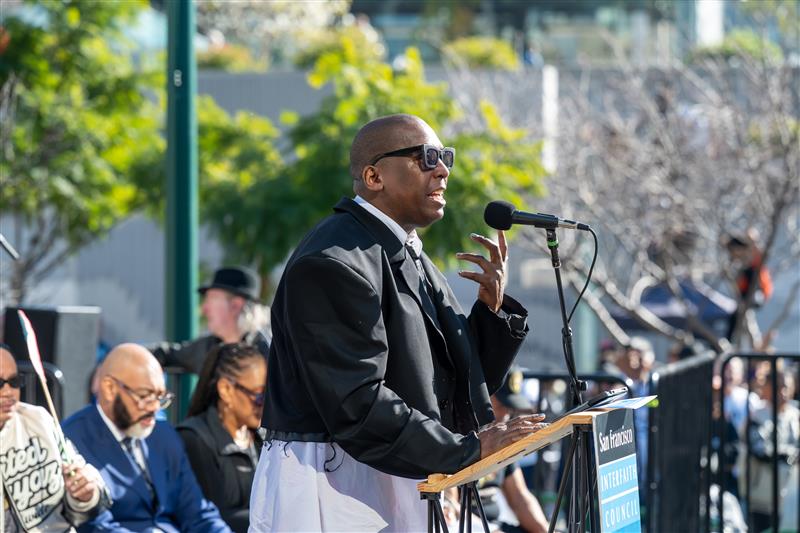
From L to R: Apple Cronk, Del Seymour, and Laura Guzman
On International Overdose Awareness Day, GLIDE’s Center for Social Justice hosted a powerful panel of regional and national leaders to spark dialogue about overdose awareness, prevention, and compassionate care. The event honored those lost to overdose while lifting up evidence-based strategies that save lives.
Moderated by Naeemah Charles, Senior Director of GLIDE’s Center for Social Justice, the discussion featured four leaders whose expertise is rooted in both lived experience and professional advocacy:
Del Seymour – GLIDE Board member, founder of Code Tenderloin and Tenderloin Walking Tours, and a survivor of 18 years of addiction. Known as The Mayor of the Tenderloin, Del spoke powerfully about overdose awareness through the lens of survival and community.
Apple Cronk – Alum of GLIDE’s Social Justice Academy, mother, writer, and advocate whose lived experience with homelessness and addiction fuels their fight for justice.
Laura Guzman – Executive Director of the National Harm Reduction Coalition (NHRC), advancing harm reduction, housing, and health equity nationwide.
Maurice Byrd – Licensed Marriage and Family Therapist and harm reductionist with two decades of experience creating mental health programs for people navigating substance use, homelessness, and chronic mental health conditions.
Humanizing the Overdose Crisis
The panel illuminated the urgent need for overdose awareness and compassionate solutions to the epidemic:
Del Seymour reminded us not to lose sight of humanity: “Let’s deal with humanity. It seems like this city has forgotten about humanity.”
Maurice Byrd emphasized that overdose impacts us all: “Overdose looks like me. It looks like you.”
Apple Cronk highlighted the importance of centering the voices of people who use drugs: “Let drug users be in charge of their own health needs. Meet people where they’re at. I can be abstinent and a harm reductionist. I can carry Narcan to keep someone alive.”
Laura Guzman warned of disturbing trends: rising overdose deaths among Black and Brown communities and the isolation caused by stigma: “Numbers look really bad in 2025. Fifty percent of deaths are in Black and Brown communities. Most people dying are dying in housing, not in the streets.”
Honoring Lives, Inspiring Action
The conversation closed with a call for hope, remembrance, and overdose awareness as a path to prevention:
Del Seymour: “They lived a whole life. It’s not what happened on that last night. The person had a disease just like cancer. They died of a disease.”
Laura Guzman: “Say their names. And remember that overdoses are preventable. Overdose is something that can be addressed. It’s not something that needs to be policed.”
Maurice Byrd: “I want this work to inspire me to keep up the fight. To do something. How do we turn these words into action?”
Apple Cronk: “Little steps are a big deal. Ask people what they need, offer them support, and they can do great things.”
GLIDE’s Commitment to Overdose Awareness
International Overdose Awareness Day is a time to honor those we have lost and recommit to ending preventable deaths. At GLIDE, our Health Empowerment and Access team works every day to advance overdose awareness, harm reduction, and recovery support. We meet people where they are—with compassion, dignity, and without judgment.
This blog is dedicated to the lives lost to overdose in the past year. We carry forward this work in your name, with hope, action, and unwavering commitment to overdose awareness.
From L to R: Maurice Byrd, Apple Cronk, Del Seymour, Laura Guzman, and CSJ Senior Director Naeemah Charles
From L to R: Jeanette Driskell, GLIDE Safety, Mimi Paris-Dickerson (GLIDE Pre-School teacher, dressed in gold), and Cecil Brathwaite, GLIDE Safety Shift Lead (light colored jacket)
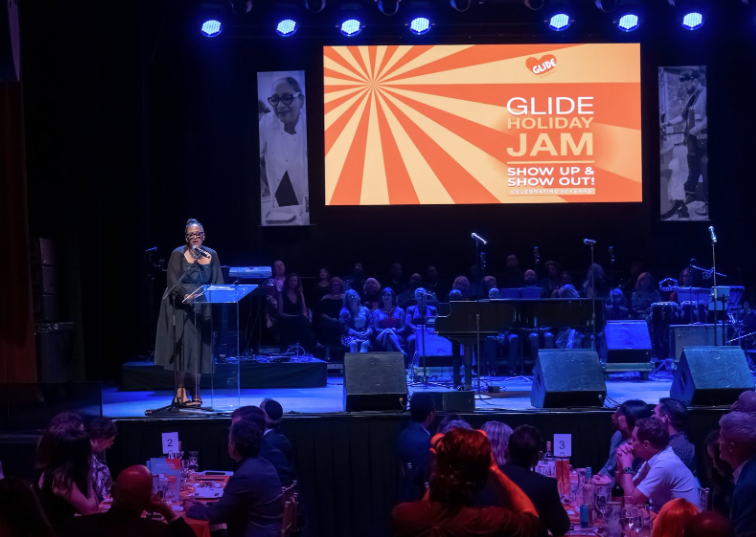
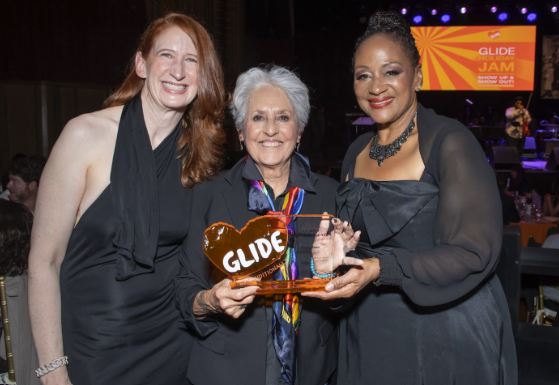
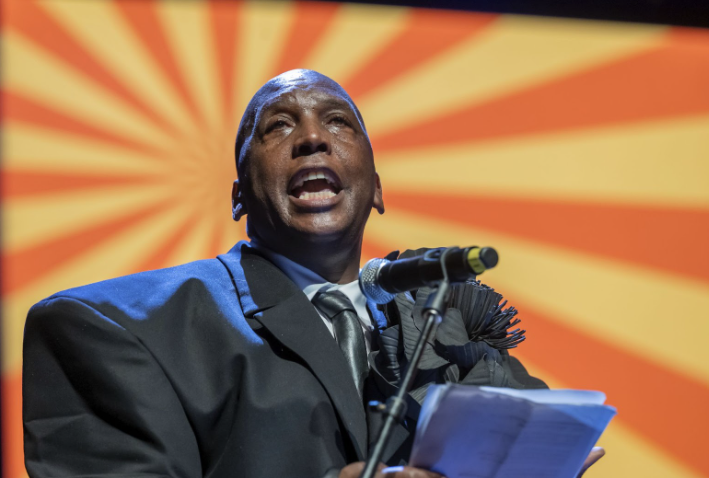
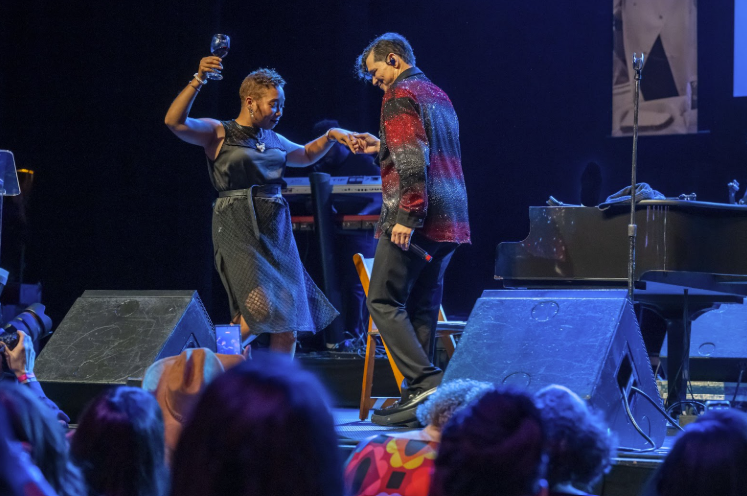
GLIDE’s Young Professionals Committee turned out over 200 GLIDE supporters to the Pheonix Hotel last Friday to honor the awardees of the Rev. Cecil Williams and Janice Mirikitani Legacy Awards. Every year, not only does the Summer Gala raise money for GLIDE’s vital programs and services, but it honors leaders who are carrying Jan & Cecil’s torch forward.
Legacy Awardee Roberto Hernandez
Roberto Y Hernandez, the Receipient of the Rev. Cecil Williams Legacy Award, reminisced during his acceptance speech about the way Rev. Cecil mentored him when he was a young activist. One of his fondest memories was how Cecil insisted on a donation of 200 front-row seats for low-income people when he was invited to a concert.
Renowned for his dedicated organizing for youth education, food security, and housing security in the Mission, Roberto also had a warning for the audience. “They have a war against Latinos in this country right now. They are kidnapping our people!” he said. Then he urged the audience to “make ten phone calls this weekend,” urging their friends and family to get involved in GLIDE and other organizations that fight for the marginalized.
But despite the serious purpose of the event, the evening was far from solemn. There was also drinking, dancing, laughing, talking, a silent disco, and a rousing performance from the Glide Ensemble.
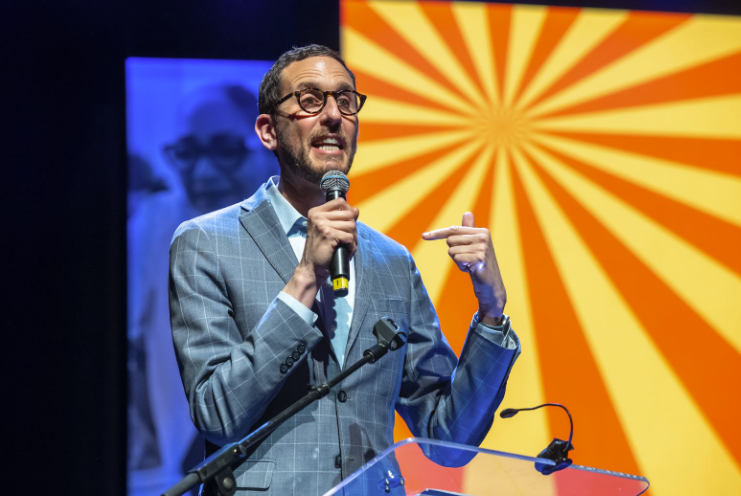
We were blessed with remarks from several government leaders, including State Senator Scott Weiner, and Assemblymember Matt Haney. They commented on the importance of GLIDE and the Tenderloin in the fight for San Francisco’s legacy of diversity, inclusion, and love.
Legacee Awardee Teresa Goines
Senator Scott Wiener addresses the Summer Gala audience
Dotcom leads the Glide Ensemble
Until next year, folks!
Tami with her son Anthony outside of Glide Memorial Church
When Tami stepped off a train into San Francisco three years ago, she carried almost nothing—just the clothes on her back—and a quiet determination that things had to change. Her arrival was the culmination of years spent surviving on the margins: childhood loss, decades of addiction, and life in a dangerous riverbed outside Madera County. What followed was not a sudden miracle but a slow, stubborn rebuilding—shelter, treatment, community, and the steady work of reclaiming a life.
Tami’s childhood was marked by devastating loss. “My childhood was very unstable—my mother was murdered when I was seven. My brother and I found her lifeless body after returning from the corner store. By the time I was eleven, my father had left us.” The siblings entered Oregon’s foster-care system and, according to Tami, moved through more than 150 foster homes and/or shelters before she aged out at eighteen. Despite that instability, she finished high school and became a young mother to now three grown sons.
As an adult, Tami struggled with drug abuse, in particular, methamphetamines. It led to repeated homelessness. For years she lived in a riverbed with her partner and others—a place with no services, constant danger, and few options for help. The assault she experienced there became the brutal turning point in her life. Raped by four men, Tami knew she could no longer protect herself. “I needed help. I had to get away,” she says. That crisis—along with encouragement from others and, later, a train ticket a counselor gave her—led her to San Francisco.
Her first stop in the city was HealthRight 360 (a Walden House program), where she entered drug treatment and completed the program. From there she moved into a step-down placement and kept looking for support. GLIDE emerged as a lifeline: a free meal became a doorway into community. She spent time at the Women’s Center, began making friendships, and slowly relearned how to be part of a community that did not revolve around survival on the streets.
Work prospects soon followed through Glide’s network. She lives a couple of blocks away at a local Salvation Army residence. The job would be modest but meaningful: routine, purpose, and the dignity of contributing.
Faith and education are central to Tami’s recovery. She speaks of finding God later in life—an experience that reshaped how she sees herself and her future. She also completed Episcopal Community Services’ (ECS) case-management program (Reach Program, Cohort 18) and is working to convert that training into college credits, with an eye toward a bachelor’s degree someday.
A new chapter is also unfolding: Tami’s 40-year-old son, Anthony, who arrived in San Francisco recently after serving time in jail. He has entered treatment at HealthRight 360. “We’ll both be at Celebration services at Glide Memorial Church on Sunday,” she says, voice bright with hope. The counselor who once gave her a train ticket helped start a cycle of care that is now, improbably, bringing mother and son together in recovery.
Tami’s story is not a tidy redemption tale. It is a history of grief endured, harm suffered, help accepted, and slow, steady rebuilding. Clinics and nonprofits provided pathways out; a contractor offered work; a counselor handed her a ticket. “I received help when I needed it. I also found faith in God and Jesus, which has changed my understanding about my life.”
Tami’s persistence has carried her forward. She now tells everyone she meets about the assistance that enabled her to make the changes necessary in her life to begin living again. “If GLIDE helped me, it can help anyone.”
“God is not finished with this country. Our creator knows what comes next. A promise on His lips. Morning is on the way. Morning– that looks like healthcare when you need it, and food when you’re hungry.”
Congresswoman Lateefah Simon’s words rang out across a packed sanctuary, her voice carrying both defiance and deep conviction. She spoke to truth and justice in a way that mirrors GLIDE’s values of radical inclusion and unconditional love.
Framing the moment as a struggle between darkness and light—between midnight and morning—Lateefah reminded us that GLIDE stands as an anchor in troubled times. As cameras rolled and the Glide Ensemble swayed behind her, she called the community to action.
“What do we do at midnight?” she asked. “GLIDE has taught us what to do. We shout from the rafters and practice grace with a backbone. Grace tells the truth about harm. Grace never confuses accountability with abandonment. Grace stitches together what policy tries to tear apart.”
A rising force in the U.S. House of Representatives, Congresswoman Simon spoke with urgency about the storms already breaking over poor people, queer people, and immigrants. “God meets us not after the storm, but during the storm,” she said, giving language to the daily struggles of those most marginalized.
Yet her message was not despair—it was persistence, resilience, and hope. She called us to believe in the possibility of morning and to fight for it together. She left us with this charge:
“When they go low, we fight back.”
The Executive Order titled, “Ending Crime and Disorder on America’s Streets,” really ought to be called “Ending Love and Compassion on America’s Streets.” This order acts like arresting unhoused people is the solution to homelessness. It absolutely is not. Encampment sweeps rob people of their dignity and their possessions, without finding solutions to the problems that left them unhoused in the first place.
Our federal HUD and SAMHSA grants shouldn’t depend on whether we are punishing homeless people harshly enough. Our unhoused neighbors need love and support to better their lives. You can’t scare and punish them into finding housing– that’s not how it works. People need to be supported, not frightened, into achieving their goals.
Cities who refuse to abuse and frighten unhoused people shouldn’t be threatened with loss of federal funds. We are in a housing crisis. The Big Ugly Bill’s cuts to Medicaid, SNAP, and other needed programs will push many new people into homelessness. Those people will already be so frightened. The last thing they need is more policing. Our message to our unhoused neighbors must be loud and clear: being poor is not a crime. Being homeless is not a crime.
This executive order also calls for putting unhoused people into mental institutions without their consent. Many people know the beloved founder of GLIDE, Reverend Cecil Williams, experienced a severe mental breakdown as a child, driven in part by racial trauma in the segregated South. He recovered his mental health because of the loving support from his community. It is doubtful whether he could have recovered it in an institution influenced by medical racism.
This is why medical incarceration is not the answer to the mental health crises we see daily among our traumatized street populations. Violating people’s human and civil rights will not clean up our streets. A real plan to clean up the streets means investing in organizations like GLIDE and a network of services to address root causes and effectively support and house people.
Our Cecil Williams Community Ambassadors do trash pick-up, address concerns from local businesses, and compassionately refer our unhoused neighbors to the programs and services that will get them off the streets. To solve our country’s problems, we need to treat people like people. This executive order treats people like trash that needs to be thrown away.
More people are experiencing homelessness now than they have for decades. The cost of living is going up. Wages are going down. People are losing their healthcare. This is the wrong time to invest in punishment.
Unhoused people are not criminals. They include people who lost housing because our city is too expensive, women fleeing domestic violence, elders struggling to re-skill for today’s economy, and disabled people facing discrimination. Everyone’s got a story.
Of those that do have mental health or substance use issues, many of those are caused by the trauma of living in the street. This trauma is compounded when police pick up their tents and throw away their possessions.
As a city, as a state, and as a country, we need to stand for love, not judgment. Let’s not bow down or beg for those federal dollars; let’s stand tall, strong, and firm in our convictions. When we stand in our dignity, we also stand for the dignity of the people we serve. Let’s hope the leaders of the great state of California make a stand for love and compassion.
On Thursday, July 24th, GLIDE hosted a powerful community-led Public Safety Forum, bringing together over 130 youth, community members, non profit leaders, and city workers to collaborate on real solutions to improve safety and well-being in our San Francisco neighborhoods.
Community leaders pictured below convened the forum with a simple dream: to ensure that community feedback is the first stop, not the last, when it comes to the city developing policy.
Bishop Ishamel Burch opened the forum by remarking, “Everyone wants to be safe, right? We have so many problems, but by coming together, we can truly make a difference.”
Every Neighborhood in San Francisco Deserves to Feel Safe
GLIDE’s President & CEO Dr. Gina Fromer gave an opening keynote, talking about her experience growing up in Bayview. Despite the Bayview being stereotyped as an unsafe neighborhood, Dr. Gina felt safe there as a child– because everywhere she went, people were looking after her. She talked about going to the YMCA and the library as a teenager– and feeling like the librarian and youth workers really cared about her.
For Dr. Gina, it was devastating to turn on the news this spring and see a woman she grew up with crying about the death of her 27-year old son due to gun violence. This tragic death helped inspire and motivate our community leaders to convene this forum.
A focus of the keynote was how safety resources are distributed inequitably between San Francisco’s neighborhoods. “We hear sirens all night long in Tenderloin, but we don’t hear sirens in Pacific Heights,” Dr. Gina pointed out. “There are some neighborhoods where the mom peeks out the door in the morning before taking the children out, just to make sure there’s no dead body on the ground when they walk out the door. It’s not new, we’re just tired of it. And now you’re going to listen to us!”
After Dr. Gina’s opening remarks, we had an inspirational panel featuring Ziggy Brown from the youth group United Playaz, Rev. Stephanie Burch from the St Andrews Missionary Baptist Church, Richard Beal from the Tenderloin Housing Clinic, Shavonne Allen from Skywatchers, and GLIDE’s very own Freddy Martin. The panel was moderated by Tinisch Hollins, the Executive Director of Californians for Safety and Justice.
To Increase Safety, Increase Opportunities to Build Relationships
Tinisch Hollins opened with a reminder, “If things get better in the Tenderloin, they get better in San Francisco. When we improve conditions for our people, it benefits everybody. That’s the message we bring to City Hall every day.”
Ziggy Brown, our high-school age panelist, spoke to the experience of growing up in unsafe parts of San Francisco. “It was a struggle seeing people collapse, always seeing the ambulance. But this is a very big deal for us [marginalized community] as a community: getting invited to GLIDE so we can get our ideas out, and talk about what we need to better ourselves and our future.”
Reverend Stephanie Burch talked movingly about her experience losing two of her sons to violence, and spoke strongly about the need to “take back,” the TL and recreate it as a place of safety. “People are scared to come to the Tenderloin looking nice,” she observed. “Well, I like to look nice for work. We need to take our joy back, take our strength back. I’m hoping that together, we can all decide we want our streets back.”
Richard Beal observed that public safety absolutely begins with relationships and community. He urged the audience, “As you walk through the neighborhood, grab someone and find out where they work, what they do. It’s all about showing people you care about them.”
Freddy Martin doubled down on that point, saying, “Whether someone is a victim or a perpetrator, when you understand who they truly are, you will see them differently. We’ve got to talk openly about these things, because otherwise how will we find the solution?”
The audience applauded when they heard, “We need to go to the mayor and tell him what it’s really like in our neighborhoods. You don’t know what it’s like if you’re just sitting in your office, going from BART to your office and your office to BART.”
The panelists agreed strongly with Dr. Gina’s keynote when it came to the importance of giving youth places where they felt safe– places to better themselves and do supervised activities. Shavonne Allen observed, “Youth want to be a part of things. They have things to say, and a vision of the society and the world they want to live in. We really need to listen. Be the auntie, be the uncle, invite them someplace, take them to lunch. Some are just missing that support system– so listening to their story can be a really big deal.”
The panelists also discussed the stress of navigating unsafe and unclean streets, the negative consequences of Prop 36, and the systemic forces which push the city’s problems into the Tenderloin. Freddy Martin received applause when he declared, “The money and funds taken out of the community historically need to be reinvested in the community.” He suggested it should be a requirement that city leaders visit different neighborhoods in the city to listen and learn on a monthly basis.
Developing Policy Recommendations on Drug-Related Crime, Public Safety, and Access to Treatment
Afternoon breakout groups were on reducing drug-related crime, enhancing public safety, and expanding access to treatment. The goal of the break-out sessions was to develop policy recommendations to bring to city leaders.
Breakout group #1 Behavioral Health Crisis Response was led by the Department of Public Health, Equity Office did a deep dive into how to get people treatment resources without exposing them to stigma.
Breakout Group #2 Public Safety Resources was led by GLIDE’s community safety team pointed out the importance of giving people safety options, in order to break out of the cycle of “one size fits none,” policies.
Breakout Group #3 Youth Engagement and Awareness was led by Ziggy Brown from the United Playaz which surfaced insights like, “Sometimes our youth just need someone to bring out the best in them– someone who can relate to them,” an observation made by a youth named Damien.
Thank you to San Francisco’s Public Defender Manohar Raju for turning out to the event, and lending a listening ear to our community! We look forward to presenting city leaders with our policy recommendations.
The graduation ceremony for GLIDE’s Social Justice Academy on June 26th was both triumphant and bittersweet. Triumphant, because of all the truly remarkable things our cohort accomplished– and bittersweet because the funding for our Social Justice Academy was cut by the city, and there will not be another cohort unless we find a way to renew funding.
The Freedom Hall was packed for the graduation ceremonies, and every person who attended could receive a copy of the group’s final project: a report for the city on what was missing from the city’s current response to substance use– and how to address the gaps, based on the lived experience of substance users.
The graduation was a joyous occasion, full of poetry, song, and poignant storytelling.
Here is how the conclusion of the graduate’s report on substance use reads:
***
Substance use services in San Francisco are doing critical work—helping people stay alive and supporting them on their individual paths to recovery. However, the current system does not have the capacity to meet the scale of need. Awareness of existing services is inconsistent, and many people face confusion, stigma, and logistical barriers when trying to access support.
One of the most significant systemic challenges is the lack of deeply affordable housing. Widespread housing instability undermines recovery efforts and makes it harder for people to engage with available services. To address these issues, several promising strategies have been proposed. These include:
Wellness hubs to centralize and simplify access to currently fragmented services;
Peer-led advisory councils to ensure that people with lived experience have real power in shaping
programs and holding systems accountable;
Expansion of cultural competency and anti-discrimination training to improve the quality and equity of care.
Increasing the visibility and availability of support groups.
Education about life-saving treatment options and clearer processes for accessing them.
Emphasizing the importance of preventative care.
With bold, coordinated action and a commitment to centering the voices of those most affected, San Francisco has the opportunity to create a more compassionate, effective, and inclusive system of care.
***
To reach these conclusions, our Social Justice Academy graduate surveyed community members who currently or formerly had engaged with city services for substance users, 53 people in all. The graduates also brought extensive lived experience of their own to the table.
GLIDE is grieved by the decision to cut Social Justice Academy funding, but we hope that city leaders take advantage of their past investment in our academy, by heeding this research and these policy recommendations. We wish our graduates luck in their future social justice endeavors!
Rally with RV Residents – GLIDE's Advocacy Manager, Erick Arguello, on the far right
GLIDE and the End Poverty Tows Coalition (EPT) have been working with RV and vehicle residents for years to advocate for solutions like safe parking sites and housing. GLIDE believes that the most effective and compassionate approach is to support people living in vehicles to access the resources that they need to thrive, including housing and services. Restrictions that increase the likelihood that a vehicle is towed can cause deep crisis and instability for a household – ultimately resulting in street homelessness for many.
In June, the City of San Francisco introduced legislation for a citywide, 24/7, two-hour limit on RV parking. This approach is being paired with a permit program and limited access to housing, but it will likely result in many RVs being towed. This means that many families and individuals will lose their home, their only means of transportation, and all their belongings.
On June 17, the MTA Board voted to establish a permit program for large vehicles that will protect some vehicles for up to a year from the 2-hour parking restrictions
GLIDE’s Public Policy Director, Eleana Binder, giving public comment at the Board of Supervisors Budget & Finance Committee hearing on this legislation.
On July 22, the Board of Supervisors passed the two-hour parking restrictions. GLIDE and EPT were able to pass some amendments to improve the permit program and increase protections, although the restrictions remained intact and will be very harmful as there is not enough housing to house all RV residents.
GLIDE’s Center for Social Justice spoke with the media (KQED, the SF Examiner, and Univision) to raise awareness and worked directly with RV residents so that their concerns could be heard. We supported public comment at Board hearings and organized meetings with SFMTA Directors, Supervisors, and the Mayor’s Office. We continue to advocate against parking restrictions and for more access to housing and greater protections in the permit program.
GLIDE is concerned about the lack of adequate affordable housing available to meet the needs of all the people in San Francisco experiencing homelessness, including the hundreds of households in RVs. The permit program is only designed to protect people from parking restrictions for 6 – 12 months. The City counted 437 occupied large vehicles in May 2025. This means that either all these households must be able to access housing or non-congregate shelter within a year, or many of them could be towed.
We are also concerned about households not being able to access permits or losing permits over rule violations, which means they would be towed. Even with permits, RVs can still be towed over common issues like expired registration, a practice that targets poor people who cannot afford to renew their registration. We are advocating for people with permits not to be towed for expired registration
Eleana Binder Director of Public Policy GLIDE Center for Social Justice
We’ve all been studying the deeper implication of the passing of the Big Ugly Bill, but here’s what everyone needs to understand: the promise of the American dream– the promise that any person can keep their family housed, fed and safe– has been broken. It has been broken so deeply, we’ll need to spend decades picking up the pieces.
The Americans with the heaviest burdens will be hit the hardest: immigrants, children, working parents, and especially BIPOC. As a Black American, my people’s history of determination and resilience helps me face these dark times with hope. After all, this won’t be the first time our people have seen America break its promises. We were promised freedom– we fought to get it. We were promised the vote– we fought to get it. We were promised reparations– those still haven’t arrived yet. As a people, we are veterans of the American nightmare.
And that is why we refuse to give up on the American dream! People always ask me, “Dr. Gina, where do you get your energy? How do you always stay so positive?” The answer is simple: I belong to a people that will never stop fighting for safety, love, and liberation. I believe in my people’s ability to lead community through crisis. Beloved Community is the foundation of GLIDE, where as President and CEO I lead with radical inclusion and unconditional love.
Now that the federal budget has passed, Beloved Community is all we have to ensure our collective survival. It’s almost impossible to exaggerate the extent to which our social safety net has been devastated. Over a trillion dollars have been cut from Medicaid and the Affordable Care Act: that’s 17 million people losing their insurance. Not only will cuts to the Supplemental Nutrition Assistance Program (SNAP) reduce food for more than 40 million people, but they are imposing work requirements to access food stamps which are impossible for many family caregivers– and about 3.2 million people will lose their food stamps entirely.
We asked hard-working parents whose children attend GLIDE’s Family, Youth and Childcare Center what they thought of the new budget. Mindful of the possibility of retaliation for immigrant families that practice political speech, our staff insisted on the protection of anonymity for parents giving quotes. More than one parent observed, “Mothers are going to be hurt by [work requirements for SNAP] the worst because there are times when they really cannot work.”
The cuts to Medicaid worried them deeply. One said, “This will be very hard for my family, because I will have to wait to take the children to the doctor until it is serious, due to lack of coverage. When I took my 12 month old to the doctor, I got a bill for $8000 and at first I was so worried– but I was able to pay just $2000 because of Medicaid.” How will this parent make it without Medicaid? Another said, “I have a child with special needs who needs a lot of surgeries. I can’t afford that myself.”
A budget is a statement of values. What the latest budget says about American values is not looking good. We are divesting from peace to invest in war. We are transferring wealth from the poorest to the richest, which hurts all of us. We are divesting from inclusion so we can invest in excluding, deporting, and policing innocent people.
The new budget invests $170 billion more dollars in ICE– terrified immigrant families will live in daily fear of government kidnappings. We are divesting from helping people so we can invest more money in harming people! This is wrong: and people will die for these decisions.
We can’t let this stand. We’ve got to show up and show out. In March, I called on city leaders to put in place an Emergency Food Plan for when SNAP is cut. But now I see the reality: when federal budgets shrink, state and city budgets strain frantically just trying to cover the gaps. And that means nonprofits– including GLIDE– struggle with layoffs, cuts, and lost government funding even as demand for our meals and services skyrockets.
As I write this, our whole community is mourning the loss of our Social Justice Academy. This academy was a city-funded program that trained members of marginalized groups to be leaders and advocates. A city suffering under the weight of federal cuts trimmed it out of existence.
But I don’t think listening to voices from the margins is optional. Funded or not, we need leadership from the margins. It’s the people in the margins who understand the problems the most deeply. That gives them the vision to see the solutions. As someone who relied on nonprofits when I lived in poverty, I know: nonprofits are the safety net of last resort. So, nonprofits have to get loud. We have to demand resources for our people. Love must be our agenda.
All of you: remember the nonprofits. Remember you are not powerless. Direct your time, talent, and treasure towards the issues that you care about. For every attack on abortion rights, trans rights, food security, and health access, there are hundreds– thousands– of passionate people fighting for those causes. All you need to do is help them.
Can we rely on the people and the nonprofits of this city to keep the promises our government has broken? I think so: I believe in the people of this city. The dream of San Francisco has always been that no matter where you come from, no matter who you love, no matter what you’ve been through — you matter here. You are welcome here. Together, we will keep that dream alive.
GLIDE will never stop feeding, healing, and loving. At GLIDE you can practically feel the spirits of all the ancestors who fought tirelessly here for civil rights. Come volunteer at GLIDE and see where I get my energy. I will NEVER give up on creating an America that invests in spreading peace, welcoming immigrants, and caring for its most vulnerable people.
Stand with me!
Dr. Gina Fromer, President and CEO of Glide Foundation