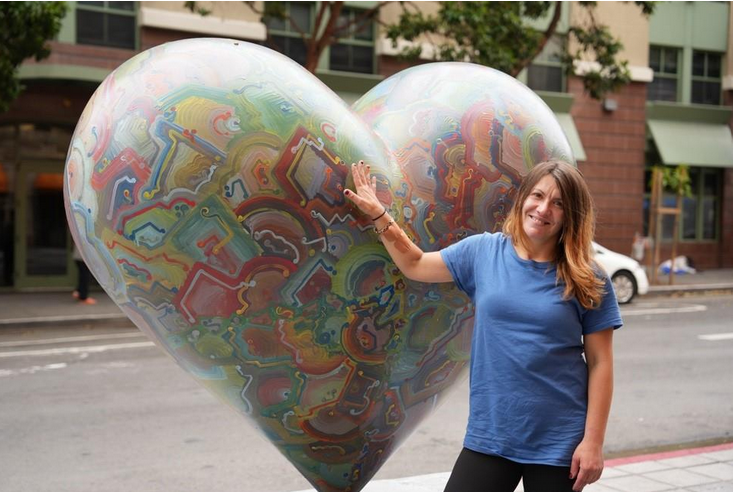
The Pride Parade this year was GLIDE’s time to shine!
GLIDE proudly took center stage at the 2025 San Francisco Pride Parade, showcasing its enduring commitment to LGBTQ justice, radical inclusivity, and joyful resistance.
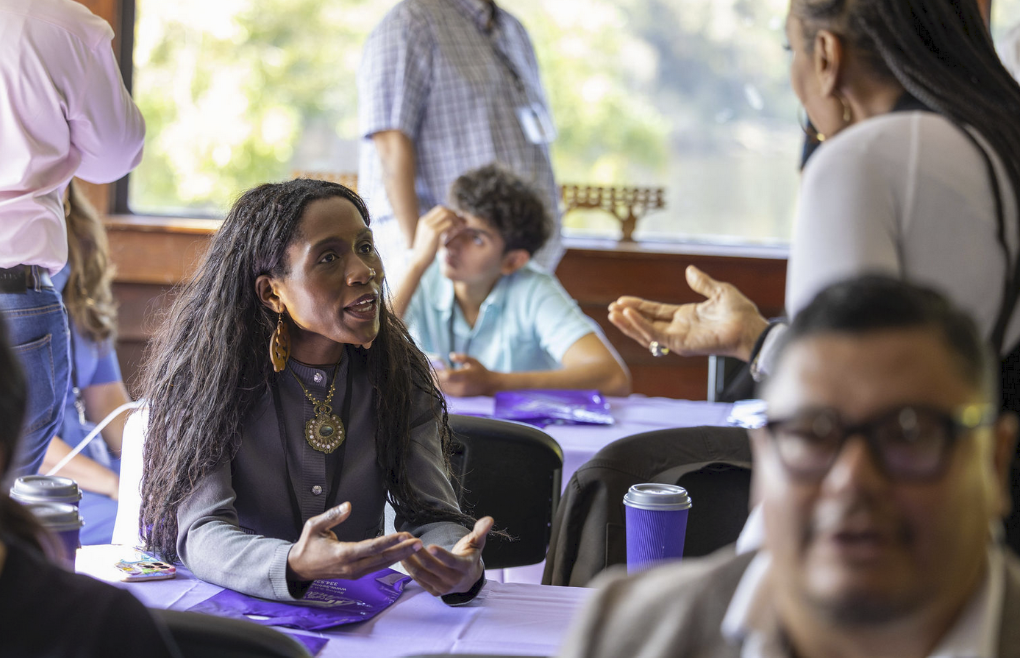
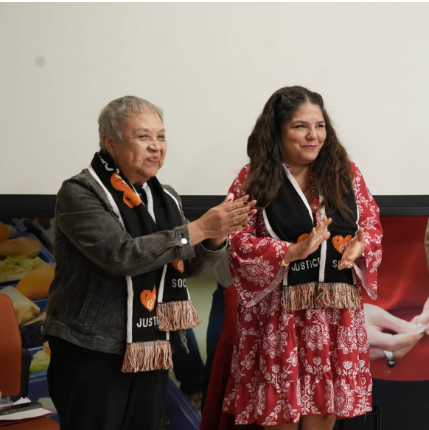
The day began with plenty of GLIDE Pride (and coffee!) at the 50th Anniversary Pride Breakfast, hosted by the Alice B. Toklas LGBTQ Democratic Club—the nation’s oldest queer Democratic club. Dedicated to building queer political power, the Club works to resist divisiveness and defend LGBTQ+ rights and representation across California and the country.
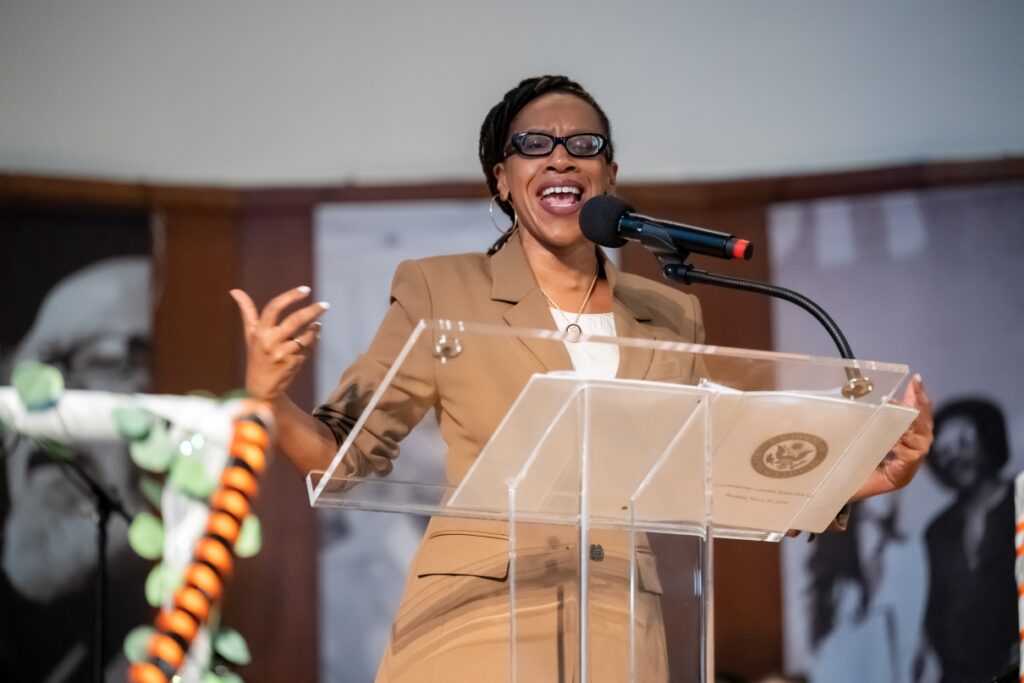
The event featured stirring remarks from San Francisco Mayor Daniel Lurie, State Senator Scott Wiener, and keynote speaker Representative Sarah McBride—Delaware’s U.S. House member and the first openly transgender person elected to Congress. The message rang out loud and clear: the fight for LGBTQ equality is far from over, and the work continues until everyone shares equal rights—to safety, health, happiness, and the freedom to love.
A Celebration Like No Other
GLIDE was honored with the 12th position in the Pride Parade line-up, right across from the Mayor’s float. As we gathered, Mayor Lurie addressed the crowd with a hopeful message. Then it was time for CHURCH ON THE STREET—GLIDE’s unique spiritual celebration, bursting with music, movement, and love.
The GLIDE Ensemble, dressed in dazzling rainbow attire and led by Zoë Ellis, lifted spirits with rousing gospel melodies. Minister Marvin K. White delivered a passionate street sermon that rose above the music and noise, while our AV team livestreamed the experience to our wider community watching from home. You can catch a recording of the full Celebration on the Street here.
Dancers from Glide Memorial Church whirled through the parade route alongside our dignitary cars, sound truck, and massive double-decker bus draped in rainbow balloons shaped like fireworks. In one dignitary car, GLIDE board member Andrea Henson sat regally beside Minister Marvin, wearing an elaborate wig and a T-shirt that read: “America doesn’t need a king, only queens.”
GLIDE President & CEO Dr. Gina Fromer added rainbow gauze, glitter, and a parasol to her signature elegant style, while Minister Marvin’s black ensemble was emblazoned with shimmering letters: “I ❤️ Jesus.” As GLIDE passed the MC booth, the announcer declared Minister Marvin, “the sexiest pastor around!”
Watch our full parade video below, featuring Minister Marvin’s powerful voiceover message about joy, dignity, and radical love.
Joy as Resistance
Pride 2025 unfolded during a time of unprecedented attacks on LGBTQ+ freedoms, yet the celebration was as defiant, dazzling, and deeply joyful as ever. Nothing can quench our spirit. Nothing can silence our celebration. At GLIDE, joy is resistance—and we will never stop showing up.
The Big Ugly Bill Has Passed.
Statement by Dr. Gina Fromer, President & CEO
Millions of Americans are going to be left fearing for their families, worrying about food, healthcare, and safety, as a result of the Big Ugly Bill.
As President & CEO of GLIDE, this makes me want to scream! This bill is an assault on poor people and shamelessly un-American. It reinforces my long-held belief that our strength is measured by how we care for those who are most in need.
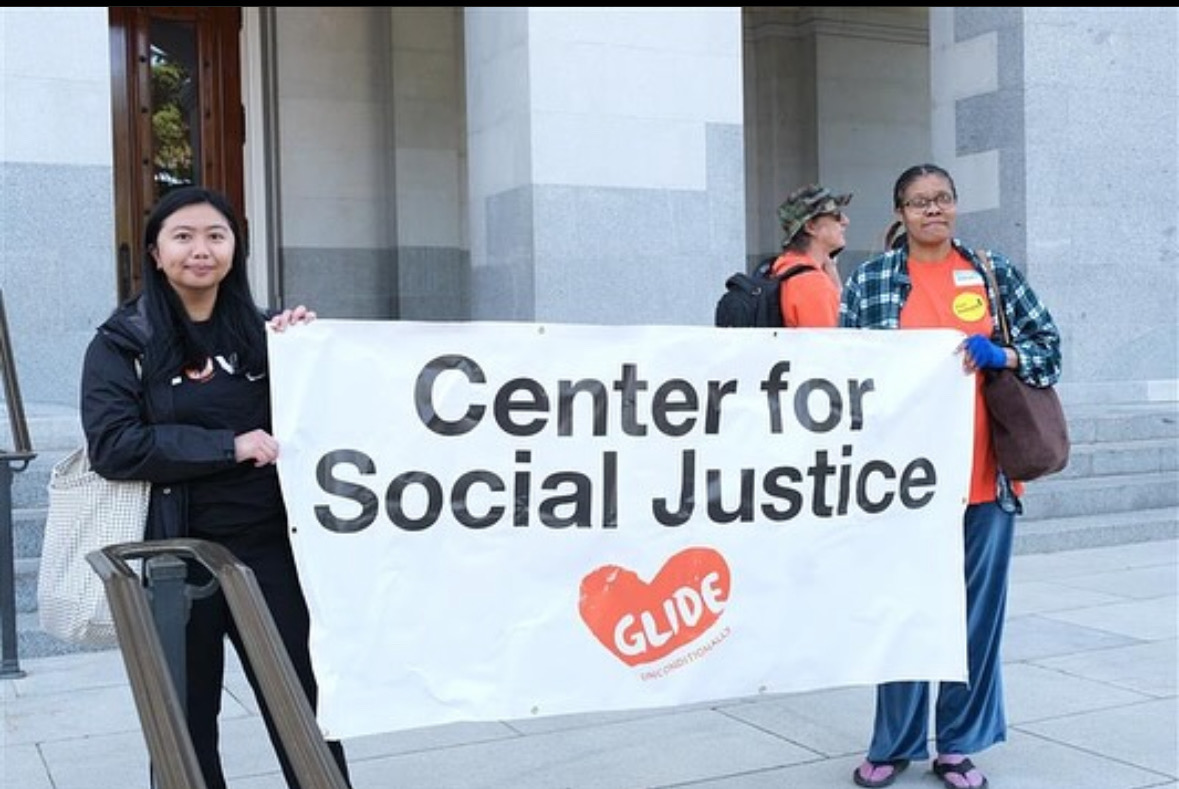
We won’t stop advocating for those who are most in need– we’ll just need to advocate harder. And to do that, we’ll need your help. Will you sign up to be one of our Social Justice Warriors? You’ll get emails about participating in protests, phone banks, letters, public meetings, and all the other ways GLIDE’s Center for Social Justiceworks to influence our lawmakers– we’d love to have your help.
In case you’re wondering how serious this situation is right now, here are some numbers– which speak for themselves. According to the Budget Lab at Yale, the poor get poorer and the rich get richer because of this ugly bill:
Robbing the poor to give to the rich: The bottom 40% of income earners in this country will see their after-tax income fall– while the top 0.1% gain an extra $118,000/year. At GLIDE, clients who have a job make an average of about $17,000/year and the median income across all clients at GLIDE (employed or not) is less than $7,000/year. This means GLIDE clients will disproportionately suffer because of this bill.
17 million people are likely to lose access to their health insurance.
3.2 million people face losing their SNAP/food stamp benefits, and all 40 million who use food assistance will likely face some kind of reduction.
This bill highlights the troubling consequences of historical income inequality and an increasingly fragile safety net. As the City and State brace for dramatic cuts to healthcare and food security, at GLIDE we will feel it right away. These statistics translate into life-threatening consequences for real people, resulting in longer lines for free meals and increased pressure on our already strained rental assistance budget.
A budget is a statement of values. This bill reveals a disturbing set of values that treats poor people as collateral damage for the political gain of the powerful. We will not stand for this at GLIDE. We will get louder in the face of this oppression and we will keep fighting back.
We need you in this struggle. The time for strength, solidarity, and unconditional love is now! Will you join us?
Dr. Gina Fromer President & CEO, GLIDE
Meet GLIDE client and Long Beach native Taylor Daniel Klahn, age 42 In his own words
“It was March 2023, and I came to GLIDE to get tested for Hepatitis C and when I came up here, I ended up meeting a dude namedMel. We hit it off right away. You know I came in, and I immediately reacted to all of his body tattoos, like what I have. We started talking about music and such things. And he tested me for Hep C.
We ended up talking at length about so many things, and I ended up staying at the Health Hub for like four hours. From then on, I would come here daily to talk with Mel, but while I was talking to him, I got really close with everybody else who came to the Health Hub. It felt like people actually cared and it was cool to go to a place where people ask you how your day is and they genuinely cared about you and it was like one of the only places that I can think of in my life at that time where people actually cared how my life was going.
From then on, I really looked forward to coming here. I hated the weekends because the Hub was closed. I kept asking myself, “What am I going to do?” l would literally countdown the minutes on Sunday before Monday saying to myself, “Yes, I can’t wait to go back to GLIDE.”
Anyway, after I got my Hep C cured, I volunteered with Syringe Access and Supplies (SAS) as part of the Community Navigator Program through End Hep C SF/DPH. I would go and pass out overdose prevention supplies and be a source for health and resource education to the people in the TL.
At that point in my life, I felt like I really needed a purpose. I needed something to do, and GLIDE was able to facilitate something for myself to feel like I was not only part of the community, but I could also be myself again.
You know, after I met Mel, I have a job now and I’m clean. I’ve been off fentanyl and feel like I’m leading such a better life than I was before. The Hub has helped me out enormously.
I’m originally from Long Beach. I came to San Francisco originally during theOccupy San Francisco protests. I’ve stayed ever since. I love it here.
GLIDE’s Health Hub comes to Taylor’s rescue
Fentanyl has ravaged San Francisco. No two ways about it. I’ve seen so many people die from it. I watched 4 people die from Fentanyl addiction while I gave them CPR, waiting for the ambulance to arrive. This is so far from normal.
Fentanyl was one of the hardest things for me to overcome in my life. But I had so much support here at GLIDE to get off it. I was offered rides for medical appointments, and you need that kind of level of support when you are going through addiction. But for me, it was almost akin to having an epiphany. I was watching 50- and 60-year-old fentanyl addicts on the streets shooting up, and I finally said to myself, “I can’t end up like this. I’ve got to get off this shit.”
I came to the Health Hub and the staff got me on methadone. And now, I can honestly say I’m leading such a better life than I was before. I’m working at the Pit Stopnow and I’m happy.
And really, I owe so much to GLIDE for helping me get my life back. I recommend GLIDE to anyone who is seeking help, whether it’s for housing or for your health, in general. And even if GLIDE can’t help you directly, they can refer you to the right folks who can help you.”
This week saw the city of San Francisco honor Glide Memorial Church’s Minister of Celebration Marvin K. White. As a Black gay man and minister, he brings a rare and powerful voice to the Tenderloin—one rooted in compassion, justice, and unwavering faith. We have reprinted Supervisor Bilal Mahmood’s words for you to read and appreciate.
Colleagues, today I have the profound honor of recognizing a visionary artist, spiritual leader, and truth-teller whose work has reshaped how we understand faith, justice, and joy in San Francisco.
We are here to celebrate Minister Marvin K. White, the Minister of Celebration at GLIDE Memorial Church, whose ministry is as rooted in poetry as it is in prophetic power, and whose leadership speaks not just to the soul of a congregation, but to the soul of a city.
He is a public theologian, a preacher, and a poet who brings people together across perceived boundaries of race, sexuality, gender, faith, and identity and invites us into a more loving, liberated, and unified future.
First Time Learning About His Work
When I first asked around about Minister Marvin, I expected to hear about his work at GLIDE, his sermons, or his art. And I did. But what I heard most clearly, over and over again, was how he makes people feel.
People said:
“He gives me permission to feel joy again.”
“He helps us grieve honestly and celebrate fiercely.”
“He reminds us that God is not done with us yet.”
Whether on stage, behind a pulpit, or holding space for healing, Minister Marvin brings people into a deeper relationship — with themselves, with one another, and with a higher calling toward justice.
Background and Artistic Legacy
Minister Marvin earned his Master of Divinity from the Pacific School of Religion in Berkeley, and he has never stopped creating. He is the author of four books of poetry, including Our Name Be Witness, Status, and two Lambda Literary Award-nominated collections: Last Rights and Nothin’ Ugly Fly.
His words have been performed on stages across the country and adapted for screen and he himself toured nationally and internationally as a member of the groundbreaking performance collective PomoAfroHomos, one of the earliest groups centering queer Black narratives on stage.
He has led writing workshops in classrooms, prisons, and churches. He is a Cave Canem fellow, and he helped found two vital spaces for queer and BIPOC writers: Fire & Ink and B/GLAM. In 2019, he was named one of the “YBCA 100” for his cultural and community impact.
But his artistry is not separate from his ministry. At GLIDE, and throughout his life, he has used storytelling as salvation, and imagination as resistance.
Spiritual Leadership and Community Healing
When Reverend Cecil Williams selected Minister Marvin to serve GLIDE, he didn’t just choose a successor, he chose a path forward.
Minister Marvin leads with celebration, but he is not afraid of grief. He leads with laughter, but he does not ignore pain. And above all, he leads with love- radical, inclusive, embodied love.
In a world where so many queer and trans people have been told that faith does not belong to them, Minister Marvin has rewritten the script. He has reminded us that the divine can be found in a poem, in a protest, and in each other.
His leadership during Pride Month and Juneteenth is not incidental. it is essential. He shows us what liberation can look like when rooted in history, acceptance, and a look forward.
Legacy and Living Ministry
Minister Marvin is what we in District 5 call a light. Not a spotlight, but a lantern, something you can carry with you, something that helps you see more clearly, something that calls you home.
He is part of a lineage of Black queer faith leaders who have redefined what the church can be, not just a sanctuary, but a stage, a school, a site of resistance.
He is not only building a spiritual legacy. He is building space for healing, for art, for presence, and for endless possibility.
Commendation
So colleagues, please join me in recognizing Minister Marvin K. White, for his visionary leadership, his unapologetic joy, his enduring ministry, and his ability to see holiness in places the world too often overlooks.
Minister Marvin, thank you for showing us that celebration can be sacred, that poetry can be prophetic, and that community can be church.
On behalf of the people of District 5 and the City and County of San Francisco, we are proud to honor you today.
We kicked off this year’s San Francisco Juneteenth Parade right at Spear and Market streets. The beat of music filled the air, a parade of sounds that celebrated Black joy in every note. Classic muscle cars rolled by, polished and gleaming under the morning sun, as families lined the sidewalks smiling and dancing.
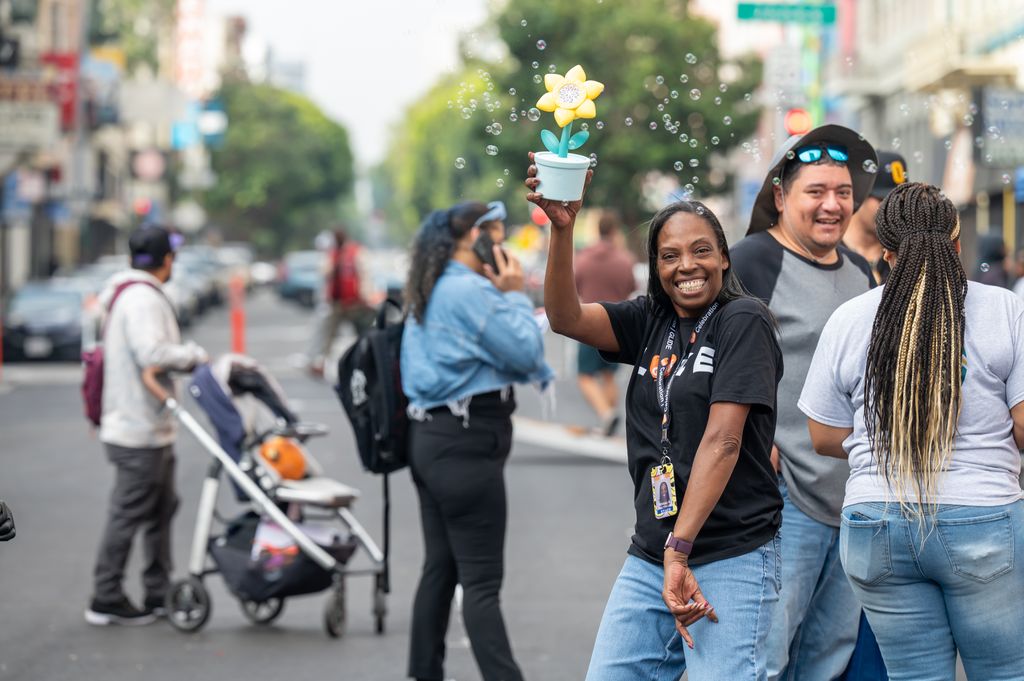
As we made our way down Market Street toward Civic Center, the energy grew. Block parties sprang up along the route, full of children laughing, people lined up dancing, games being played, and live performances echoing the spirit of freedom. Every part of the celebration carried the weight of history and the lightness of joy.
We are proud to be in the heart of it all. Our President and CEO Dr. Gina Fromer rode with Supervisor Bilal Mahmood, standing side by side with us as we celebrated the legacy of Juneteenth.
At one point during the parade, Dr. Fromer was praised over the loudspeaker for her leadership in San Francisco and for guiding GLIDE into its future. Hearing the crowd cheer as her name was called reminded us how deeply this city values the work happening at GLIDE and the people who lead it.
This day marks the moment in 1865 when enslaved people in Galveston, Texas, learned they were free, years after the Emancipation Proclamation had been signed. Being part of this parade means something real for us at GLIDE. It is not just a moment to celebrate, but a reminder of the work we do every day. We stand with our community as we push for justice, dignity, and true liberation for all. This is not just history. It is now.
As we celebrate, we also continue to charge ahead. Liberation is not a day, it’s a movement, and we invite everyone to stand with us as we keep pushing forward.
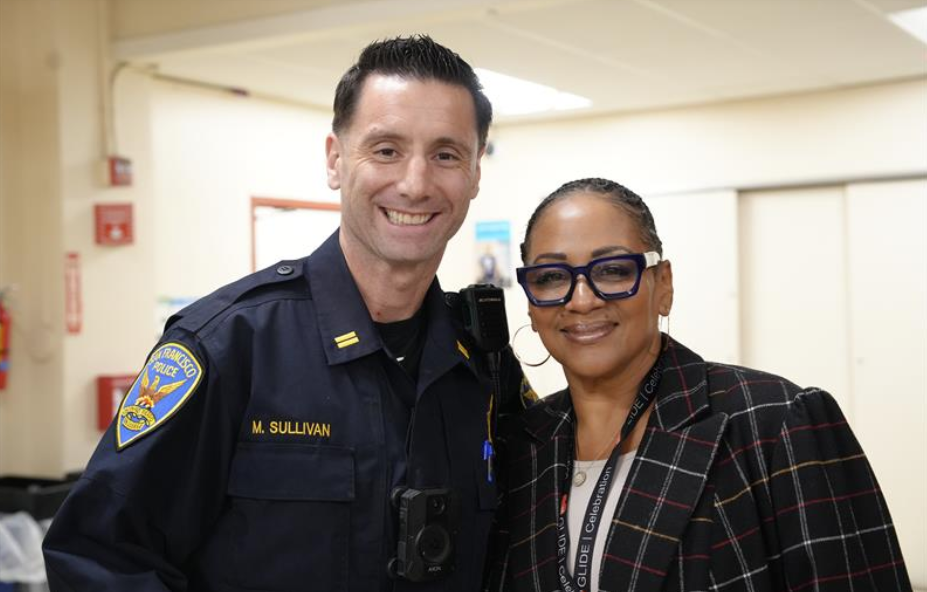
2nd from L, SFPD Chief Bill Scott and SF Executive Pride Director Suzanne Ford
Pride is not just a parade; it is an entire month dedicated to the celebration of identity, resilience, and love. To kick off the month of Pride on June 1st at 11 AM, Glide Memorial Church hosted a powerful ceremony with SF Pride’s Executive Director, Suzanne Ford. She began her sermon with these words: “I have learned this morning what church is supposed to be like.” A profound statement that set the tone for a special celebration.
Glide Memorial Church also honored San Francisco Police Department (SFPD) Chief Bill Scott, who was transitioning from his role as one of San Francisco’s longest-serving chiefs of police. It’s rare to witness a chief of police being celebrated alongside the Executive Director of San Francisco Pride, but that’s the heart of Glide Memorial Church—an unwavering commitment to bridging communities and embracing all people.
On Chief Scott’s last Sunday in his position, after eight years of service, GLIDE honored him for his service and dedication. Del Seymour, Glide Foundation board member and de facto Mayor of the Tenderloin, paid a heartfelt tribute to the Chief. Every holiday season, Chief Scott volunteered by serving meals to those in need. To honor him, Glide presented him with his chef coat—symbolizing the legacy of compassion he’s leaving behind as he embarks on a new chapter in Los Angeles, leading a public safety division of the transit system.
Ironically, as Glide honored him, Chief Scott reflected on how Glide has been a beacon for the community. “GLIDE is the lifeblood of the city,” he said, “When times are tough, whether it’s an officer-involved shooting or reckoning with our past mistakes, we come here. We come to GLIDE.”
Suzanne Ford, the first trans Executive Director of SF Pride, boldly declared that SF Pride is “the most iconic queer organization in the world.” She shared her powerful journey, one shaped by mental health struggles, addiction, deep shame, and the radical grace that helped her heal.
She spoke passionately about transformation—both personal and collective—declaring, “It is not only possible, it is holy.” Suzanne then drew an inspiring connection between SF Pride and GLIDE’s shared mission: to embrace those who have been persecuted for who they are and who they love. But at GLIDE, she emphasized, “You are not just tolerated—you are celebrated!”
As Suzanne shared her story of overcoming adversity, she ignited a fire of hope and self-empowerment, reminding us all that we can love ourselves fully, embrace our authentic selves, and rise stronger after every trial. Good people are drawn to those who live true to themselves.
The theme for 2025 Pride is “Queer Joy is Resistance”—a powerful reminder that joy, in all its forms, is a radical act of defiance. It’s a celebration of resilience, love, and freedom. Join us on Sunday, June 29th at the Pride Parade and stand with us in the joyful resistance that defines Pride!
“Freedom delayed is not freedom denied,” proclaimed Eric McDonnell, Chair of the African American Reparations Advisory Committee and guest speaker at Glide Memorial Church on Father’s Day. “Even when the world tries to leave us behind, God says, ‘I see you. I love you. I care for you.’”
This Father’s Day at Glide, everyone felt free—free from incarceration, free from trauma, and free in identity, including our queer brothers and sisters (some of whom are fathers) still fighting for full liberation.
Photos of generations of fathers and father-figures lit up the giant screen on stage as Minister Marvin K. White, Eric McDonnell, and fathers from across the community gathered to honor a powerful trifecta: Father’s Day, Juneteenth, and Pride.
The spirit of freedom filled every pew. We remembered the excruciating delay between the Emancipation Proclamation—issued on January 1, 1863, declaring an end to slavery—and the moment that freedom finally reached enslaved Black Americans in the fields of West Texas on June 19, 1865.
That delay was real. That pain was deep. But still, we celebrate. Because freedom delayed is not freedom denied.
McDonnell’s booming voice echoed through the sanctuary and into the streets: “True freedom doesn’t come from paper or proclamation. It comes from the power of persistence—and from God.”
“Healing is possible,” he declared. “Deliverance is possible.”
He then invited the congregation to celebrate five ways to live free:
Tell your truth.
Serve your community.
Worship boldly.
Build something.
Love radically.
With that, he transformed the moment of Father’s Day and Juneteenth into a call to action—a living movement rooted in freedom and hope.
A movement that sets us free—today and every day.
Social Service Providers As Pioneers in Transformative and Restorative Justice
Restorative and transformative justice are ways of dealing with harm that focus on healing instead of punishment. Our mainstream justice system is frequently punitive, which can trap people in cycles where they repeat their mistakes instead of transforming their lives.
When service providers like GLIDE respond to infractions of rules by clients in a way that’s grounded in grace and community care, they light a way forward to a better world– one where everyone has the opportunity to grow from second chances.
What is restorative justice?
Restorative justice is about bringing people together—those who were hurt and those who caused harm—to talk honestly, take responsibility, and try to make things right.
What is transformative justice?
Transformative justice looks even deeper and asks, what needs to change in our community or society so this kind of harm doesn’t keep happening?
What is GLIDE’s Return to Care Program?
Every social service provider has clients who break the rules. People experiencing extreme poverty are under all kinds of physical and mental stress, and often have mental health problems or understandable difficulties with emotional regulation. GLIDE’s values of radical inclusion and unconditional love deeply inform the way we approach rule-breakers. We interviewed Lando Del Rio, our Community Safety and Training Assistant Manager, to get deeper insight into how our approach works day-today.
“Our clients come to us with a variety of complex situations: but we know them, we talk to them, we have a rapport with them. We code-switch with them and meet them where they’re at. We don’t use inaccessible professional language if we know they won’t understand it; we talk to them in the same way that talks to us.”
This includes hiring staff of many different backgrounds and trying to learn phrases of your client’s languages. “It’s about cultural competency and interpersonal skills,” Lando adds. “You need to have a great memory for names and faces.”
It’s easier to de-escalate someone who’s upset or breaking the rules if you have a pre-established relationship or call them by their name. Our community safety team members have a wide range of safety-related skills in addition to de-escalation: training in first aid, CPR, narcan administration, and mental health first aid.
What governments can learn from social service nonprofits
“City leaders should approach unhoused people like people: like individuals,” says Lando. He shared his discomfort with the tactics that sometimes get used in encampment sweeps across the country: “Unhoused people are treated like animals sometimes: kicking them out, rushing them, grabbing their belongings. That’s not the way we do things in the morning. Of course, people camp on our doorstep overnight, after closing hours.”
“When it comes to morning time, we have a system. Our announcements often include a friendly ‘Good morning!’ or ‘Top of the morning, everyone!’ gently signaling that it’s time to rise and shine. If they don’t hear that, we will individually greet them, and politely let them know it’s time to start gathering their things. We give them time. They’re regulars, they know the system. They know we’re going to come out there and greet them and be nice to them, so they’re okay with being woken up– they know breakfast is coming soon.”
“Every now and then, we’ll have a couple of issues in the morning, maybe because we woke them up after we just got to sleep. In those cases, we just give them a few minutes. If cities approached unhoused people with that kindness and humanity, we’d be in a better place. No one should ever talk to unhoused people like they are in the way. They’re just trying to live; they’re trying to get by.”
Transformative justice in action
One core tenant of the philosophy of our Return to Care Program is that someone’s actions don’t define who they are. When people make mistakes, our priority is still ensuring they are never lost to care. We hire staff who are formerly unhoused, formerly incarcerated. So many people at GLIDE understand on a deep level what it’s like to be on the streets and making unwise decisions. They know better than anyone– the person you are today, isn’t the person you have to be tomorrow.
A committee of safety and program staff meets every Thursday to discuss incident reports from the week and choose a way to handle each situation individually. Often the solution is a cool-down period, the length of the cool-down period depending on the severity of the rules infraction. We also consider whether it’s a repeat or a first-time infraction. No one is ever kicked out of GLIDE forever; it’s against our values. But often, a cool-down period to reconsider can help a person be restored to their community.
We still feed them during their cool down period; we give them a to-go meal and ask them to eat it outside the building. And we have a conversation with them about why the decision was made to institute the cool-down period. Usually, they’re very very understanding about it. They generally understand they’ve done something wrong and feel the consequence is fair.
Justice means solving root causes, not just punishing behaviors
“Sometimes when people get into fights inside the building, they’re continuing conflicts that have been occuring outside the building,” Lando explained. “People have lots of personal drama. They’re in survival mode. I get it. We have to put ourselves in their shoes so we can respond with compassion– and also be clear with them about what we won’t tolerate at GLIDE. I don’t always agree with the choices and actions people take, but I keep on reminding myself, I’m not them, I haven’t gone through what they’ve endured.”
The most important thing, more important than imposing consequences, is attempting to solve the underlying issue causing the behavioral issues. For example, a client who’s underlying problem is dementia doesn’t need a cool-off period, they need medical assistance. Our Safety Team might problem-solve that situation by doing handoffs to the client’s caseworkers, or particular cases can be handled by a licensed clinician on GLIDE’s staff.
Compassionate problem-solving in complex situations is what our safety team does– their work is so much more advanced and intensive than that of a “security” worker. Ensuring the safety of people is much more labor-intensive and vital than ensuring the safety of property– and much more important!
What to do when restorative justice doesn’t work at first
On the rare occasions when our restorative justice conversations don’t go well, and people don’t appear to understand the gravity of what they’ve done, the Return to Care committee discusses the next steps and strategy as a group, considering many factors, including the urgency of the care.
People who are on a timeout from Meals Service are still welcome to see their health access workers at the Health Hub beside the building, so no one is ever removed from care entirely. We will also sometimes bring their services to the sidewalk and see if we can help them there. That way they can be cared for without negatively impacting others trying to enjoy services within the building. Our first priority is always the safety of everyone, including staff!
Violence and physical restraints are not necessary to ensure safety
We have a Hands Off Policy which is rare among social services agencies– meaning that our staff is never allowed to lay hands on a client to physically restrain them– not even if the client is initiating a fight. This policy increases the overall safety of staff. The policy helps people feel safe– it makes them more relaxed and less inclined to escalate in the first place.
A safety staff is different from a security staff: we remove ourselves from violent situations instead of trying to “vanquish” the “enemy.” In a world of unconditional love, no one is an enemy. There are some situations where calling 9-11 is called for, but it’s neve a first resort!
Using these policies, we’ve been able to keep our guests safe. Lando says, “We’ve found that even after a withdrawal, most individuals show significant improvement in their attitudes and behaviors. While we do occasionally see repeat offenders, the overall trend is positive change.”
De-escalation tips
Gwen McDade, our Community Safety and Training Manager, is fond of telling staff she trains, “Do not match their energy. If they’re at 100, we stay at 50.” We can’t outdo an escalated client when it comes to energy, so we use calm and teamwork to handle the situation.
Our Safety Team also does tag-in and tag-out. Lando says, “If I am having a confrontation and it’s not going well, someone else will be like ‘I got this,’ and I will leave.” Basically, sometimes clients get triggered because a particular person rubs them the wrong way– so switching out can de-escalate. We also always respect a client’s bubble and make sure they don’t feel crowded. Crowding someone can escalate them. They will feel threatened if five people are all crowded around them!
The most important de-escalation tactic, Lando says with great conviction, is LISTENING. “You don’t want them to feel scared or defensive, so we do lots of listening, we say, ‘Let me hear your side of the story.’ We offer them help, we ask them how we can make this better. And we let them walk away. If there are two people fighting and we’re separating a fight, we always ask them to please walk in opposite directions.”
A rewarding practice
One of the most rewarding aspects of our justice approach is we get to see the magic of people growing and changing, “People often come back and say , ‘I’m so sorry!’” says Lando. He described a client with multiple infractions who was so touched that the team allowed him back into care, he eventually became infraction-free.
When you approach justice with a mindset of radical inclusion and unconditional love, everything changes. You are able to keep the community safe– and keep those who violate community norms safe and cared for as well. It’s all about hearing people out, and giving them a chance to change.
My name is Vincent Smith. I’m 61. I’ve been coming to GLIDE since 1993. I’m originally from Richmond, Virgina. My 12-year-old daughter was killed by a drunk driver. I knew the person who did it, but did not want to take any action for fear of any repercussions. Frankly, I was just too scared to go back home. So, I moved to California.
Her passing is a part of me that’s gone. It’s never coming back. But when I arrived in San Francisco, I heard about GLIDE. And I’ve been coming to ever since to the meal services. I used to make use of GLIDE’s health clinic, where I received assistance for my mental health.
I also worked part-time for the city and would come to GLIDE on Wednesdays and Thursdays for lunch. But I’ve been a Thanksgiving regular for a while now, including Christmas. Thanksgiving is family time, and I normally would have been with my family back in Virginia.
But since I can’t, GLIDE is my number two, and I consider it my adopted family. And all of the volunteers who come here to serve on Thanksgiving, I’m so grateful for all of them. These are the people I know. Most of the people I know on the streets are doing drugs like Cocaine and Fentanyl. I’ve seen too many of them die, as a result. But GLIDE is like a brother to me.
Robert (Russell) R. DePhillips in his own words
“I was born and raised in Brooklyn, New York. I’m 58 years old. I’ve been coming to GLIDE to get my meals for nearly eleven years. I was a former police officer for the NYPD. I later worked for the movie and TV industry in Hollywood. I was at the Trade Center on 9/11 when the planes hit. Hurricane Sandy flooded my home while I was living in New York. This was back in 2012.
I lost everything. FEMA screwed me. I lived off my savings for a year in a hotel while trying to clear things up, but wound up on the streets homeless, just before Thanksgiving. A friend of mine who was living in the Bay Area, at the time, suggested I move out to California and purchased a train ticket for me. But I struggled to find work and wound up homeless. I lived on the streets for about ten years before I could finally get some assistance from the city. I now live in an SRO.
During that time, I found out about GLIDE’s meal services, and I’ve been coming here ever since, at least five days a week for breakfast, and sometimes for lunch and dinner. The food is good and the staff are wonderful. They are so welcoming. They know me by name now. It’s like family. I feel I’m treated like a human being.
If I had money in my pocket, I’d be donating to GLIDE every month. When I had money back in New York, I would donate money to organizations like Covenant House. But in all honesty, I don’t know where I’d be without GLIDE.
I’m currently waiting for my SSI benefits to start. I’ve been suffering, but I am being patient. “