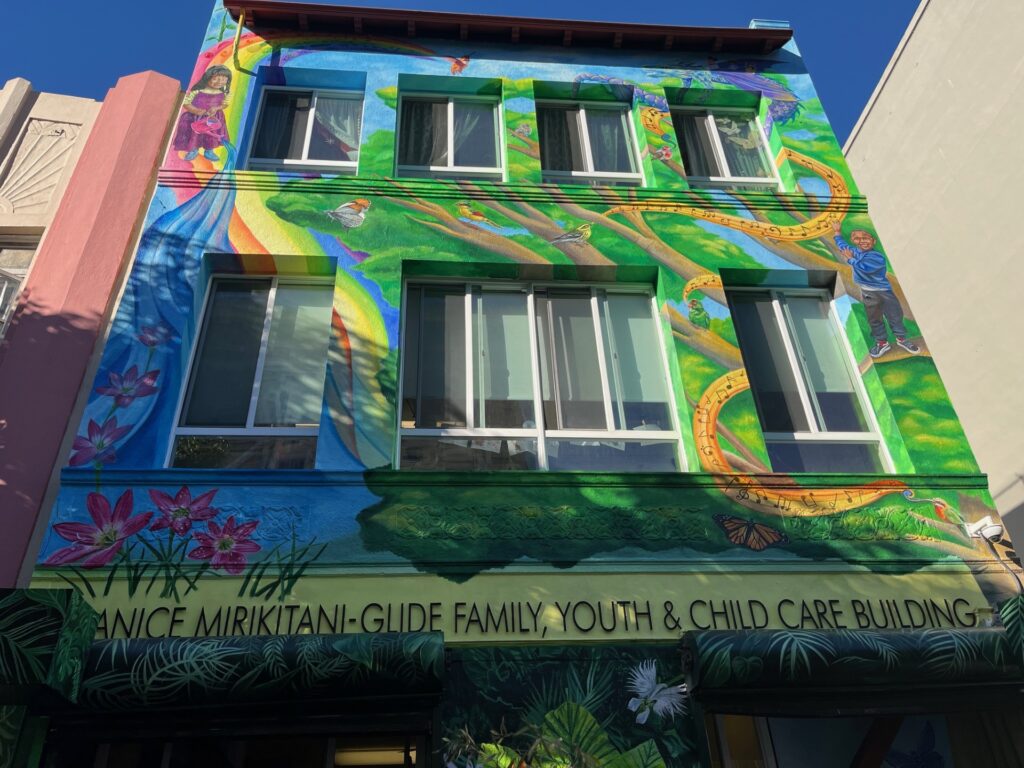
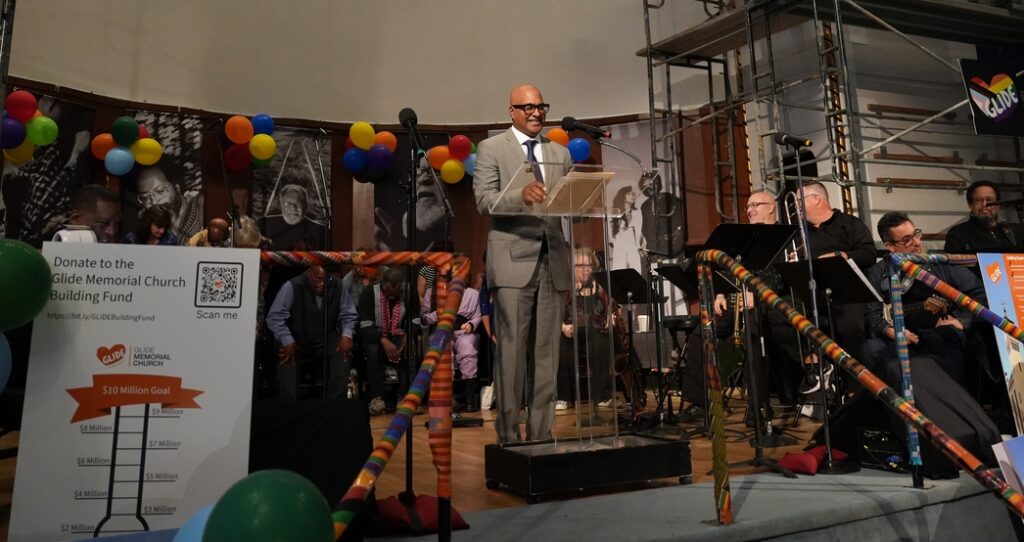
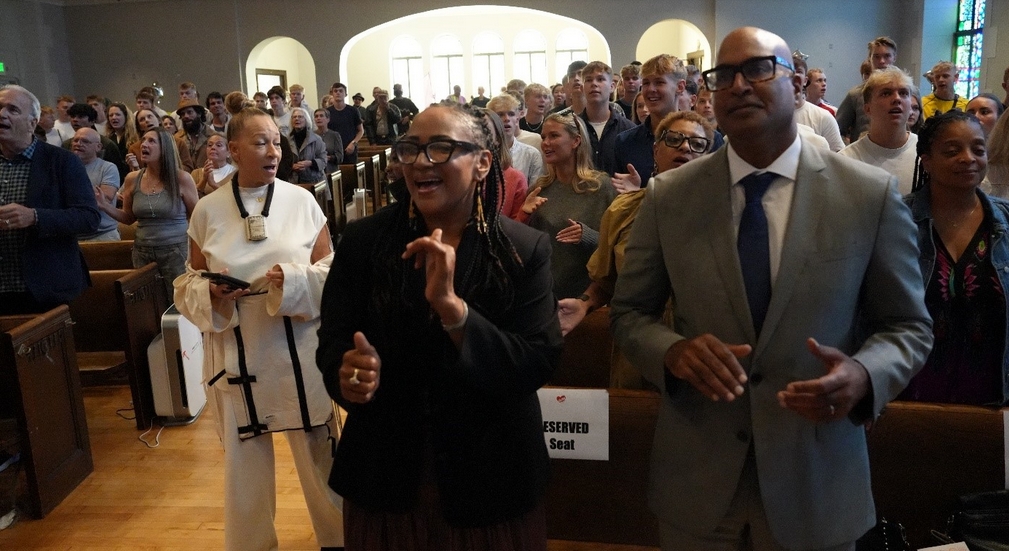
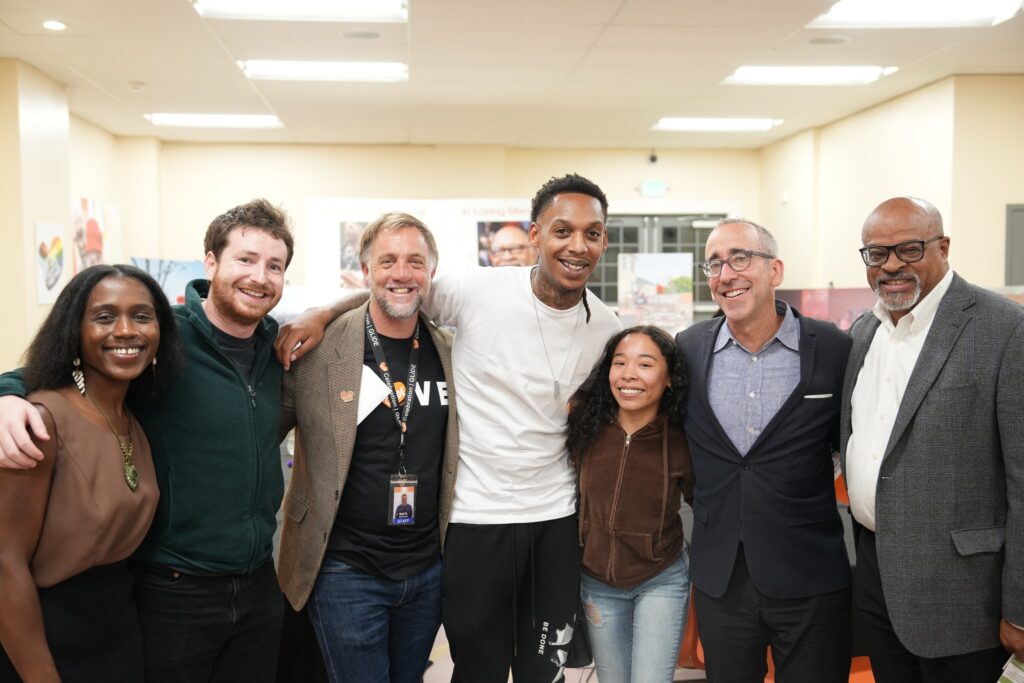
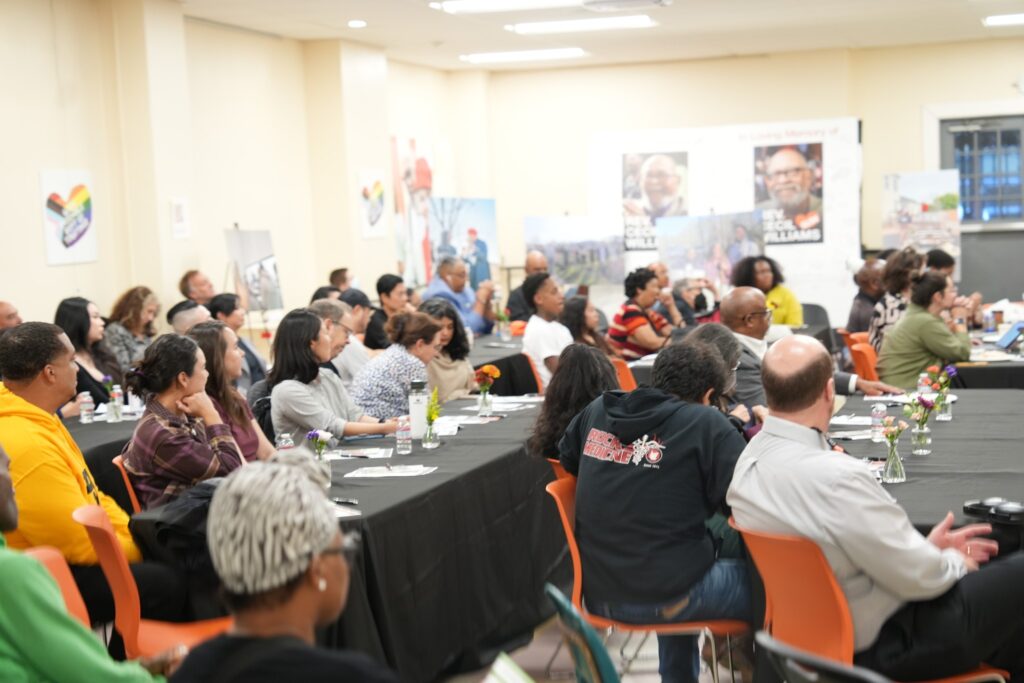
On October 23rd, 2024, the Janice MirkitaniFamily, Youth, and Childcare Center (FYCC) honored its 25th anniversary (and its first Back to School Night since 2019!) with a celebration of the new mural painted on the front of the building. At the same time, we celebrated our President & CEO Dr. Gina Fromer’s one year anniversary of working at GLIDE.
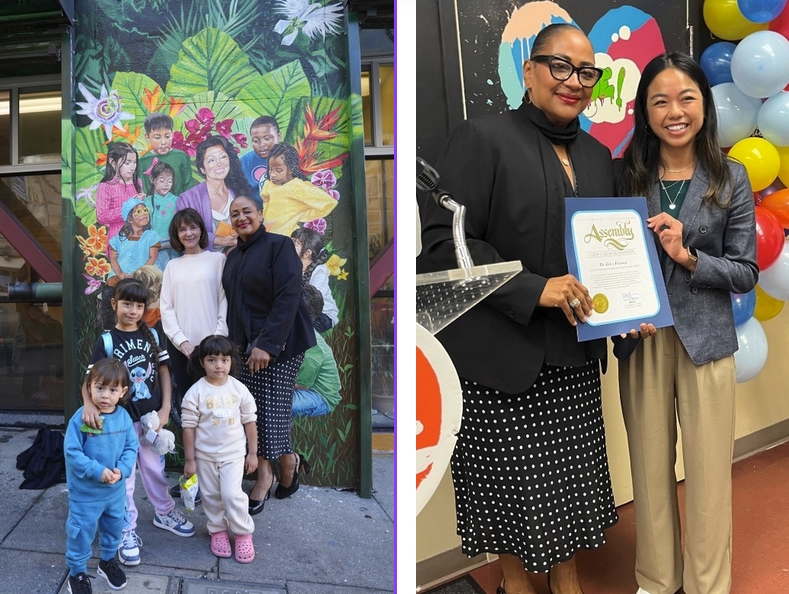
(L) GLIDE President & CEO Dr. Gina Fromer (wearing black jacket) standing next to former GLIDE Board member Sharon Osberg and on the (R) Dr. Gina Fromer receiving recognition from Assemblymember Matt Haney’s office
A representative from Matt Haney’s office gave Dr. Gina a Certificate of Recognition for her exceptional work. Children munched popcorn and picked up free plushie penguins and llamas during celebratory remarks in English and Spanish.
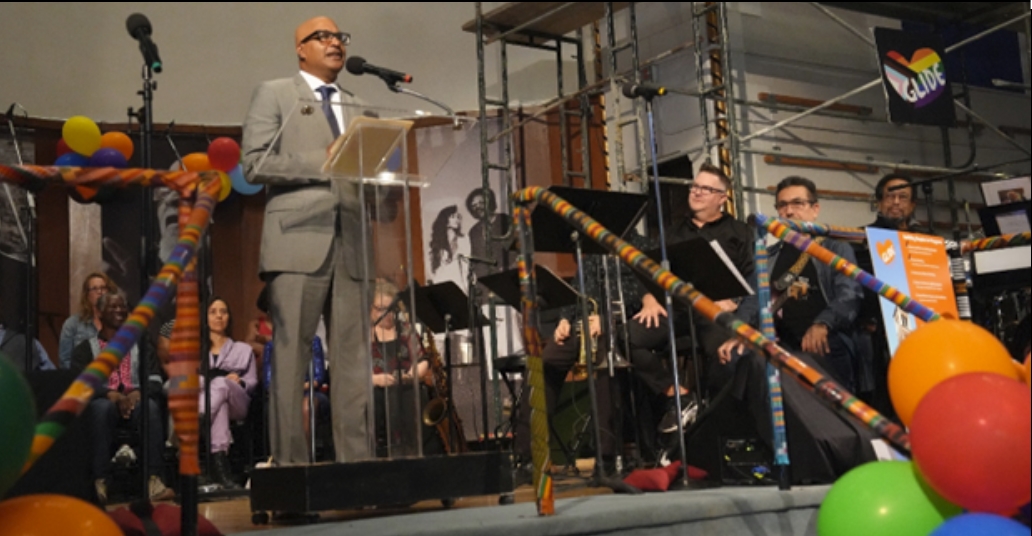
Our Chief Program Officer Lillian Mark spoke about how FYCC was living Janice Mirkitani’s dream of loving, consistent support for parents. When Dr. Gina took the podium, she quoted Janice’s proverb, “Never forget about the women and children.”
Beaming with a warm smile on the parents, children, and FYCC staff, she added, “We adore and love you. You need anything, we got you.” FYCC parent Kaitlyn Lang spoke as well, saying, “GLIDE has been my family for ten years, it has helped my family grow immensely, in ways we never could have imagined.”
The new mural on the front of the FYCC building, depicting Janice Mirkitani reading a book about Maya Angelou to a group of children, used the actual children who attend the childcare center as inspiration for the painting.
It was designed and painted by the muralists Precita Eyes. Although painting on scaffolding in the heart of the Tenderloin was hectic, they said they were amply rewarded by the joy in the children’s eyes when they saw themselves in the mural.
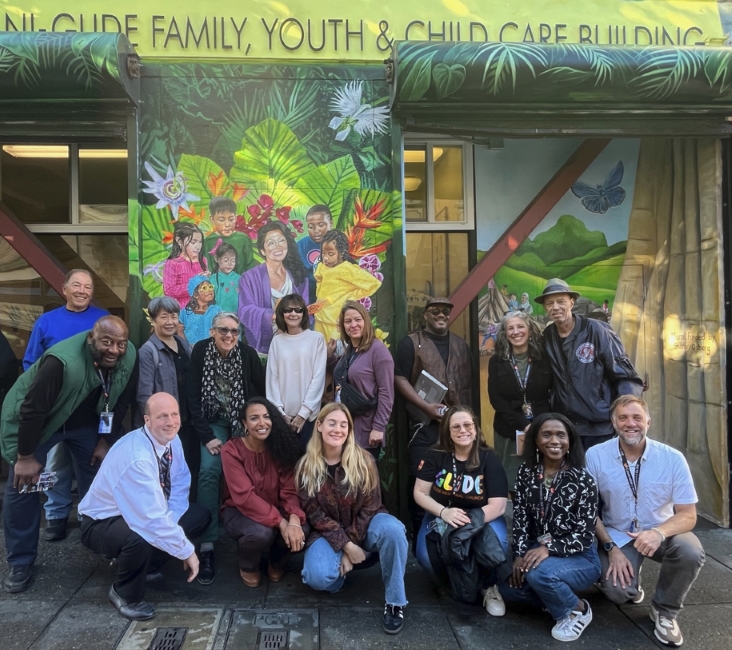
A mixture of GLIDE staff and board members outside of GLIDE’s FYCC building
On September 22nd, San Francisco’s Public Defender, Mano Raju, spoke at Glide Memorial Church’s Sunday Celebrations for Justice Sunday.
The celebration also honored co-founder Rev. Cecil Williams’ first birthday since his passing in April. “In many ways the mission, vision, and values of GLIDE are similar to the values of the Public Defender’s office,” said Mano Raju. “One of our core values is love, and our vision is one where all of humanity (not some of humanity!) but ALL of humanity, is cherished.”
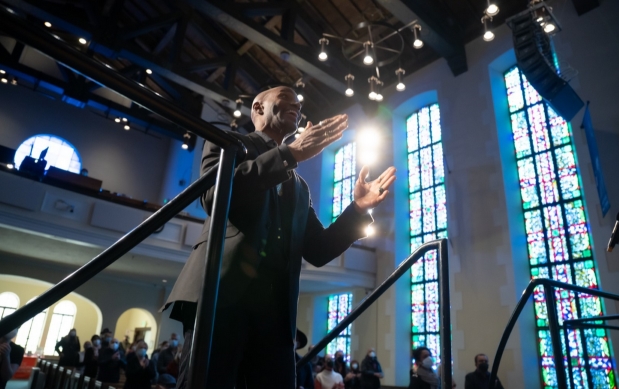
Dr. Gina Fromer, GLIDE’s President and CEO, energized a packed house by singing “welcome GLIDE” and speaking about how having the freedom to be who you want to be is true justice, and how pursuing freedom honors Rev. Cecil William’s memory. When Dr. Fromer introduced Mano Raju, she highlighted GLIDE’s Cecil Williams Ambassadors and new recovery programs. Through these programs, GLIDE “helps others learn what it means to be free: freedom to not be judged and freedom to choose” Dr. Gina said.
From L to R: Kimberly Williams (Rev. Cecil Williams’ daughter), GLIDE President & CEO Dr. Gina Fromer, and SF Public Defender Mano Raju
Both Dr. Fromer and Mano Raju centered racial justice in their remarks. GLIDE provides services, advocacy and healing for all who are affected by racial bias. For anyone interested to learn more, there are two congregational life groups to join, the White Antiracism Group and the Racial Justice Group. Find out more here.
GLIDE’s Center for Social Justice (CSJ), and other members of the Coalition to End Biased Stops partnered with the Public Defender’s office, resulting in reforms that impact everyday life for San Franciscans. “Together we urged the Police Commission to create a new policy limit, to ban the Police Department from using certain traffic stops as a pretext for harassing people of color,” said the Public Defender. Check out the CSJ blog. We are incredibly proud to be the first in the country to enact such an important reform.
The Public Defender shared several heart-wrenching cases when San Franciscans experienced racial bias during arrests, court appearances, and in sentencing. Watch the Public Defenders full speech at Glide Memorial Church to hear these important stories:
The Public Defender centered his words in the Book of Acts, Hafez and the Rev. Cecil Williams. “I need to be in touch with the people. You’ve got to look in their eyes. You’ve got to feel what they feel. You’ve got to engage people,” read the Public Defender, quoting Cecil. “All that we do and believe is engaging people to touch, to heal, to look at each other’s eyes, to feel with each other, to cry with each other, to moan, to groan, to rejoice, to be happy.”
Public Defender Mano Raju leading a Town Hall discussion in Freedom Hall after Celebration
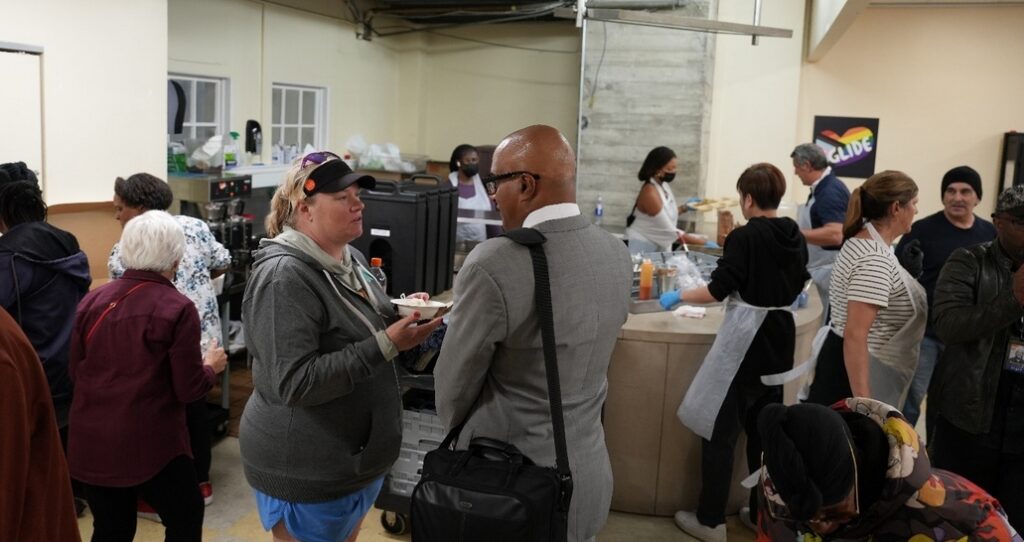
After the Celebrations, he put Cecil’s words into action, meeting with individuals eating lunch at GLIDE. In a crowded Freedom Hall, those who navigate the criminalization of poverty daily were able to speak directly to San Francisco’s Public Defender and received “Know Your Rights” cards.
After an arrest, people who cannot afford an attorney rarely get much time with the public defenders fighting on their behalf. On this day, individuals from the streets were able to share a meal in a safe place with one of San Francisco’s top elected officials.
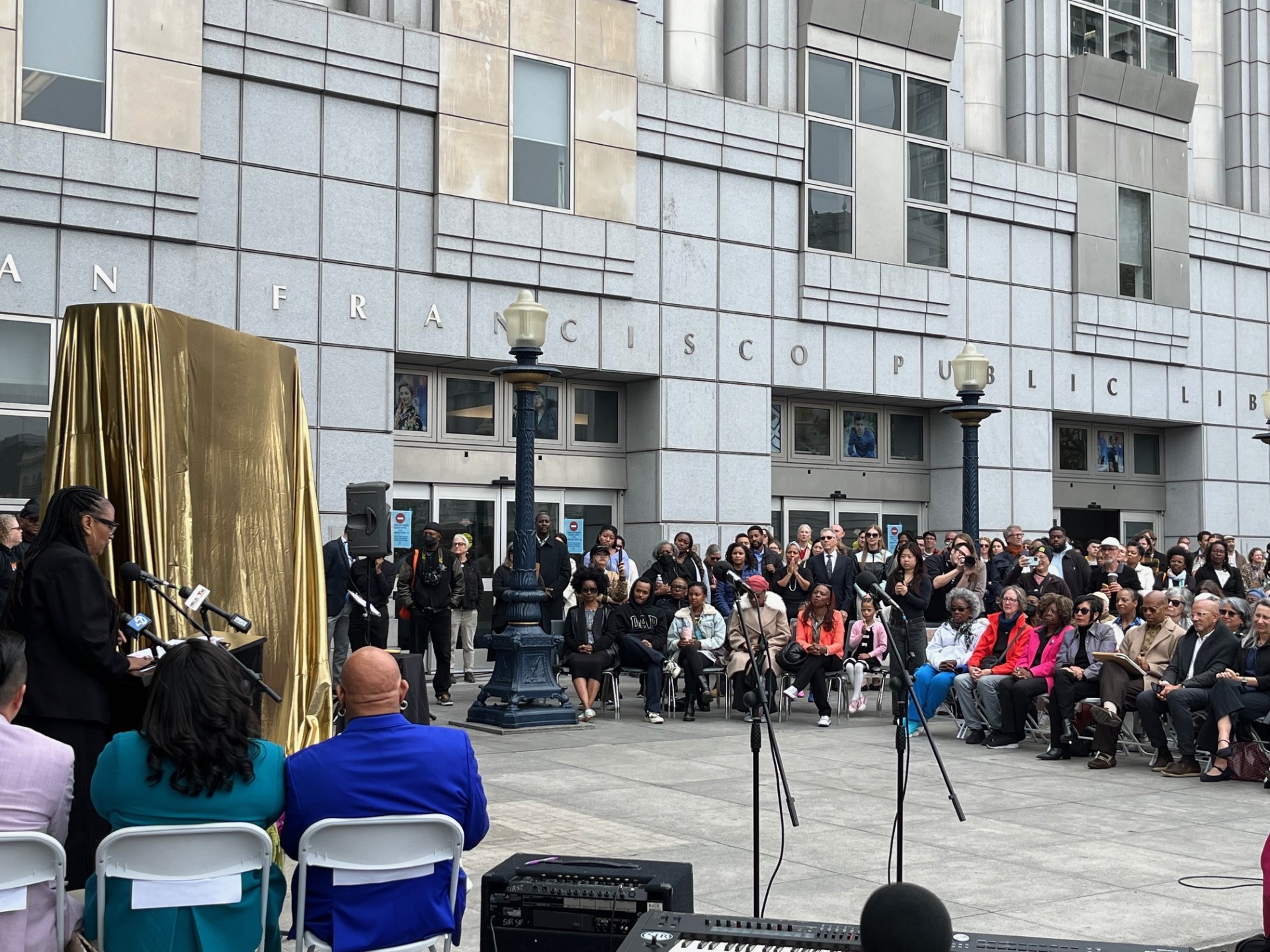
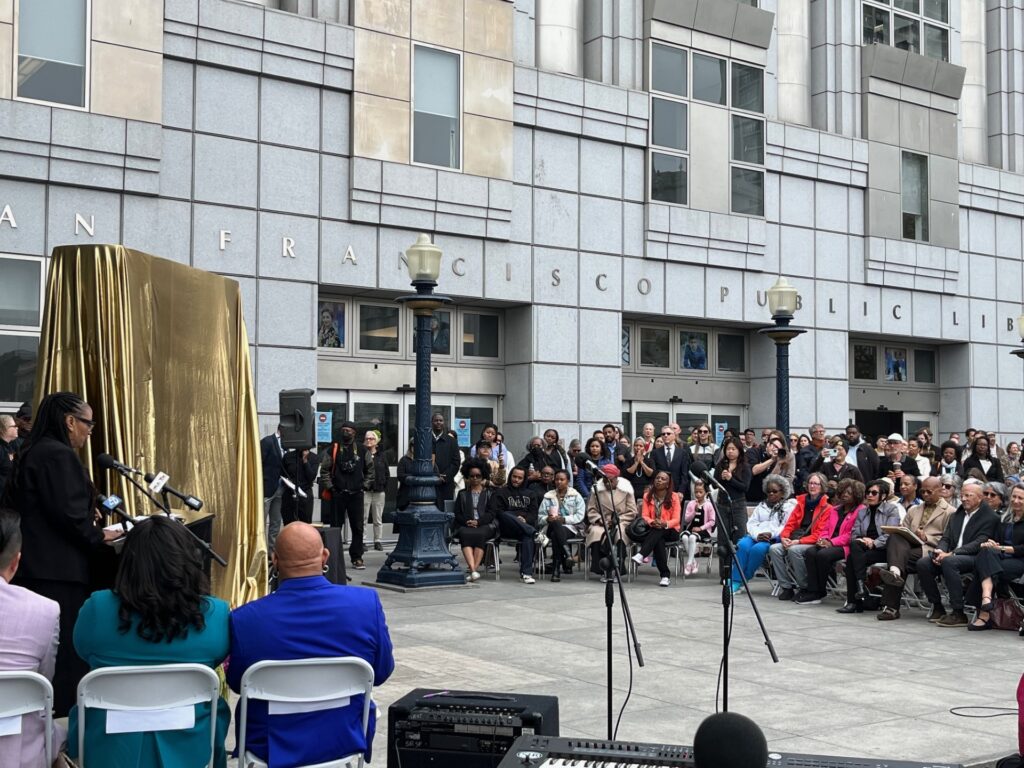
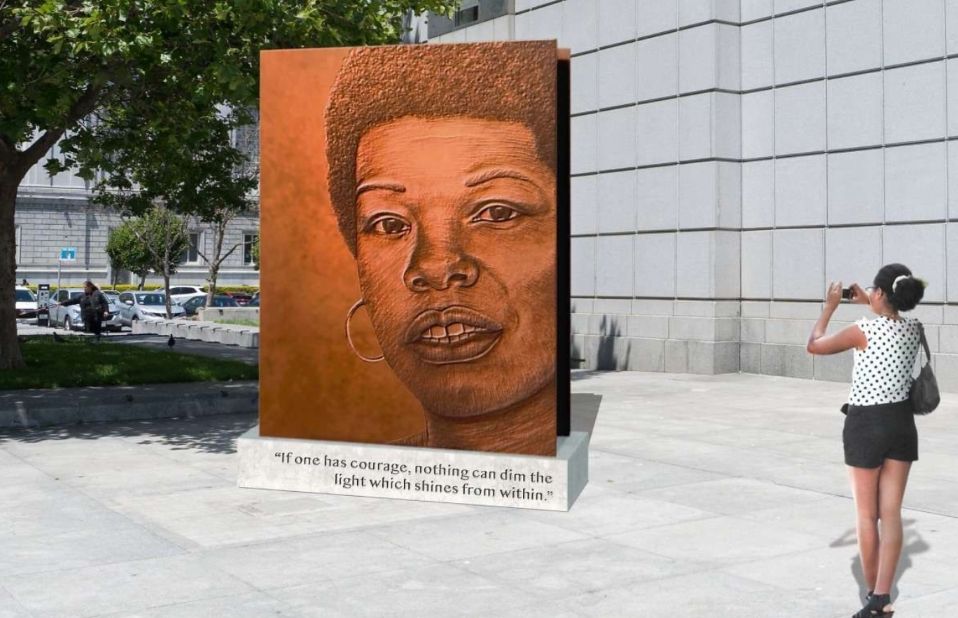
GLIDE President & CEO Dr. Gina speaks at the Maya Angelou statue unveiling outside the Main SF Public Library
On Thursday September 19th, GLIDE’s CEO spoke and Glide Ensemble performed at the SF Library’s unveiling of their new Maya Angelou statue. Glide Memorial was Maya Angelou’s church, and it was wonderful to see her memory celebrated.
The event opened with the announcements: “This is the first Black woman to be honored with a statue in San Francisco,” and the audience filled the air with cheers and shouts of, “It’s about time!” and “Not the last!”
The struggle to get a Black woman’s statue erected in SF coincided with the George Floyd protests and the nation’s dismantling of Confederate monuments. Even when the statue design was approved, the city temporarily withdrew the approval because they didn’t understand the nontraditional design, in the shape of a book rather than a body. (Eventually the approval was reinstated, with apologies to the artist).
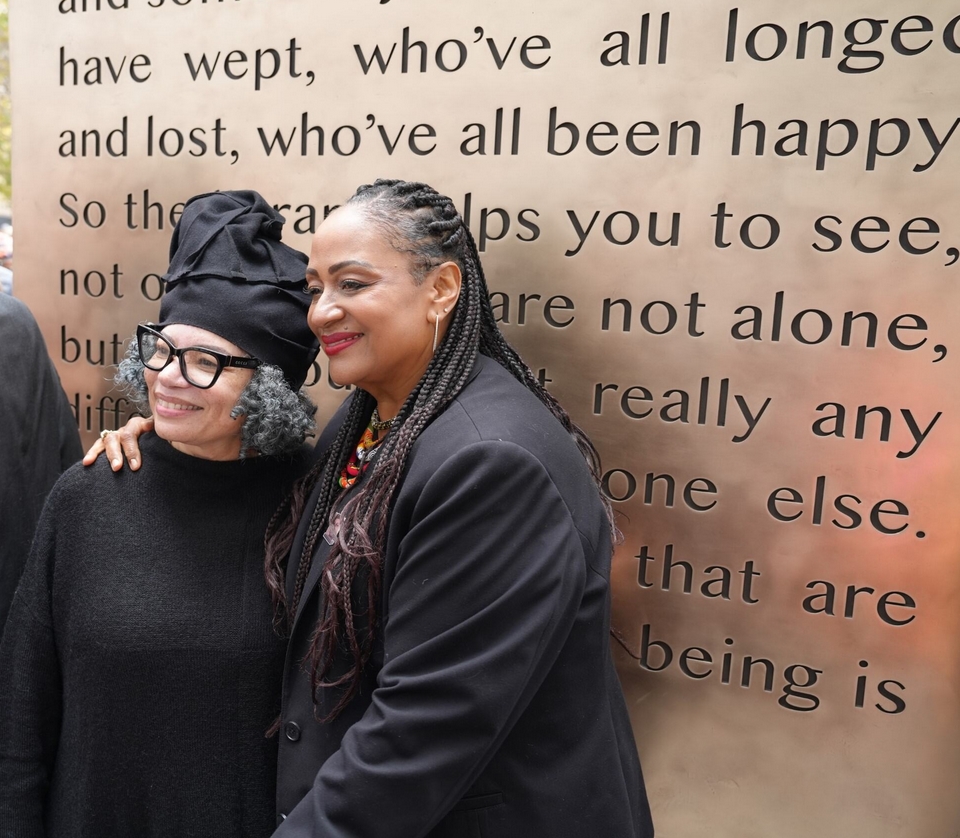
Maya Angelou sculptur Lava Thomas with GLIDE President & CEO Dr. Gina Fromer
The sculptor, the talented Lava Thomas, did not elude directly to the controversy in her remarks in the unveiling, but did explain the deeper logic of her artistic decision, “A writer IS his or her books.” In a world that often objectifies women while underestimating their intelligence, it’s so symbolically meaningful to see a woman’s intellectual achievements celebrated in preference to her physical form.
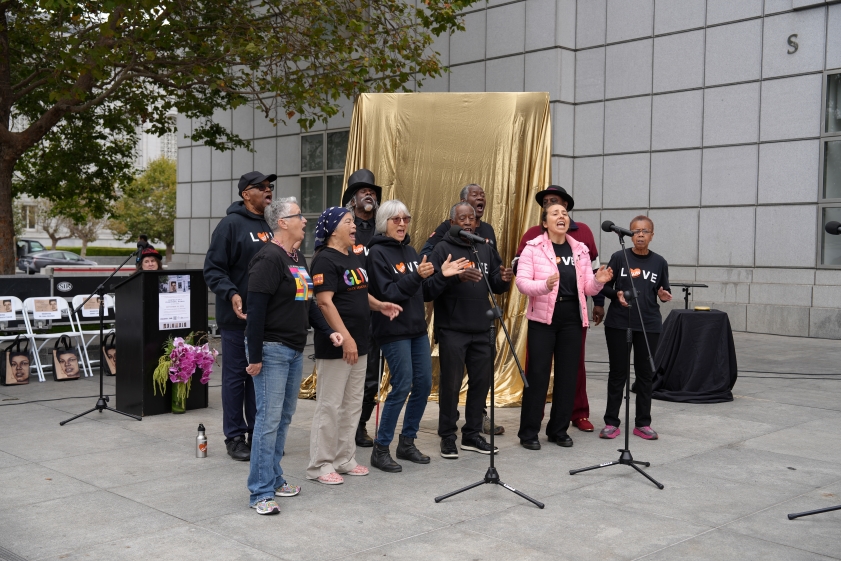
Glide Ensemble chose to honor the struggle to get the statue erected with the amazing song, Long Way To Go (I’ve Come a Long Way), a song that simultaneously celebrates progress and acknowledges the road ahead. Our President & CEO Dr. Gina Fromer shared the Maya Angelou quote, “Nothing can dim the light which shines from within.” And indeed, the light of Maya Angelou’s spirit is not dimmed by her passing, but shines brighter than ever.
GLIDE Ensemble performing prior to the statue unveiling
Now everyone who passes through the library doors will be welcomed by the sentiment engraved on the back of the statue, “Information helps you to see that you’re not alone. That there’s somebody in Mississippi and somebody in Tokyo who all have wept, who’ve all longed and lost, who’ve all been happy. So the library helps you to see, not only that you are not alone, but that you’re not really any different from everyone else. There may be details that are different, but a human being is a human being.”
Three young poets from Youth Speaks performed a moving poem which included the lines, “She [Maya] taught me my body is a temple. / My body is a temple, now a statue forever to be remembered. / We are all just poems in the flesh.” They had a Maya Angelou quote, “There is no greater agony than bearing an untold story inside you,” on the back of their t-shirts.
At one point in their performance, they turned around in synchronized choreography to make sure the audience read the quote, literally making their body’s movements part of the poem. Just as Maya Angelou’s body became a book in the statue’s design, the youth poets’ bodies also turned themselves into literature.
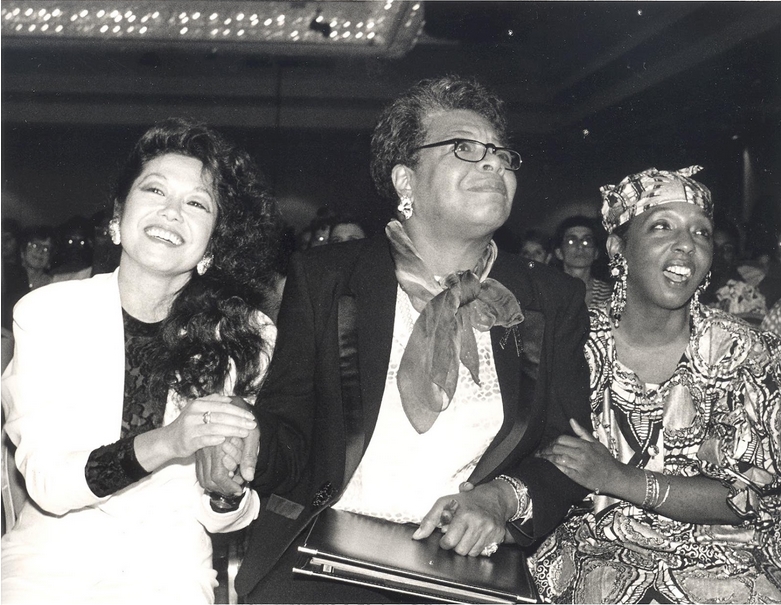
The stunning highlight of the program was Maya Angelou’s niece, Rosa Johnson, also a big part of Glide Memorial Church’s history. In this photo from the archives, you see Rosa dressed in African clothing standing next to her Aunt Maya and our co-founder Janice Mirikitani.
“The two most important rooms in my aunt’s home were the kitchen and the library. She inspired my family and me and my children and my children’s children to have libraries,” Rosa reminisced. She talked about how her aunt saved her life, persuaded her to pursue education, and convinced her that God loved her. “You mean the God that created these trees and flowers and ALL THIS– loves me, Rosa Johnson, mother of four? Loves ME?” Rosa talked about how her acceptance of God’s love brought her to GLIDE, where she started a recovery program for women called African Queens.
“Auntie would always say ‘Courage is one of the greatest virtues; because without courage you cannot be consistently kind and compassionate,’” Rosa said. After pausing to wipe her eyes, she went on to say, “It has taken lots and lots of courage and patience to keep on standing up and saying how beautiful we are.”
This statue represents the spirit of Maya Angelou, because it was erected in defiance of the hundreds of years we refused to acknowledge Black women’s beauty. Maya Angelou’s absolute belief in her inner beauty was a light which could not be diminished by anyone or anything.
Lava Thomas said of her sculpture, “This embodiment is a monument of her works. It is an invitation for us to read her works, and to internalize the lessons of faith, daring, courage and perseverance, as we navigate our life’s challenges. It is an invitation to live bodaciously and expansively, with purpose, conviction, and generosity.
Those of us whose ancestors survived the Middle Passage, to arrive on these shores in bondage, remember: we are the hope and dream of the slave. We rise!”
The inscription on the base of the statue was, “We Rise.”
Photo credit: SF Chronicle
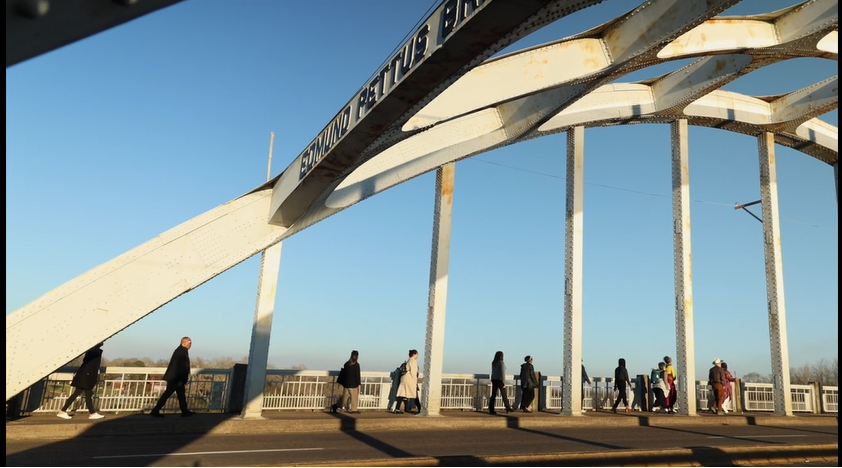
On Saturday September 11th, GLIDE packed Freedom Hall for a twelve-minute documentary film and panel discussion about GLIDE’s Alabama Pilgrimage.
The film, Pursuing Progress, was created by the talented born-and-raised Tenderloin filmmaker Lana Vy, and you can watch it for free online here. The Alabama Pilgrimage is a tour for GLIDE community members through the civil rights and slavery museums and monuments in Alabama. The trip leads white people along the spiritual journey of becoming more compassionate allies, and it helps Black people contextualize their modern-day challenges with a deeper understanding of their ancestors’ heroism and resilience.
Our President & CEO, Dr. Gina Fromer, opened the event by talking about her feelings about her upcoming first Alabama Pilgrimage trip. “I know that when I go on this trip, as a Black woman, I’m going to feel things I never felt,” said Dr. Gina, contemplating the intense emotion that comes from being immersed in the history of slavery and oppression. “But this trip is important because of truth-telling. We’ve got to tell the truth about what happened,” she added.
How historical truth-telling leads to Black empowerment
GLIDE staff, including (L) Naeemah Charles, Senior Director of the Center for Social Justice (far left), Alabama trip participant Deshawn Dupre Brown (center) and GLIDE Rabbi Michael Lezak (2nd from the right)
Terrie Kendrix, GLIDE’s Women’s Center Program Coordinator, helped introduce the film by explaining the effect of the pilgrimage on her own career. “The Alabama trip broke my heart and gave me the strength I needed to prosper at GLIDE,” she said. She was working as a Case Manager at GLIDE when she went on the pilgrimage, and the trip inspired her to apply for promotion to her current position.
Terrie was not the only one who gained a better understanding of her own strength and potential by learning what her Black ancestors overcame. DeShawn, a client of GLIDE selected to go on the pilgrimage, had a similar experience to share. “Seeing my ancestor’s journey made me want to do better. They risked their lives for us, hoping we could have better outcomes. We come from some strong people. I’m grateful we came together as a community to learn about it together.” He also shared his outrage on how mass incarceration has become a modern-day form of slavery.
The role of reclaiming our voices in ending racial oppression
Attendees at the Pursuing Progress film screening inside GLIDE’s Freedom Hall
Regina Wells, GLIDE’s Senior Manager of Training and Development, spoke on the panel about the importance of music and self-expression to anti-racist resistance. “The vibration that comes from singing is how my people survived day in and day out without sleep, not properly nourished or fed,” she said, referring to the cruel conditions on plantations and slave ships. “Sounds are our first nourishment… I want to apologize today on behalf of anyone who ever discouraged you from speaking or singing. Anyone who ever said, ‘you shouldn’t sing,’ or ‘keep it down in here!’ I want you to promise yourself today, ‘I will reclaim my voice, my authentic voice.’”
Unlike South Africa, the United States has never undergone a truth and reconciliation process for the racially motivated cruelty and violence in U.S. history. So part of the Alabama Pilgrimage’s purpose is for us here in San Francisco to begin our own process of truth and reconciliation. It is foundational to this effort that each of us step into our own truth, our own voice.
Opportunities for white people to grow in accountability, empathy, and allyship
GLIDE’s Rabbi Michael Lezak, our Social Justice Director, spoke humorously and self-deprecatingly about the missteps on his own white allyship journey. In a culture where people can be tense about admitting their own mistakes, Rabbi’s willingness to lovingly make fun of himself opened up safe space.
Rabbi Michael Lezak served as rabbi in a wealthy and very white area of Marin County for 14 years. His transformation began when he traveled past the San Quentin prison while reading The New Jim Crow, a book about racial discrimination in the justice system. In that moment, he was struck by the necessity of leading his synagogue on their own anti-racist journey. He brought in speakers like Bryan Stevenson, the author of Just Mercy, who fights to overturn death penalties for prisoners. That helped inform the vision for his work at GLIDE, including the Alabama Pilgrimage.
Rabbi’s original vision for the Alabama Pilgrimage was for hearts to be shattered open by the devastating nature of our country’s history. However, his Black colleague told him, “Black people’s hearts are shattered every day in America.” She urged him to redesign the pilgrimage to focus less on Black pain and suffering and more on Black empowerment and hope, adding stops to meet thriving Black activists and students. “She made me realize that the pilgrimage should be like a hug for Black and Brown people who encounter harm every day,” Rabbi said.
Rabbi joked, “My colleague was too polite to call me, ‘dumb white Rabbi,’ but that was what she meant. Through her, I learned the importance of designing the trip to be a celebration of Black wisdom, resilience, brilliance, and creativity.”
The panel closed with a challenge from our rabbi to the audience: “How might we dream prophetic dreams of healing and transforming our ancient wounds?” He added, “We will not begin to heal America, until we help both George Floyd’s family heal and Derek Chauvin and his family to heal.” GLIDE’s radical inclusivity and unconditional love encompasses the healing of both the oppressed and the oppressor.
Rabbi’s sentiment reminded me of the words of the famous poet James Baldwin. In a letter to his nephew, Baldwin speaks movingly about how white people remaining “innocent” to the harms of racism cripples their spiritual development.
Therefore, Black liberation and white liberation are bound up together. “There is no reason for you to try to become like white men and there is no basis whatsoever for their impertinent assumption that they must accept you, “ Baldwin writes to his nephew. “The really terrible thing, old buddy, is that you must accept them, and I mean that very seriously. You must accept them and accept them with love, for these innocent people have no other hope.
They are in effect still trapped in a history which they do not understand and until they understand it, they cannot be released from it…. those innocents who believed that your imprisonment made them safe are losing their grasp of reality. But these men are your brothers, your lost younger brothers, and if the word ‘integration’ means anything, this is what it means, that we with love shall force our brothers to see themselves as they are, to cease fleeing from reality and begin to change it, for this is your home, my friend. Do not be driven from it.”
GLIDE President & CEO Dr. Gina Fromer interviews SF Supervisor Aaron Peskin
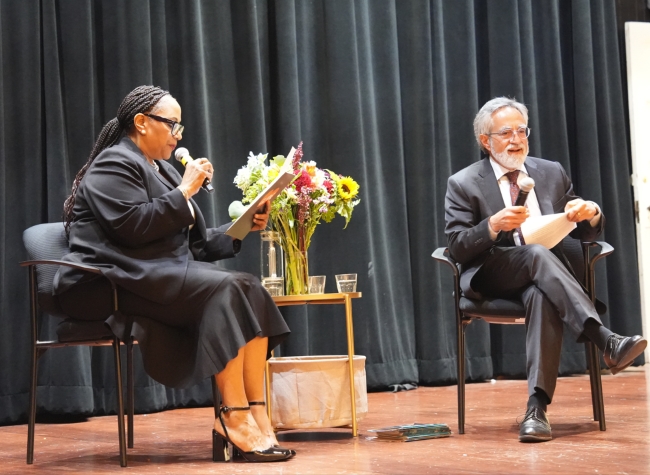
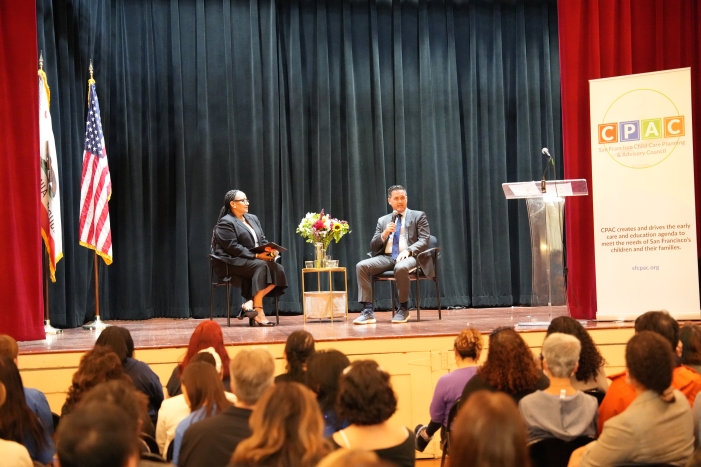
“Don’t be balancing the budget on the backs of our babies,” Dr. Gina Fromer proclaimed as she warmed up the audience ahead of a Mayoral debate focused on Childcare in San Francisco.
During Dr. Fromer’s opening remarks, organizers from the San Francisco Child Care Planning and Advisory Council (CPAC) scrambled to add more rows of chairs as attendees streamed into the room – an impressive feat given the debate occurred at the exact time as the first Presidential Debate between Vice President Kamala Harris and former President Donald Trump.
Dr. Fromer, a seasoned leader on the issue of families, children, and early childhood education, repeated a mantra of the childcare community, “Every child deserves quality, affordable, and accessible early care and education system services.”
Dr. Fromer knows the importance of this from personal experience. As a young mom of three boys, Dr. Fromer turned to the GLIDE Foundation for support at a critical time to help her make ends meet.
Now, several decades later, she is the President & CEO of GLIDE, leading the organization to expand and fortify services for low-income families and children in San Francisco.
Over the course of the event, Dr. Fromer interviewed four of the five Mayoral candidates competing in the election this November 5, 2024. Mark Farrell, the fifth major candidate for Mayor, had a scheduling conflict during this time. She asked each candidate the same questions:
Why are you running for Mayor?
What is your vision for supporting children between the ages of 0-5 and their families?
What can the City do to incentivize more families to stay in San Francisco?
How do you plan to work with the Department of Early Childhood (DEC) on their strategic plan?
How can we recruit and retain early childhood educators in one of the least affordable cities in the country?
Will you commit to using Baby Prop C funds to create a universal childcare system that pays the workforce a living wage?
How do you feel your own childhood is reflected in your view of childcare in San Francisco?
Candidates expressed the importance of creating and maintaining an environment in which all families not only survive, but thrive in San Francisco. Three of the four candidates grew up in San Francisco. The fourth candidate, Board President Aaron Peskin, grew up in Berkeley. Each candidate focused on two key themes: the affordable housing crisis in the Bay Area and the concentration of children in the Tenderloin.
A 2018 ballot measure, known as Baby Prop C, passed a tax on commercial real estate designed with the goal of creating the country’s first city-run universal child care program. Every candidate except Mayor Breed made a steadfast commitment to use Baby Prop C for its intended purpose.
The audience included many immigrant women and women of color, the dominant demographic of early childhood educators. While each candidate espoused their view of how they would strengthen San Francisco’s early childhood education system, they acknowledged the best ideas come from the educators themselves. Over the next 8 weeks, residents of San Francisco will put that expertise to use as they select the next Mayor to lead our city.
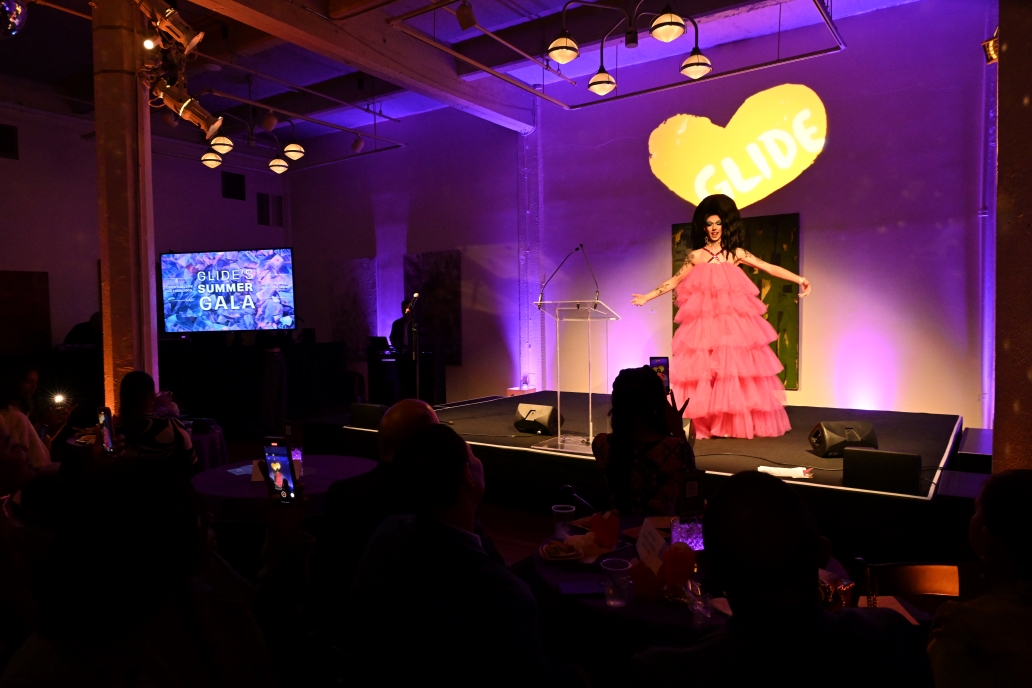
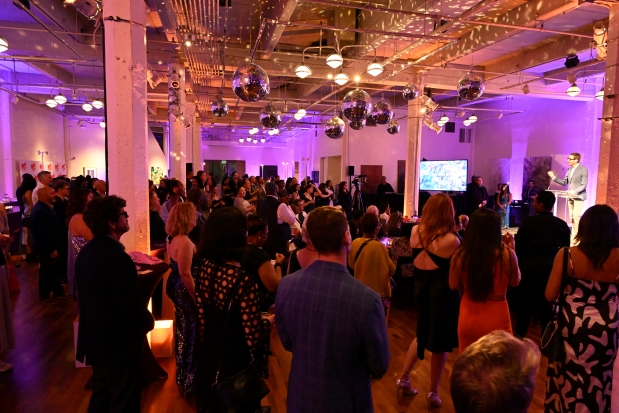
“GLIDE is on a mission of spreading unconditional love in this great city. It’s about making the lives better for all San Franciscans in the T.L. and outside,” said our President & CEO, Dr. Gina Fromer, welcoming the crowd.
Our Young Professionals Committee, organizes this gala every year, as a way of inspiring the next generation of Bay Area change-makers to engage in the life-saving work of GLIDE. (Are you a young professional who would like to support GLIDE’s work? Email youngprofessionals@glide.org to join the quest for justice and unconditional love).
Poet Ramona Laughing Brook Webb received the Janice Mirikitani Legacy Award and spoke movingly about how GLIDE’s support of her work inspires her through tough times. Flor Martinez, founder of a nonprofit that focuses on the human rights of immigrants, received the Cecil Williams Legacy Award.
“It means so much that you see me,” said Flor, before urgently requesting that GLIDE support bills moving through Congress that would give more immigrants a path to citizenship.
Senator Scott Weiner also addressed the crowd, provoking cheers with the line, “GLIDE’s values are San Francisco’s values are American values!”
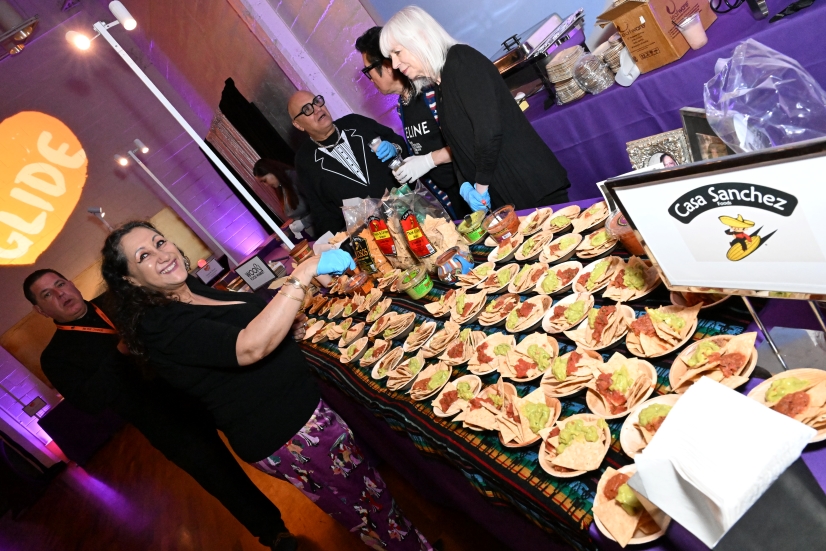
At the conclusion of the program, the dance floor opened, enlivened by some professional dancers wearing costumes bedazzled with iridescent lights. Folks danced the night away accompanied by DJ King Most’s music, and enjoyed a variety of party entertainments: from tarot cards to a photo booth to bites of GLIDE’s famous fried chicken.
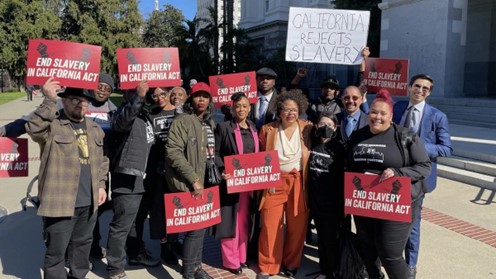
GLIDE is a proud supporter of Proposition 6, the End Slavery in California Act. California’s current constitutionactually allows slavery and involuntary servitude when it is a punishment for a crime.Proposition 6 would prohibit slavery and involuntary servitude in any form.
In 2022, voters in Alabama, Tennessee, Oregon, and Vermont voted to remove slavery and involuntary servitude from their states’ constitutions. In November,Californian voterscan weigh in on this historic ballot measure, taking a stand to remove language in our constitutionthat is a threat to human dignity and justice for all.
If you would like to phone bank for Prop 6, please sign up here.
Proposition 6 would prohibit the California Department of Corrections and Rehabilitation from disciplining any incarcerated person for declining a work assignment. Proposition 6 would still allow the Department of Corrections and Rehabilitation to award credits to an incarcerated person who voluntarily accepts a work assignment.
It would not guarantee minimum wage, but it may assist separate efforts to get prisoners fairer wages.
As it is now, incarcerated people do not have basic workers’ rights or protections, yet they face severe penalties for just declining to work. As of 2021, California’s prisons held about 64,7888 incarcerated workers who make less than $1 per hour.
Declining to accept or perform a work or training assignment can lead to reduced privileges, including limitations on visits, phone calls, canteen purchases, yard time, entertainment and recreation access. One ofthe most impactful punishments to an incarcerated person is delayed or denied parole.
Nationally, the United States government profits from allowing slavery by forcing incarcerated workers to generate more than $2 billion dollars each year in products and services. In California, government entities and private companies generate and save at least hundreds of millions of dollars each year from incarcerated people’s labor.
For example, incarcerated workers make up about 30% of California’s firefighters, but even after some were released from prison, they were barred or faced significant barriers to serve as firefighters. Unfortunately, when they leave prison, incarcerated workers face challenges securing similar jobs to those they held while incarcerated, which affects their ability to reenter society and stabilize their lives.
To qualify for the ballot and become Proposition 6, a piece of legislation had to pass successfully through the California Legislature. GLIDE co-sponsored the previous bill (ACA 3) in 2022 and the latest bill (ACA 8) starting in 2023, which ultimately passed with bipartisan support on June 27, 2024. Now, GLIDE proudly stands with our community as a vigorous supporter of Proposition 6.
At GLIDE, we support the purpose and intention of Proposition 6, which allows our clients and community members who are incarcerated to have a choice in their work assignment.
Proposition 6 would give incarcerated people more flexibility to engage in rehabilitative programs like education, emotional intelligence courses, mental health and substance use treatment, which can reduce recidivism; they would no longer be punished for choosing those activities over a work assignment.
Join us in supporting Proposition 6 through your vote and your time; lend your voice to our community members who are incarcerated in their fight for human dignity, morality, and justice.
If you would like to phone bank for Prop 6, please sign up here.
When I think of how He brought me through and how, how the Lord changed my life; my soul, my soul is overwhelmed. I’ve got joy, joy, joy, unspeakable joy.
-Unspeakable Joy lyrics by Douglas Miller
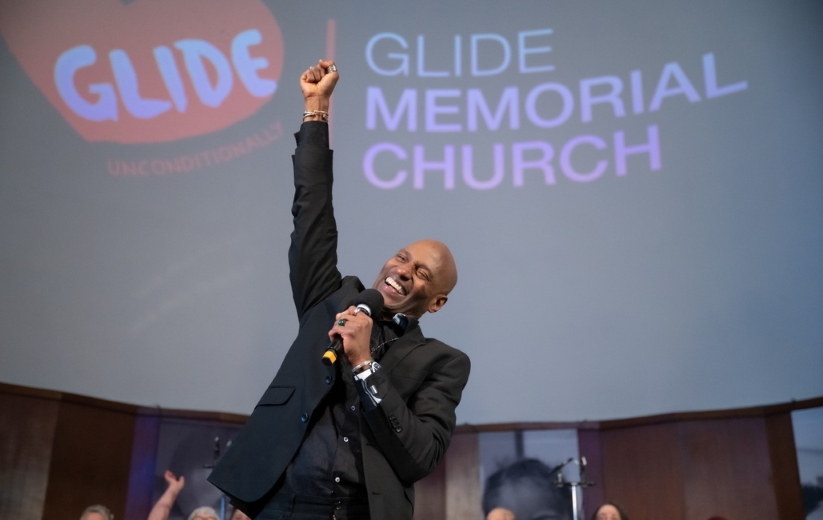
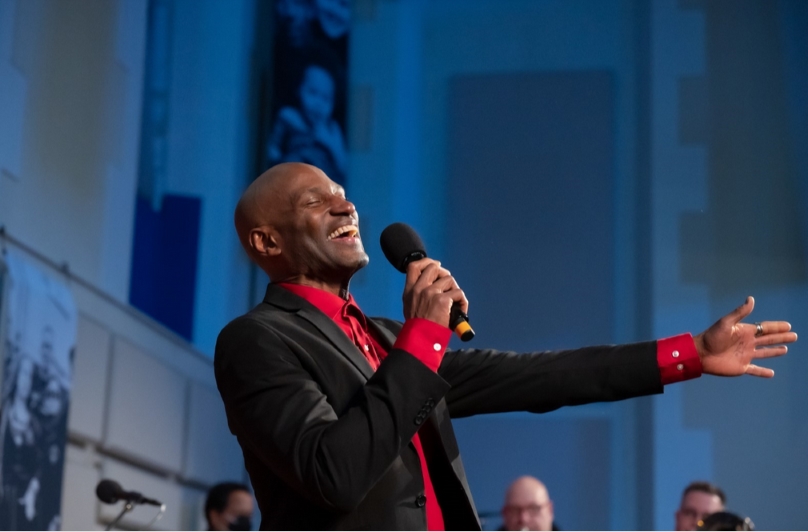
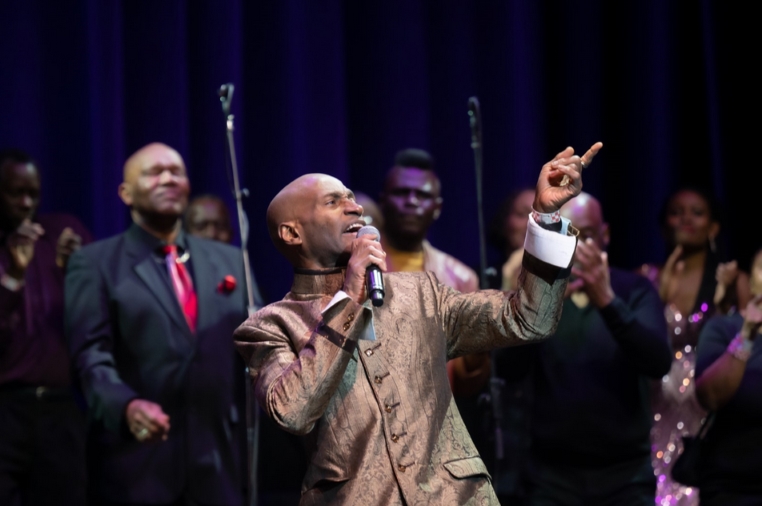
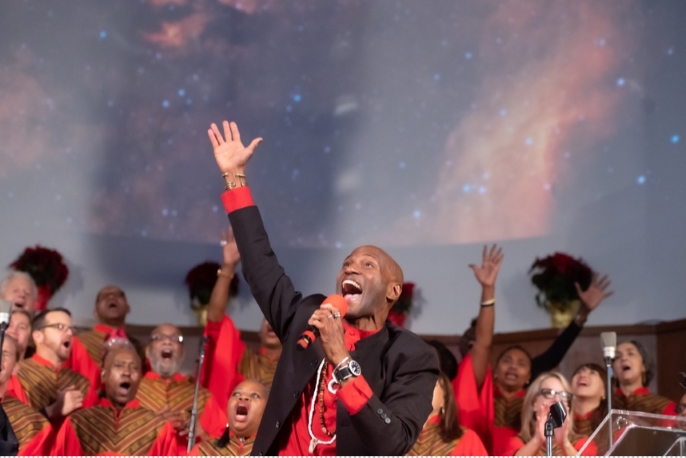
For eight years GLIDE’s Music Director, Vernon Bush, has embodied unspeakable joy. His infectious smile, open heart and his dedication to Beloved Community has made him a vibrant part of GLIDE.
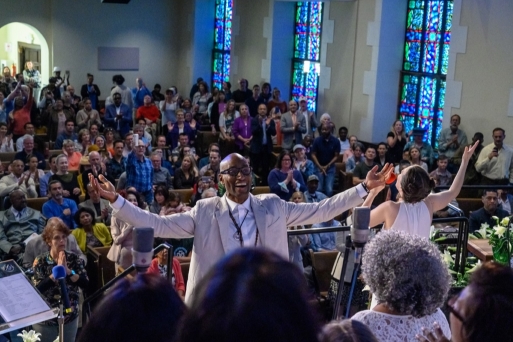
Sunday, August 4th, Glide Memorial Church encircled Vernon Bush’s and blessed his final Sunday at GLIDE. Those gathered shouted “yes he did” as Minister Marvin K. White read Vernon’s accolades before the congregation.
“Vernon my brother, my friend, my compatriot,” Minister Marvin declared, “for all the ways you have led us in spirit and for all the unspeakable joy you have brought into our lives, we give thanks for your ministry, for your movement and for your life.”
Dr. Gina Fromer, GLIDE’s President and CEO, began her tribute to Vernon with a song. “I’m going to miss that smile!” Dr. Gina declared, “On behalf of the board of trustees, the GLIDE board, the staff, we want to say that we love you and we are going to miss you.”
Other members of the GLIDE community also shared their memories and well wishes for Vernon, including former members of GLIDE’s teen choir, who surprised Vernon with a visit. The GLIDE Ensemble said goodbye by singing the songs that Vernon led. To maximize the songs performed on his final Sunday, the Ensemble sang different songs at the 9 and 11 am Celebrations, including: Unspeakable Joy, Standing in the Need of Prayer, Bless Me and Glory.
In addition to providing the soundtrack for Glide Memorial Church’s Sunday Celebrations, the volunteer Ensemble also performs at events throughout San Francisco. One of Vernon’s most iconic performances with the Ensemble took place at the 2009 Celebration for Cecil’s 45th Year at GLIDE. Two days later, Vernon joined the GLIDE Ensemble on the Conan O’Brian Show. The Ensemble also recently performed at the Celebration of Life for Willie Mays.
From its humble beginnings on Christmas Day, 1966, when it was only 10 singers and jazz legend John Handy, the Glide Ensemble grew to include more than 100 voices and eight musicians.
Beginning with the first choir director, Faith Winthrop, the Glide Ensemble has benefitted from the direction of such talented leaders as Donnell Hickman, Ronald Sutherland, John F. Turk, Jr., Clifford Coulter, and Vernon Bush, and has teamed up with a host of notable musicians such as Sammy Davis Jr., Leonard Bernstein, Marvin Gaye, Bono, and Maya Angelou.
During Vernon’s tenure at GLIDE, the ensemble performed with Joan Baez, Michael Franti, Bobby McFerrin, Martin Luther McCoy and many other celebrities. Under his leadership, the Ensemble has provided the soundtrack from some of San Francisco’s most iconic events, including Juneteenth Celebrations at City Hall. Vernon also helped GLIDE navigate through tragedy and grief, during the COVID epidemic and the recent death of the Rev. Cecil Williams.
Performing at fundraisers, programs and community events, Vernon’s effervescent energy touched every part of GLIDE’s work. Participants of the Center For Social Justice’s Alabama Pilgrimages often celebrate Vernon’s compassionate witness and musical support.
Vernon departs GLIDE to pursue his personal musical goals. On Sunday he sang from his forthcoming album that celebrates his mother.
“The joy that I have tried to live out, and be as an example,” remarked Vernon, “I really want you all to carry on.” Thank you, Vernon, for all the ways that you have touched the lives of GLIDE staff, participants and church members. We send you off with joy, joy, joy, unspeakable joy.
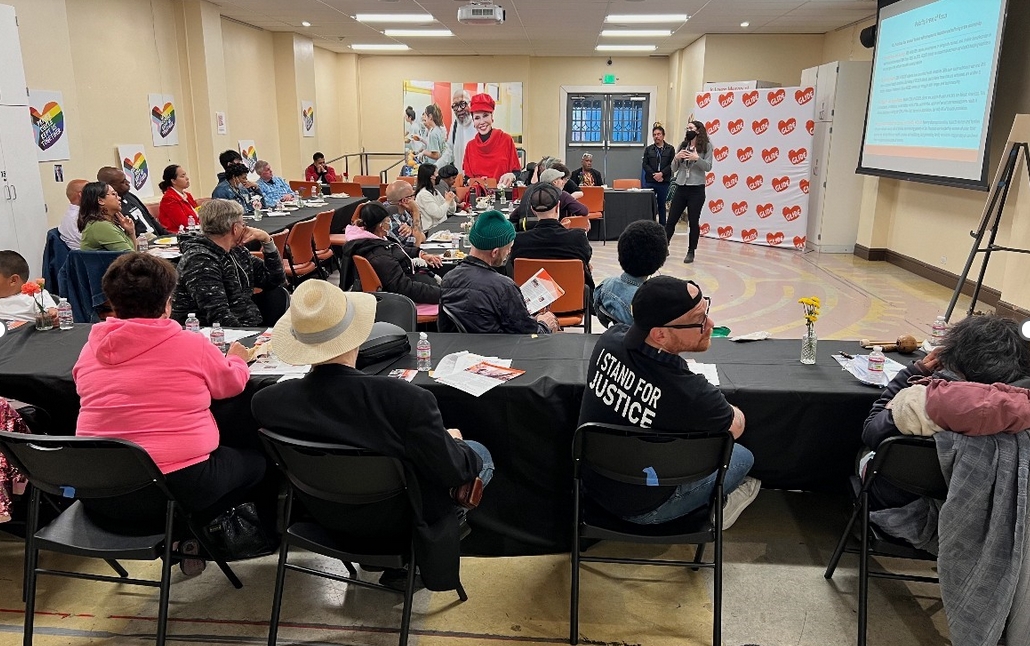
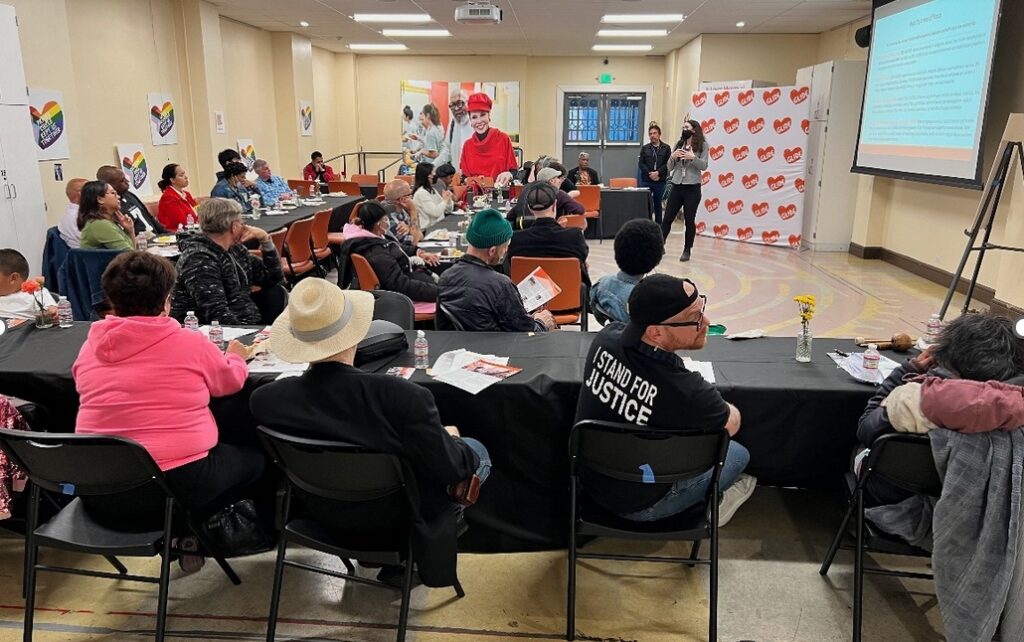
There’s more to serving the people of the Tenderloin than providing free meals: GLIDE fights every day against the interlocking systems that cause our people suffering. On the evening of August 1st, we threw a Social Justice Mixer to bring our advocacy community together and to unveil our plans for building power together.
At the mixer, we urged people to sign up or renew their engagement with the Justice Warriors volunteer program. Of the 101 people who registered for our event, 13 were joining the volunteer program for the very first time. Currently we have more than 300 Justice Warrior volunteers in our program. They support GLIDE’s policy agenda with whatever level of direct action feels most comfortable to them: attending marches, making phone calls, writing letters, leaving public comments, or raising awareness.
If we grow our program to 1,000 Justice Warriors, we will truly be a force to be reckoned with! Are you ready to join us? Sign up here to specify what kind of support you can offer and what issues interest you most. Justice Warriors fight for racial reconciliation and repair, safety for homeless people, safe paths out of substance use, and an end to poverty, among other things.
At the mixer, Center for Social Justice staff also presented plans for a new Justice Warriors Council. This council will lead in planning campaigns, organizing advocacy with the Justice Warriors, and throwing other mixers in the future.
Social Justice Academy graduates, as well as anyone who has been signed up for our Justice Warriors program for over a year, are all eligible to apply. Please contact Erick at earguello@glide.org to receive an application.
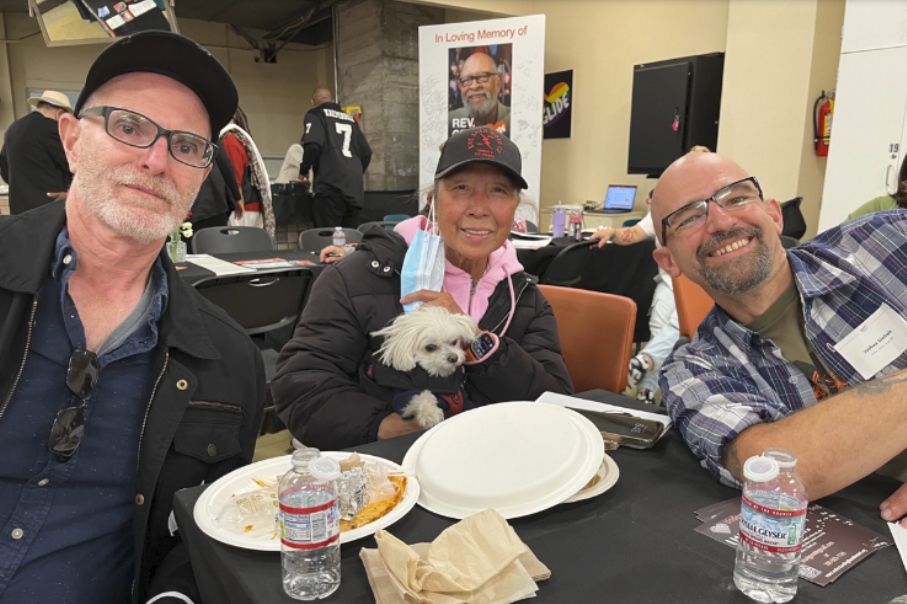
(From L to R: Justice Warriors Steve Dalton, Mike Ilaw, and Joshua Siebalt)
“I’ve been coming to GLIDE for years,” said Tenderloin resident Steve Dalton. “I did not know about the Center for Social Justice Warriors program. There is so much I care about in this neighborhood, particularly as it concerns senior citizens. I care about homelessness and other inequities in the TL too.
Perhaps you, like Steve, have been connected to GLIDE for a long time without knowing about our Justice Warriors program. Now is the time to sign up!
We love how our community is full of ideas and energy for improving the Tenderloin.
“Something that comes to mind after listening to this great session about Justice Warriors is maybe GLIDE could create something akin to a ‘GLIDE Village’ for seniors,” said Miki Ilaw.
And Joshua Siebalt added, “I have a podcast. I interview unhoused people to try and increase empathy and awareness… Especially after the recent Supreme Court decision, we need to do better at increasing empathy for the homeless.”
We’re grateful for how many of our community members have been pursuing advocacy efforts of their own all these years. We plan to continue holding these social justice mixers quarterly to swap stories and join forces. We hope to see you at the next one!
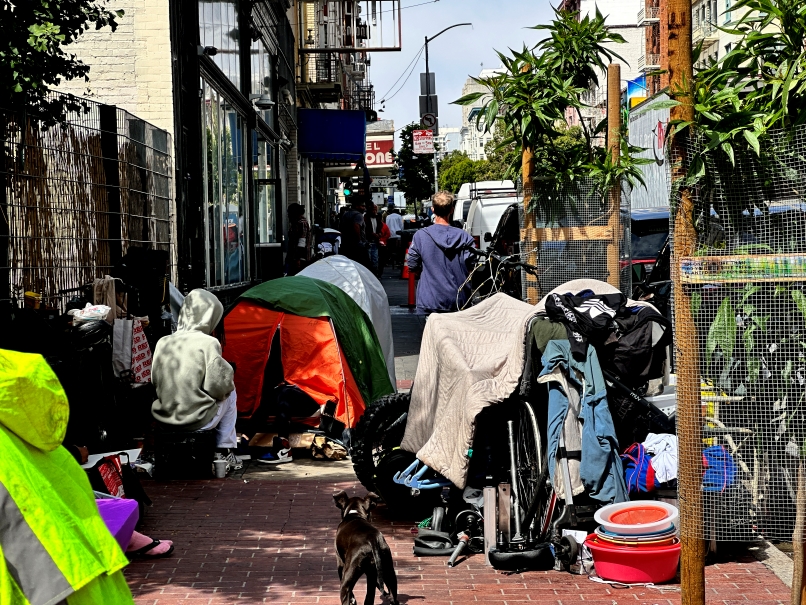
I can’t stay silent about the encampment sweeps currently taking place across California. Every step we take to criminalize poverty and homelessness takes us farther away from the empathy and compassion we actually need to resolve the homelessness crisis. Homelessness is not a crime. So-called “clean-ups,” aren’t solutions.
The solution is finding people housing: or better yet, preventing them from losing their housing in the first place! If you agree, please join GLIDE’s Center for Social Justice in sending this letter to lawmakers.
At GLIDE we care about lasting solutions; over the past three years, GLIDE’s rental assistance program has helped more than 1100 people and prevented more than 500 evictions. That’s why, when ABC 7 news interviewed me, I urged lawmakers to prevent homelessness with housing subsidies and rental assistance.
And when KQED interviewed me, I explained how we can help unhoused people who’ve got health and recovery challenges. When they turn their lives around, they can get off the street permanently.
I can’t tell you how often I see families and children waiting to eat meals at GLIDE. In California, over 4% of children in schools are homeless. Do you think it’s going to help those children if their parents are criminalized for sleeping on the streets? If their possessions are swept up into plastic bags that might or might not be retrievable? We know that people have lost ID cards, medications, and job applications in the chaos of encampment sweeps, which is the last thing any homeless person needs.
I expressed to KTVU that we see the pain that people are going through when their encampments are moved. They have to lose their connections to organizations and resources.
Public health experts estimate that sweeps could lead to a 25% rise in deaths among unhoused people over the course of the next ten years. Even when the sweeps don’t result directly in arrests, they are shown to increase racial, gender, and health inequities.
City shelters only have capacity for less than half our unhoused residents. Besides lack of space, there are other valid reasons why unhoused people sometimes find shelters undesirable. It could be lack of storage space for possessions, safety concerns, or a no-pets policy: all of those reasons make sense when you use a lens of compassion, rather than one of judgment.
Why are we acting like moving tents from one neighborhood to another will solve homelessness? At GLIDE, we know what helps people break the poverty trap: that’s trusting relationships built over time with service providers, and options to be permanently housed that won’t separate them from families, partners, and pets.
Every time we sweep up an encampment, homeless people become more suspicious of authorities, making it harder to connect them to services.
Our newly launched Community Ambassadors program is targeted at the root causes of poverty, not simply sweeping poor people out of sight. The ambassadors will patrol a ten-block radius around GLIDE in the Tenderloin, providing low-threshold case management, connecting people to services and support groups, and cleaning up graffiti and trash.
We work closely with the Mayor’s Office on holistic solutions to homelessness, because we’re determined to solve the underlying problems. We’re about creating lasting change in the Tenderloin and San Francisco. We’re about compassion.
Unhoused people need support and resources to break the poverty trap. GLIDE’s Center for Social Justice has helped secure more than $20 million in state funding for housing subsidies, shelters, and mental health support through coalition work.
Let’s focus our City resources on increased access to shelter, rental subsidies, affordable housing, behavioral health services, and workforce development programs. Arresting the homeless is a step backwards, into the past.