A personal journey through collective history, toward a racial justice practice

by Chris Dowd  

Immediately after I returned from this year’s GLIDE-led justice pilgrimage to Alabama, social distancing was in full effect. Suddenly, despite the powerful memories I carried, my period of guided reflection about race in America felt overshadowed by our global health emergency. Soon, the data around testing, infection rates, and deaths came to highlight the inequity of service and care. Then, the whole world witnessed Amy Cooper leverage her power against a Black man bird watching in Central Park. Days later came the murders of Breonna Taylor and George Floyd—at the hands of those entrusted to protect and serve. I started to feel a greater urgency to share the lessons from my experience in Alabama.

I believe we are more than the stories we tell ourselves. One of the stories I tell myself is that I grew up in San Francisco, white, the youngest of three siblings and the son of two highly educated parents. I was afforded the privileges of private education and strong role models in my community. This is part of my story, just as most of what we know of our friends and colleagues is only part of their story. It takes time and a shared context to see a more complete story. This is true not only at the individual level, with friends and family, but also at the level of our collective consciousness and history as a country. GLIDE Church has always been a place for this in San Francisco and the Tenderloin, at critical moments in modern history, to reflect and to question.

I grew up in San Francisco, but left for high school, college, and my first job. Returning in 2017, I was immediately drawn to GLIDE by the gravity of its courageous history, and its purpose: unconditional love. It quickly became the center of gravity for my new chapter in my old city.

I started volunteering on the Harm Reduction team, handing out clean needle kits and leading Narcan trainings for the treatment of narcotic overdoses. This experience on the front lines of San Francisco’s fight against the opioid crisis could not have been more different from my day job just a few blocks away at Google. I quickly saw the disconnect: that almost no one in my professional network had an understanding or connection to this life-changing work.

To bridge these communities,  I joined the Legacy Committee, GLIDE’s young professionals group, which works to engage young leaders from San Francisco’s evolving workforce and youth culture in GLIDE’s mission. In doing so, the Legacy Committee supports their learning around the nuances of systems that govern our streets as well as GLIDE’s historic role at the center of San Francisco’s progressive movements.

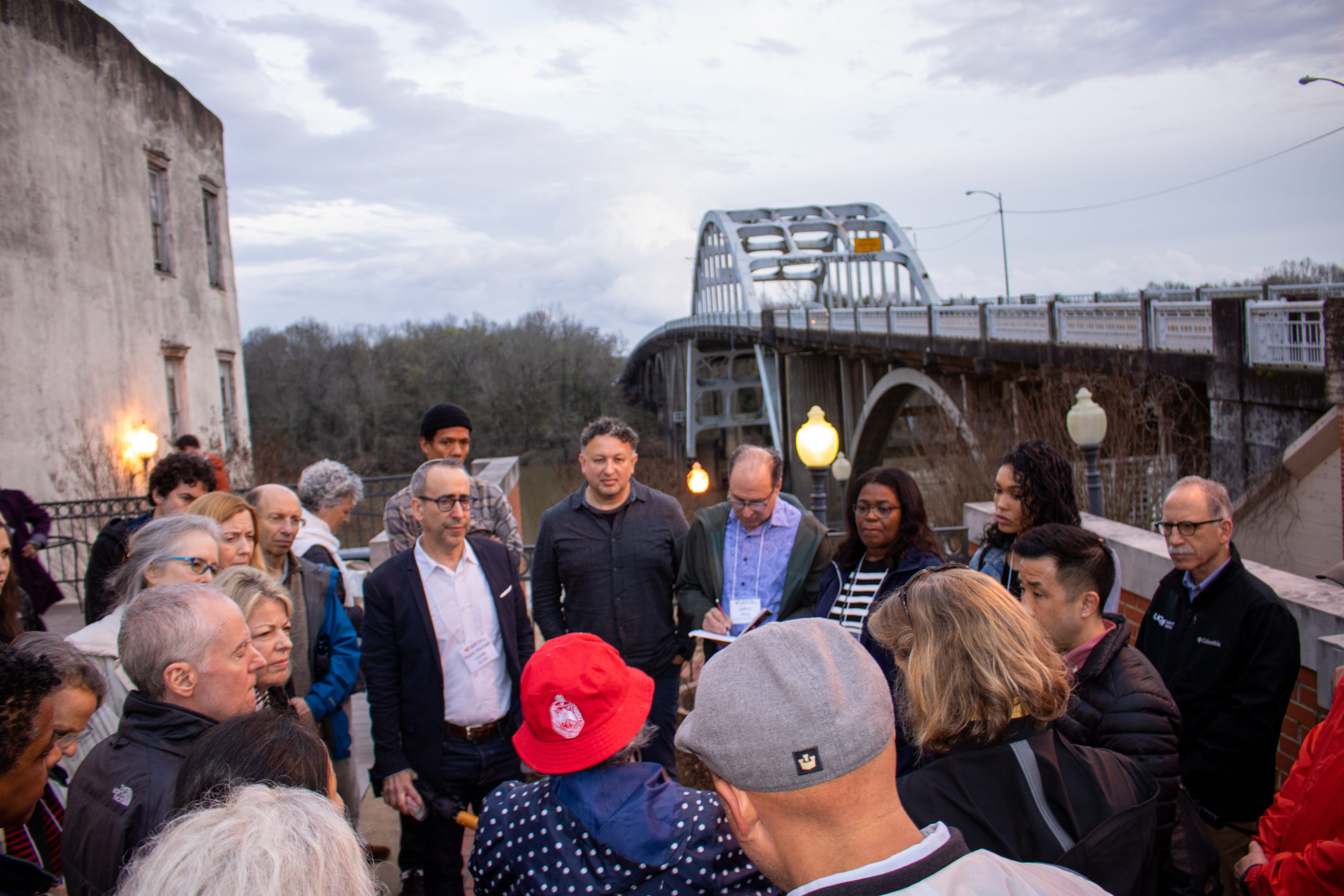
As the 2020 Co-Chair of the Legacy Committee, I was invited to join Rabbi Michael Lezak and Isoke Femi, of GLIDE’s Center for Social Justice, on GLIDE’s annual Social Justice Pilgrimage to Montgomery, Alabama. Over 100 intergenerational leaders from GLIDE, SFPD, UCSF, The Kitchen, and local government participated.

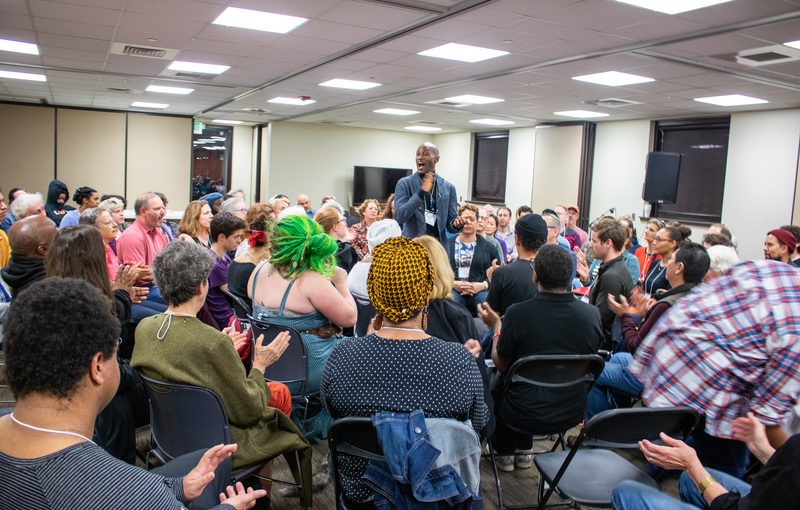
Musical director Vernon Bush at Alabama
Musical director Vernon Bush leads Alabama group in song in meeting room of Dexter Baptist Church.

Nearly two months before leaving for Alabama, our group met in Freedom Hall on Thursday nights, below the GLIDE Sanctuary. The physical space is characterized by white linoleum floors, stacks of foldable chairs, and the regular sound of overhead MUNI bus wires sparking as the buses climb up Nob Hill. For me, Freedom Hall is also a divine space of unlearning. In 2018, for example, it hosted a full-scale mock-up of an overdose prevention / safe consumption site, a temporary construction made to display the public health benefits of this proven health intervention, still largely unknown in the U.S., to regulators, community leaders, and journalists. This space was our classroom, where we would start the process of reconciling the incomplete individual and collective stories about race in America that many of us have learned, and continue to internalize within our families and communities.

Our practice and study were multisensory. Before every meeting, we were led in song by Vernon Bush, the musical director of the GLIDE Ensemble. Our reading list was robust. I was taken by the words of Ta-Nehisi Coates on reparations, then by Michelle Alexander’s account of the state of criminal injustice, and later by a 60 Minutes interview from the 1980s with Bryan Stevenson describing the work that became the Equal Justice Initiative. I will never forget the feeling of taking deep breaths before multiple pages of Anthony Ray Hinton’s story, a man wrongly kept on death row for three decades, whom we would later meet on our trip to Alabama. These works were offered as the minimum expectation for participation in our group dialogue. Everyone did their homework.

Language is the cornerstone of any shared history. At the start of each meeting, Rabbi Lezak introduced Hebrew phrases: Kavvanah, meaning intentionality or direction of the heart; Chag, a place you must visit in order to understand a history; Kriah, the experience of tearing your garment after someone dies in an effort to mend in grief. He was teaching us the ways in which Hebrew has evolved to more accurately express the trauma and triumph that is core to their history. I came to recognize, and be motivated by the vacancies in my own language as I tried to understand these unfamiliar feelings and experiences.

Just before we left for Alabama, I met with Minister Marvin K. White, GLIDE’s fearless faith leader, to see if he had any advice on preparing for the journey. We spoke about the importance of active listening, and the reality that, so often, our public discourse does not allow for spirituality or religion to take center stage. He encouraged me to listen deeply, have side conversations, and let the walls talk.

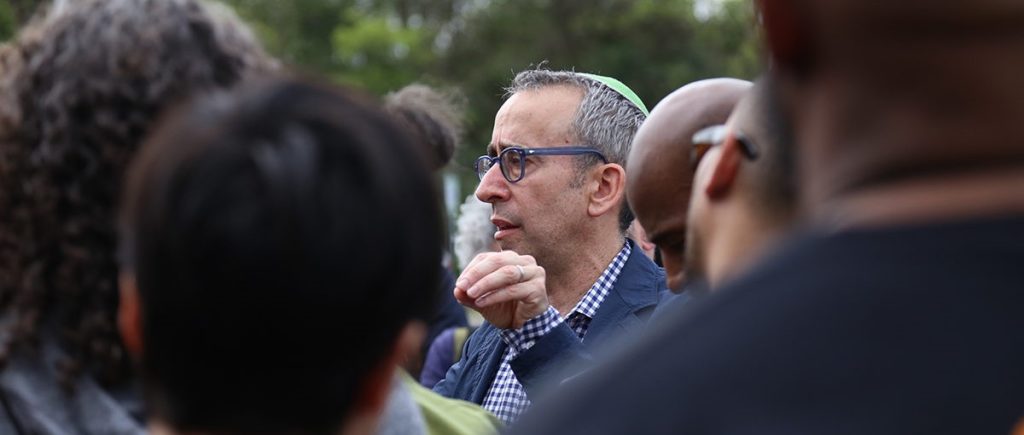
rabbi michael alabama
On the ground in Montgomery, Alabama with Rabbi Michael.

 A few days later, I was on a Greyhound from Birmingham to Montgomery passing Waffle Houses and billboard psalms. I read through past notes from our gatherings in Freedom Hall, reaching to synthesize and remember what exactly my purpose was, my why, for joining this trip. I scribbled down some scattered thoughts about bearing witness, being an ally, and having a more complete vision of my country’s past, knowing full well that nothing written on that page would equip me for, shield me from, or even enable me to name what I was going to experience in the coming days. I was ashamed at my eagerness to intellectualize and jump ahead to imagine how this experience might “fit” into my life, recognizing, even at the time, the privilege that enables such an instinct. So, I drew myself against the window and tried to just be present, as I would try to do countless times in the coming days.

Just before sundown I stepped off the Greyhound onto Maxwell Boulevard, one of the first streets along the Alabama River. That evening, we gathered in the hotel lobby occupying our in-between time with light banter about the slower pace of life best captured through the 90-second timer at a nearby crosswalk. 

That night, we walked to the basement of the Dexter Baptist Church, which would come to be our local Freedom Hall, the place where a young 25-year-old Martin Luther King, Jr. got his start as a minister, and where the organizers of the Montgomery Bus Boycott would hold late night gatherings. Just across the street is the Southern Poverty Law Center, demonstrating the power of proximity, and the rich history of collaboration between judicial activists and spiritual leaders.

Montgomery is the birthplace of modern civil rights activism in America, so casual encounters with residents led to powerful stories and important context. Through a side conversation with a tour guide from a local nonprofit, our group was able to meet the guide’s father, Chap. Chap was born and raised in Alabama in the 1950s, before migrating to New York City as a result of Alabama State University’s segregation policies.

Chap remembers how then-Governor George Wallace stood on the steps of the state university pronouncing his favorite catch phrase, “segregation today, segregation tomorrow, segregation forever.” Around that same time, the murder of the four girls at Birmingham’s 16th Street Baptist Church turned Chap’s frustration into rage, motivating his decision to head north.  

History books often describe George Wallace as a young man desperate for power. He began his career as a progressive judge until it proved politically stale, at which point he turned to channeling fear and white supremacy, later becoming a seminal character in our historical through-line from slavery to the modern era. You can imagine the complexity Chap faced when, decades later, George Wallace offered him a job, appointing him to lead ministerial services for inmates on death row. Chap would accept, returning to Alabama to deliver last rites for over two decades.

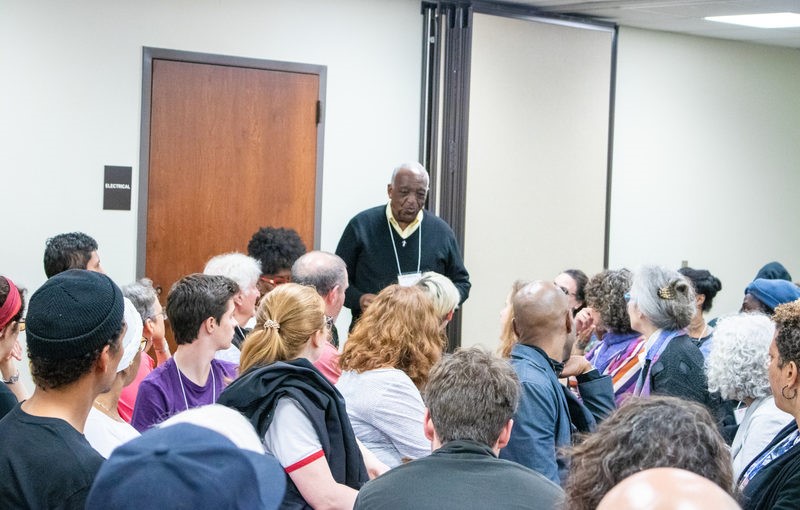
Now, in his early 80s, Chap addressed our group, in the basement of Dexter Baptist Church, with a simple message: It is more difficult to forgive than it is to hate. I could not begin to imagine what it takes for a man like Chap, who has seen true evil, to arrive at that lesson. The next day would continue to expose more challenging truths.

Chap addresses the group in the meeting room at Dexter Baptist Church

The Equal Justice Initiative (EJI) and its Legacy Museum are housed in repurposed slave barracks. Just 200 yards east is where the slave market once was, and 50 yards west lies the train station, its tracks laid by slaves for their inevitable transit and sale throughout the American South. I wrote in my journal that morning about the elusive fact that our public spaces reflect and contain our history, values, and collective memory. It reminded me of the violence in Charlottesville in 2016, following attempts to remove confederate statues and iconography associated with the same painful and oppressive history. The statue of Robert E. Lee in Charlottesville sparked a series of events that allowed the world, for a moment, to peek behind the curtain at a painful American history and culture. In the case of EJI, they chose to reclaim spaces that you might walk by a thousand times before considering their original use, and to build new monuments there.

In Montgomery, a city whose very cobblestones and roundabouts evoke similar traumas, there is no single monument you can point to, no one thing you can get rid of—everything about the city breathes its past. Just as the history of slavery cannot be removed from the fabric of Montgomery, it also has not vanished from our institutions. EJI and its powerful Legacy Museum exist to bring about a more complete American narrative, one that makes clear that slavery, far from ending in 1865, has only evolved. There is a clear chronology through American history from slavery to mass incarceration and the type of policing that grips and terrorizes Black communities across this country. EJI is trying to help America heal and move forward by addressing old, suppressed truths.

For example, Bryan Stevenson and EJI make it possible for stories and voices like Anthony Ray Hinton’s to reach a national audience. Anthony Ray Hinton was wrongly convicted and sentenced to death row in 1985. A simple ballistics review would have swiftly undermined the decades-old verdict, but the state DA rejected his appeal in the early 2000s, condemning him to another 15 years before Bryan Stevenson and EJI took on his case. Finally freed from death row, Hinton expressed his tremendous resilience in the face of such persecution in these words, “They took my thirties, they took my forties, they took my fifties, but they can’t take my joy.”

Yet, it was impossible to hear his story and not feel rage towards the extrajudicial measures that robbed Anthony Ray Hinton of his freedom. To date, he has never received an apology from the state for the wrongful conviction. As he saw it, this was no mistake. “No one with power will ever apologize to someone with no power,” he told us.

At the end of our first night in Montgomery, Nathaniel Woods, a young Black man who sat on death row for over 15 years, was killed in an electric chair just a few hours’ drive from us. I feel disoriented and horrified when I think about the thousands of wrongly accused men and women of color who are unjustly pulled from their communities in silence, whose suffering is too diffuse and systemic to warrant a thumbnail on your mobile feed. I am certain I would not have heard of Nathaniel Woods had I not been in Montgomery at that time, and that is part of EJI’s mission, to raise awareness around these less-publicized acts of injustice.

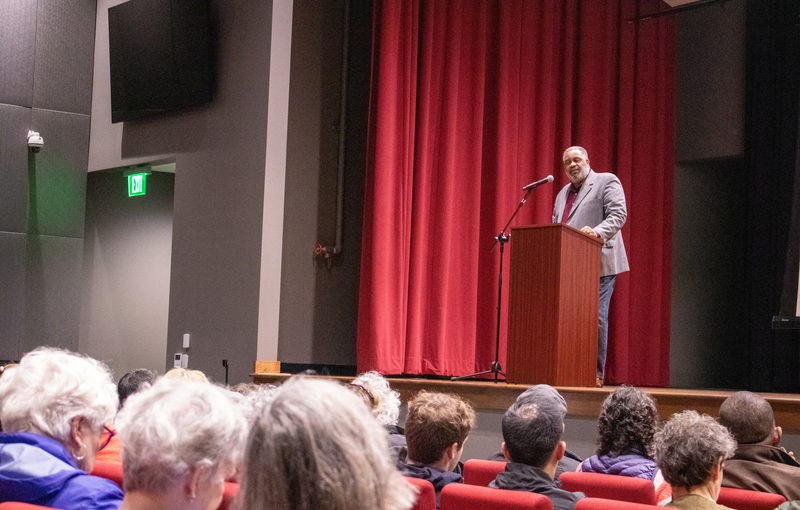
anthony ray hinton alabamba
Anthony Ray Hinton addresses the group at the Equal Justice Initiative in Montgomery, Alabama.

I was in a constant state of unlearning. Walking to our next group gathering, I stumbled on a painted iron plaque memorializing the Montgomery Bus Boycott. I knew about Rosa Parks, but not much else. I was surprised to learn that Claudette Colvin, a 15-year-old girl, was actually the first to sit in the whites-only section of the bus. The violent response from police and city officials inspired Rosa Parks, Martin Luther King, Jr., and others to create a plan to advance their cause. Mobilizing an alternative transit system sponsored by a Black-owned funeral service fleet for rural communities, and understanding that their movement could drain and strain the city’s budget largely by slashing bus fare revenues, the bus boycott forced the city’s hand: its pocket book or segregation.

The most powerful tool in the EJI-led movement is the Legacy Museum, which takes visitors from slavery to our modern-day criminal justice system and policing. No one forgets what it’s like to walk into the Legacy Museum for the first time. On the left hand of the ticket booth is a large map of the city of Montgomery in the 1860s. Just as the domestic slave trade was exploding, this sleepy Alabama town was becoming its headquarters. The map highlighted the businesses, transportation hubs, and organizations that propped up this economy. At the center was the slave market, efficient and inhumane to its core. As my finger tracked across the map, I recognized a name: Lehman Brothers—a bank which up until the 2008 financial crisis represented the pinnacle of America’s financial sector, “the smartest guys on The Street.”

I suspect their origins as the banker and lender for a growing slave industry in America were rarely mentioned at their first-year analyst orientation. And if they were still around today, I suspect that would still be the case. I mention this not exclusively to shame Lehman Brothers, or any other organization which may have had their origins in circumstances that we would rightly find morally abhorrent, but instead to recognize that it is the responsibility of citizens to ask the question, and then to ask the follow-up question, to try to understand the truth behind our institutions. Because there is no reason to suppose that injustice doesn’t still have offices on Main Street.

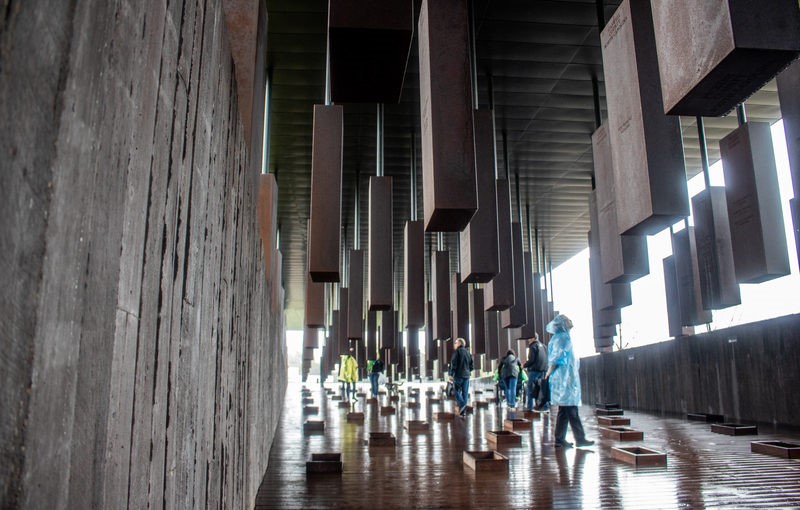
alabama
Inside the Equal Justice Initiative's National Memorial for Peace and Justice in Montgomery.

I share these stories because they represent small moments in my personal journey of understanding, and in my development of a Justice Practice that I can rely on. Travel, reading, and difficult conversations are useful ingredients in understanding a more complete American story and informing sustainable, direct, and indirect action. I believe my personal decisions and journey have an impact on my friends and family, and will meaningfully contribute to the collective growth and transformation that our children will come to expect and rightfully demand of us.

Inscribed on the side of the Legacy Museum is a quote by Maya Angelou: “History, despite its wrenching pain, cannot be unlived, but if faced with courage, need not be lived again.” There has never a better time  than  right now to dedicate ourselves to learning, practice and action.

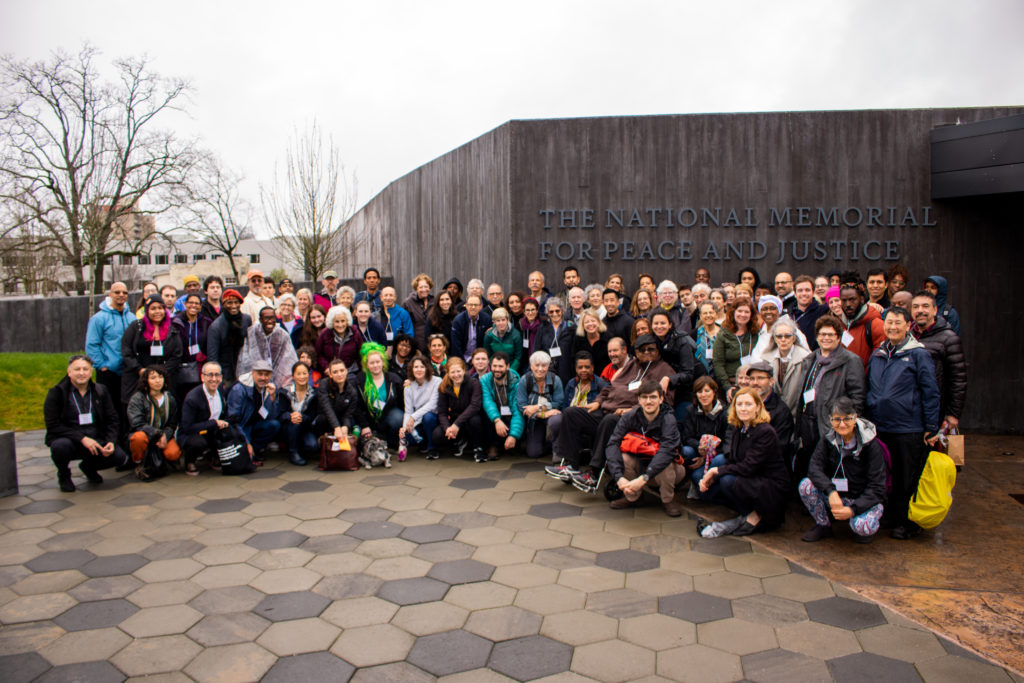
Outside the National Memorial for Peace and Justice.

If you are a Bay Area–based young professional interested in learning more about the GLIDE Legacy Committee, please feel free to reach out to youngprofessionals@glide.org or go to our website. I would also encourage you to learn more about the mission and programs of EJI, Southern Poverty Law Center, GLIDE Ministry, and the GLIDE Center for Social Justice. Now is the time to support the experts, the local leaders and those with lived experience in the struggle against racism and injustice.

Chris Dowd is former Co-Chair of the GLIDE Legacy Committee.

Many of us know the names: Sandra Bland, Daunte Wright, Philando Castile, Walter Scott, Sam DuBose. They are just a few of the hundreds of Americans across the country who have been killed by police during a traffic stop. In many of these cases, police had stopped the victim using a practice called “pretext stops” — pulling someone over for a minor traffic or equipment violation and then using that stop to conduct an unrelated speculative criminal investigation, not for the purpose of enforcing the traffic code.

According to 2022 national police violence data, police in the U.S. have killed nearly 600 people in traffic stops since 2017. Despite Black people accounting for 13% of the population, Black drivers accounted for 28% of those killed in traffic stops.

While it may be tempting to read these stories from other parts of the country and think San Francisco is the exception, the truth is, we’re not. When it comes to pretext stops, our city’s police do not enforce traffic laws equally either.

According to a recently published SPUR analysis of 2019 traffic stop data, Black drivers in San Francisco were disproportionately stopped by police. The data showed that despite accounting for just 5% of the city’s population, Black drivers were stopped 19% of the time. Moreover, the analysis found that 30% of all Black drivers subjected to a traffic stop in the city were stopped for equipment reasons — like not displaying their license plate correctly, for example — compared to white drivers who were far more likely to be stopped for a moving violation. Add to this the fact that, unlike any other racial group, Black drivers are less likely to end up receiving a citation after the stop and it begs the question: Are Black people really being stopped to protect other people on the road?

None of the findings in the SPUR analysis are new. For too many people of color, the generational trauma of these statistics has made the possibility of being killed during a traffic stop expected and normalized. People of color receive “pretext stop” training from a young age. They’re told that it’s more important to get home alive than protest the stop.

No one should have to grow up this way.

Despite their facade, pretext stops do not make our streets any safer for people who bike, walk or drive. Since 2014, San Francisco has made a commitment to Focus on the Five — a campaign to focus the San Francisco Police Department on enforcing the five violations that are most frequently cited in vehicle collisions with people walking: speeding, failing to yield to pedestrians, running red lights, running stop signs and failing to yield while turning. According to the department’s November 2022 traffic violations report, the most recently available, Focus on the Five violations account for 61.5% of traffic violations issued by the department.

On Wednesday, the San Francisco Police Commission will vote on a new draft policy that would ban the police from making nine specific types of stops in an attempt to minimize the racial disparities in traffic stops. None of the nine types fall under the Focus on the Five violations.

If the policy is adopted, it will be the most comprehensive in the country to address the harms caused by pretext stops to communities of color. It will also free police officers to attend to real traffic safety issues and allow the department to use more of its resources to prioritize the Focus on the Five campaign. The proposed ban has already been endorsed by over 100 local organizations dedicated to ending the department’s practice of detaining motorists, cyclists and pedestrians for low-level, nonthreatening traffic stops.

By adopting the proposed policy, the Police Commission can send a message to Black San Franciscans that it is committed to improving the treatment of Black people in our city and is committed to ensuring their safety, too.

As all of us settle into the start of a new year, those of us in the Black church are reminded of the New Year’s Eve tradition of Watch Night — where many Black people wait for the stroke of midnight at the end of the year to commemorate the moment when the Emancipation Proclamation came into effect.

Every San Franciscan should have the right to free movement — to feel safe to move about the city without fear of being targeted and stopped by police and potentially killed. Ending pretext stops is a long overdue step in solidifying that basic right.

Marvin K. White is the minister of celebration at Glide Memorial Church. Claire Amable is the movement building manager at the San Francisco Bicycle Coalition.

This editorial was originally published in the San Francisco Chronicle.


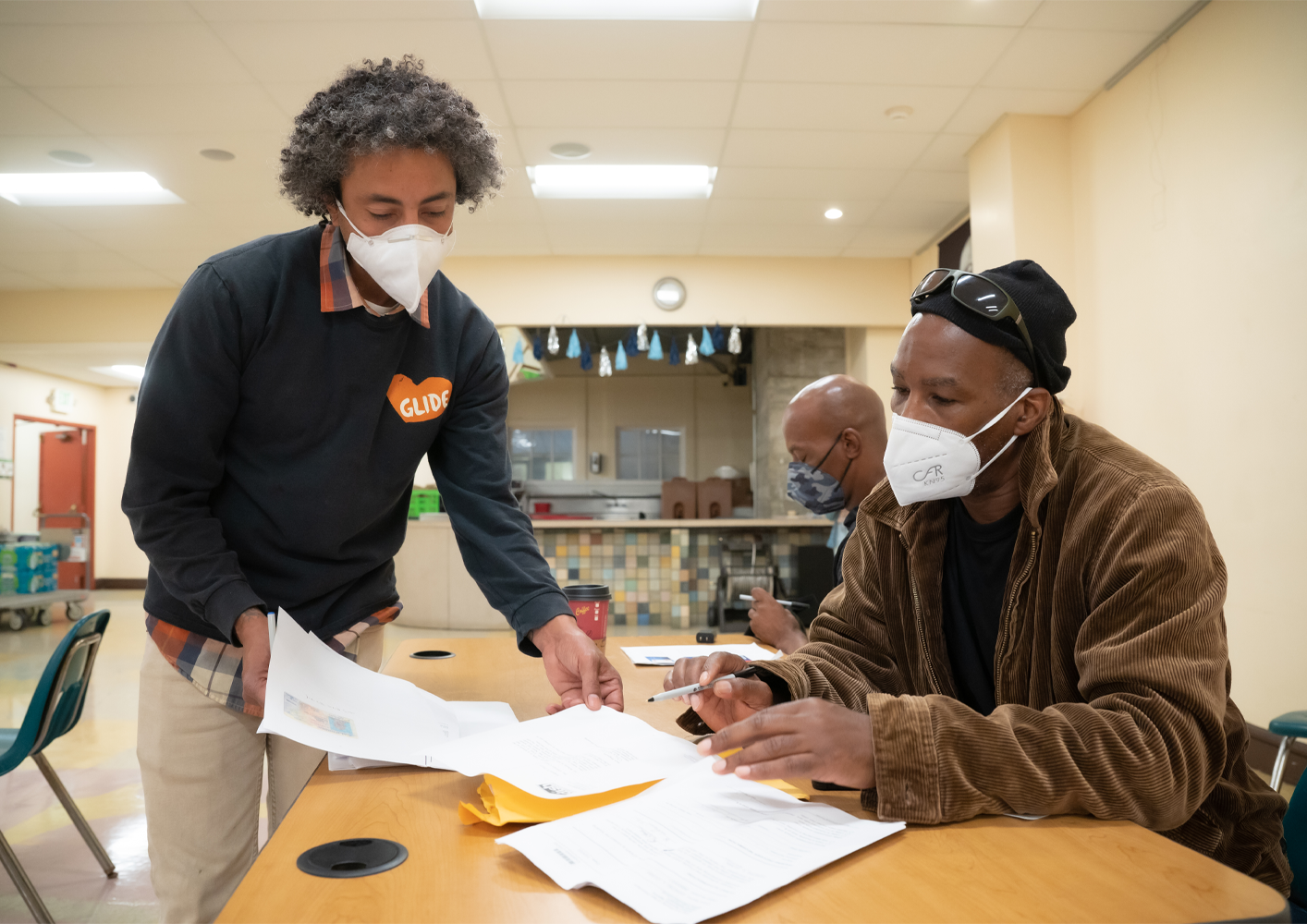
Twice a month, on Monday mornings, the staff of GLIDE’s Walk-in Center (WIC) set up a housing readiness workshop inside GLIDE’s Freedom Hall. Curious folk drop-in to learn from GLIDE staff about the intricacies of renting and rental assistance in the City of San Francisco.

GLIDE’s Eligibility Specialist Danielle Cato kicks off the workshop by reviewing some of the more critical components that go into submitting a successful rental application, including making sure you deliver a solid first impression. WIC staff take turns throughout the workshop covering a breadth of topics related to the often daunting and arduous process of securing housing – From navigating rental applications, to learning how to take care of an accommodation to maintain good standing as a tenant.

“We think of it as homing in on life skills,” said Danielle. “A lot of our clients have issues like keeping their homes clean, dealing with noise ordinances, falling behind on their bills, etc… We cover these things in our workshop,” she added.

danielle cato
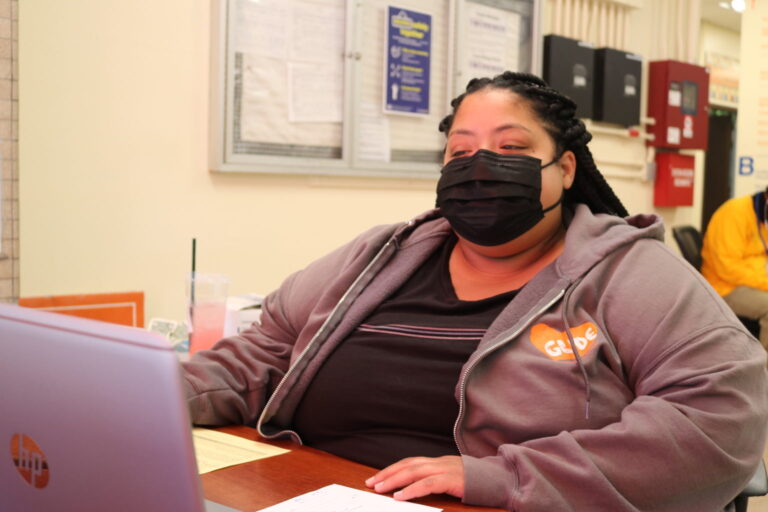
WIC Eligibility Specialist Danielle Cato prepares for an upcoming housing readiness workshop


The bi-weekly workshop is a pilot of GLIDE’s larger rental assistance program, and it began in March of 2022 to provide direct rental assistance to those who have been hit hardest by rising costs of living in San Francisco, coupled with the ongoing pandemic. Nearly 24,000 San Francisco households requested more than $332 million in rent and utility assistance from both state and local COVID-19 rent relief programs in the first half of 2022 alone. But when the state’s COVID-19 Rent Relief program expired this past March, many were still left in the lurch. 

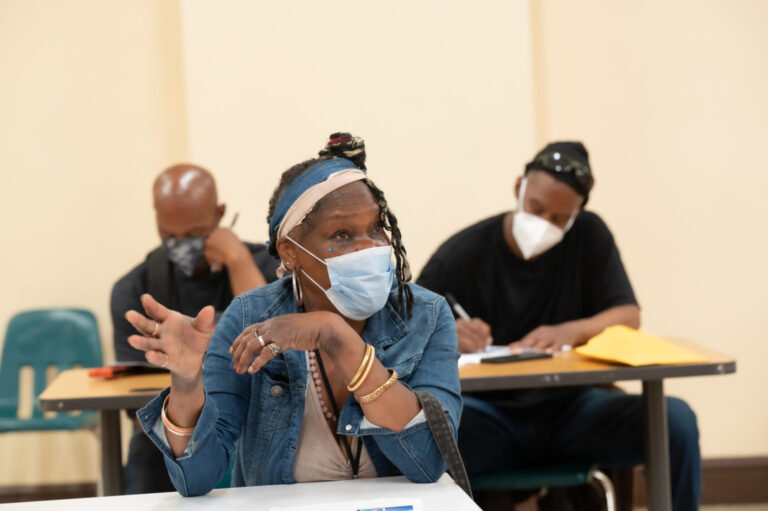
During the readiness workshops, GLIDE clients receive support and advice on navigating the intricacies of the housing system in San Francisco

The workshop grew out of GLIDE’s partnership with Catholic Charities and San Francisco Chronicle’s Season of Sharing Fund back in 2019. Walk-In-Center staff would help connect GLIDE clients with rental assistance provided by these organizations, but this assistance alone was not enough to meet rising demand during the COVID-19 pandemic. So, when initial funding came through, the Walk-in Center staff decided to take matters into their own hands and become a direct source of rental support. 

“We designed the pilot program to be ‘low barrier’ so anyone who might not be able to secure assistance from other organizations could come to GLIDE,” said WIC Manager Eunice Feathers. From March through July of this year, GLIDE’s rental assistance program has already provided $105,000 to participants. Attending the workshop is a requirement to receive any funding. 

Demarco
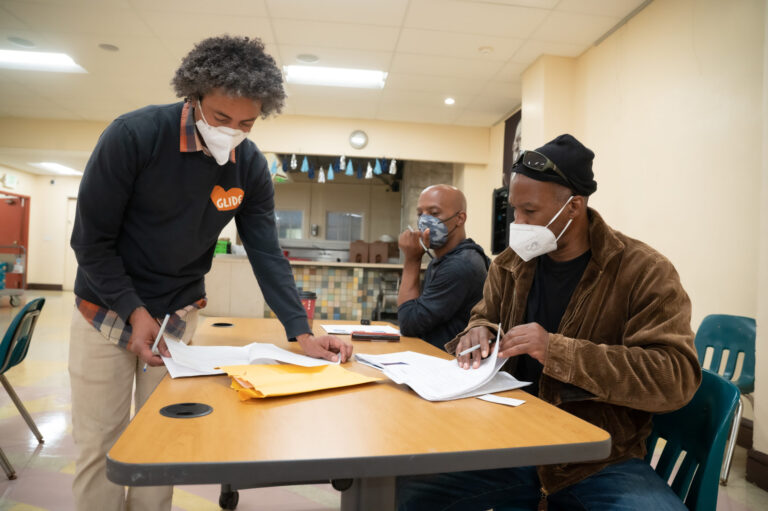
GLIDE Housing Case Manager, Demarco McCall, reviews clients’ rental application paperwork during the housing readiness workshop

For San Francisco native Ivan Graddy, the housing readiness workshop and rental assistance was pivotal in getting back on his feet after being unemployed. “Thanks to the folks at the Walk-in Center, I was able to secure the $2,160 I needed for back rent as I transitioned between jobs,” said Graddy. “GLIDE helps people who want to work. I cannot thank the Walk-in Center enough.”

Pride month is an extraordinary time, and the related festivities this June mark the first time in two years that we can all come together to celebrate the LGBTQ+ community. For decades, GLIDE has stood up for, sat in for, marched in the streets for – and opened its arms and doors widely – for the LGBTQ+ community. I am honored to be part of an organization with such a remarkable legacy of LGBTQ+ commitment and advocacy.  

During this month of Pride, I am feeling hopeful and engaged – not because we have achieved full equal rights and universal acceptance of our diverse community, but because despite the challenges we recognize in our nation, I believe we are on a positive trajectory towards those ends. We are on a trajectory that more people have joined, and new generations continue to fuel. Although the fight is far from over, we see more people understanding what we have known for decades – that equality is not a zero-sum game.  

There is a hostility in our nation that is born out of anger and unfounded fear. It is an extremist view that incorrectly perceives any legal recognition, rights, and enfranchisement gained by a historically marginalized group in this great society, that somehow another group of people — their people and their nation — will lose. The devastating circumscription of women’s rights as a result of the repugnant Roe v Wade Supreme Court decision reflects the realities and dangers of such zero-sum perspectives.

A concurring high court opinion supporting the erosion of other rights, including same-sex marriage, indicates that if unchecked, these extremist perceptions and policies will further marginalize more people and individual rights in our country. LGBTQ+ rights are the targets of growing campaigns of antagonism across the nation. For some, the right to marry whoever you love or living out a true gender identity is an infringement on their way of life and beliefs. A wave of such animosity has resulted in 28 states introducing anti-LGBTQ bills; 8 states have signed those bills into law.  

As we celebrate Pride and the intersectionality in the LGBTQ+ community, we must take this moment to recognize the intersectionality of all of our rights. The year’s San Francisco’s Pride Parade — which GLIDE will proudly once again participate in — offers us all the opportunity to enthusiastically celebrate the LGBTQ+ community and unite in solidarity for our interconnected human rights. We must never be deterred from pursuing equality for all, which is the foundational underpinning of coming together at Pride. To march, to be visible, to be heard, to not live in fear but to be free, and to come together to strategize against the threats to our collective freedoms and celebrate our capacity to overcome them. Our intersected rights to privacy, access, and identities cannot and must not be threatened. 

Radical inclusion is a GLIDE core value and key to our ongoing social justice organizing and advocacy efforts at the city, state, and federal levels. The ways we seek to overcome systemic homophobia, racism, sexism, and all other inequities will change the future for our children. We strive to make the rest of society more like what we recognize is possible here at GLIDE, a place that forever stands with and for the LGBTQ+ community, for justice, and always for all the people.  

With unconditional love and solidarity,  

Karen Hanrahan
​​​​​​President & CEO, GLIDE
@KarenJHanrahan


Dear GLIDE Community,

Today, the United States Supreme Court overturned Roe v. Wade, eliminating the constitutional right to abortion and a woman’s liberty to make personal decisions about her health and body. This ruling is a devastating blow to the progress of women and their families within our democracy.

In 1973, as women were gaining ground to exist autonomously in the workplace and the home, the Supreme Court validated that a woman’s liberty over her body was protected by the U.S. Constitution. By recognizing and affirming a woman’s right to make personal decisions concerning her body, Roe v. Wade served as a landmark ruling that would help pave a path for social, racial and gender progress. Now, nearly fifty years later, six Supreme Court justices have voted to overturn Roe, asserting that a woman’s personal liberty is a rescindable luxury.

As 26 states prepare to strip reproductive rights on the heels of today’s ruling, we face pandemic levels of maternal mortality, and have yet to establish universal parental leave and universal subsidized childcare. Many women will be forced into destitute motherhood. Low-income and Black women stand to feel a disproportionate impact from banning abortion, the latter being three to four times more likely to die in pregnancy and birthing than their white counterparts. To rescind access to legal abortion as critical healthcare while denying women a social service safety net hurts all of us. It perpetuates poverty, drives family and economic instability, and clearly rolls back the great wheels of justice in service of the few, not the many.

As we process and mourn the overturning of Roe, we must remember that reproductive rights are not a “women’s issue.” It is everyone’s fight and there is a lot at stake.

Roe v. Wade was predicated on a constitutional right that empowered and protected women while they made intimate decisions about their health and family without government restrictions. The decision to overturn Roe goes beyond abortion rights. The reasoning used by the six conservative Supreme Court justices in overturning Roe has upended constitutional and judicial precedent. This decision threatens to turn back the clock, not only on abortion, but on contraceptive rights, LGBTQ+ rights, and the right to interracial marriage, among others.

It is time to act.

It is time for each of us to stand up, speak out and protest against the erosion of our civil rights. As the rights of women are eliminated, we risk the elimination of rights for all.

It is time for a critical mass of men to advocate. As we navigate an era where men are free of laws regulating their bodies, they have the opportunity to leverage their privilege and close the contraception gap.

It is time for corporations to use their power and influence to support policies and funding that enables dignified travel by their employees and their families in states with oppressive reproductive rights statutes to where they can receive the health care they require.

And it is time for all of us to use our voices for advocacy and at the ballot, and for lawmakers and leaders to pass comprehensive reproductive rights legislation to make a legal right to abortion free and accessible to all.

Now more than ever, we need to build a radically inclusive, just, and loving community mobilized to take action and foster real and lasting change for women in our nation.

True democracy cannot exist without gender equality. GLIDE stands for reproductive rights. While today’s Supreme Court ruling marks a step backward for this country, GLIDE will always continue to move forward with a steadfast commitment to fight for the rights and freedom for all people and to bring about a more just and loving world.

In Solidarity,
GLIDE


FOR IMMEDIATE RELEASE
April 26, 2022

CONTACT
Denise Lamott
denise@deniselamottpr.com
(415) 381-8793

San Francisco, CA – GLIDE Foundation (GLIDE), a nationally recognized center for social justice, is pleased to announce the recent appointments of Tracy Layney, Allison L. Magee, Mark Ryle, and Virginia Walker to its Board of Directors. The four new members will help GLIDE in the implementation of its bold, large-scale strategic plan to deliver solutions to complex problems addressing both the symptoms and root causes of poverty and homelessness and to help more people off the streets, stabilize their lives, and thrive for good.

“We are genuinely thrilled to welcome Tracy, Allison, Mark, and Virginia to our Board,” said GLIDE President & CEO Karen Hanrahan. “With executive backgrounds in business and social innovation, collectively, they bring diverse and strategic experience from the worlds of finance, philanthropy, human resources, and nonprofit leadership that will contribute to the dynamic impact of our Board. Their insights will help advance GLIDE’s next generation of life-changing programs and services and our commitment to making lasting change in San Francisco.”

Tracy Layney is Senior Vice President and Chief Human Resources Officer at Levi Strauss & Co. Tracy is responsible for LS&Co.’s people strategy on a global scale, including diversity, equity & inclusion, recruiting, employee engagement, talent management, compensation and benefits, HR technology and HR communications.  “GLIDE’s mission to create a radically inclusive, just and loving community mobilized to alleviate suffering and break the cycles of poverty and marginalization is deeply inspiring and critically urgent,” said Layney. “I am truly honored to be a part of this mission by joining GLIDE’s Board of Directors.”

Allison L. Magee has worked for more than 20 years to transform public systems to reflect the strengths of the community and to meet their needs. Allison is Executive Director of the Zellerbach Family Foundation, one of San Francisco’s oldest and most respected family foundations. ZFF promotes belonging, connection, and a shared sense of safety among people and communities across the Bay Area and California, with a focus on Alameda, Contra Costa, and San Francisco Counties.  “I am thrilled to serve on the GLIDE board of directors. GLIDE personifies the principles of radical love, joy, and dignity and I’m proud to be a small part of the critical work of this San Francisco institution, said Magee.”

Mark Ryle earned his undergraduate degree at the McCombs Business School at the University of Texas. Soon after that, he left his proud west Texas roots for a career in corporate finance, investment banking, and private equity. After 25 years of acquiring, building, consolidating, and dissolving, he was led back to the family business of helping the most vulnerable among us. He went on to complete a master’s degree in social work from the University of Chicago. With several years of direct clinical work with children and families under his belt, Mark chose to merge his two worlds of leadership in business and social work together with the goal of building sustainability for vital services in San Francisco. He brings extensive strategic nonprofit leadership experience to GLIDE, including six years as CEO of Project Open Hand and three years as CEO of the Saint Francis Foundation. Mark noted on his LinkedIn page that he was both “honored and excited” by his invitation to join GLIDE’s Board of Directors.

Virginia Walker is a repeat C-suite executive and board member with 35+ years of financial, operations, strategy development, sales and marketing experience driving revenue and large financings for international organizations – from startups to F500 companies – in Silicon Valley and beyond. She has held CFO, VP Finance & Administration, EVP Corporate Strategy & Marketing, and GM North America Operations roles for public and private companies in highly regulated domains, including telecommunications, software, hardware, and biopharmaceuticals.  “I am honored to have been selected to join the GLIDE board. My relationship with Glide goes back to my early years in college participating in volunteer work there along with my fellow Alpha Kappa Alpha pledges,” said Walker. “That experience left quite an impression on me in terms of seeing firsthand the difference that each individual can make to positively impact the lives of the disenfranchised.  I look forward to adding my skill sets to those of the distinguished members of the GLIDE Foundation Board of Directors to help ensure that the implementation of its bold, new strategic plan is successful.”


Layney, Magee, Ryle, and Walker join current Board members Kaye Foster (Chair), Senior Advisor, The Boston Consulting Group; Mary Glide (Vice Chair), Vice President Technology, Sequoia Capital; Michael L. Warren (Secretary/Treasurer), Managing Director, Institutional Sales at Allspring Global Investments; Ime Archibong, Head of New Product Experimentation, Facebook; Emily Cohen, Executive Vice President, United Contractors; Paula R. Collins, CEO, WDG Ventures, Inc. and President, Portfolio Real Estate Consulting; Cheryl L. Flick, Financial Advisor; Crickette Brown Glad, Giver; Dr. Erica Lawson, Associate Clinical Professor, University of California, San Francisco; Hydra Mendoza, VP, Chief of Strategic Relationships, Salesforce; Tara-Nicholle Nelson, Founder & CEO, SoulTour; Gil Simon, Managing Partner & Chief Investment Officer, SoMa Equity Partners; Malcolm Walter, Former COO of Bentley Systems; Ross Weiner, Chief Administrative Officer and General Counsel, Explorer Acquisitions; Rev. Cecil Williams, Co-Founder, GLIDE; Lin-Hua Wu, Vice President of Global Communications & Public Affairs, Google; Phillip Zackler, General Counsel, VP of Operations.

About GLIDE:   

GLIDE is a nationally recognized center for social justice dedicated to fighting systemic injustices, creating pathways out of poverty and crisis, and transforming lives. GLIDE’s integrated comprehensive services, advocacy initiatives, and inclusive community empower individuals, families, and children to achieve stability and thrive. GLIDE is on the forefront of addressing some of the most pressing issues including poverty, housing and homelessness, and racial and social justice.    

For additional information, please visit GLIDE.org.

*NOTE TO REPORTERS/EDITORS:  GLIDE Foundation (GLIDE) is the correct name for the organization at 330 Ellis Street that organizes and provides the Daily Free Meals and other direct services and social justice programs. The church, historically called Glide Memorial Church, is a subsidiary of GLIDE. When referring to GLIDE social services and programs, please use the correct name, GLIDE Foundation, or simply GLIDE, rather than the historical name of the church.  

###

GLIDE, eBay and Warren Buffett Celebrate the Grand Finale Power of One Charity Auction Lunch With $19 Million Record-Breaking Winning Bid


To date, the event has raised more than $53 million to build upon
GLIDE’s enduring legacy of impact.

SAN FRANCISCO, Calif., June 17, 2022 – GLIDE and eBay’s annual Power of One Charity Auction Lunch with Warren Buffett has made history with a winning bid of $19,000,100. The record-breaking bid coincides with the 21st anniversary and grand finale of the legendary auction, which has raised more than $53 million to support GLIDE’s transformative programs and services that lift people out of poverty, hunger, and homelessness, and advance equity through systems change.

The winner of the grand finale auction has chosen to remain anonymous. Bidding for this year’s auction opened at 7:30 pm PDT on June 12 starting at $25,000 and ended at 7:30 pm PDT on June 17, with a winning bid of $19,000,100. With their generous and record-breaking bid, the 2022 winning bidder has not only made history, but will spend an unforgettable afternoon with American legend Warren Buffett at a private lunch with up to seven guests at Smith & Wollensky Steakhouse in New York City.

“It’s been nothing but good,” Warren Buffett has said about the lunch. “I’ve met a lot of interesting people from all over the world. The one universal characteristic is that they feel the money is going to be put to very good uses.”

GLIDE provides opportunity, dignity, and unconditional love to the most vulnerable populations, empowering thousands of individuals and families to get off the streets, exit crisis into stability and find pathways out of poverty. GLIDE is a leading voice and change agent on social justice, changing the systems that drive poverty and inequity.  Each year GLIDE helps 10,000 individuals and families across the Bay Area to make long-lasting and sustainable changes in their lives.

The grand finale and winning bid was celebrated by the GLIDE community, local elected officials and community leaders at a countdown party held in San Francisco. Conceived by the late Susie Buffett, the Power of One Charity Auction Lunch was launched in 2000. Over the past 21 years, the winning bids have ranged from $25,000 (prior to eBay’s involvement) to this year’s highest-ever bid of $19,000,100. Due to a two-year pandemic hiatus, the last auction took place in 2019 with a winning bid of $4,567,888. For the past 18 years, eBay has powered the Warren Buffett Power of One lunch on the eBay for Charity platform, opening the auction from just local donors to eBay’s global charitable community.

“On behalf of GLIDE and those we serve, I thank Warren Buffett for his unwavering generosity, partnership and dedication, and for his incredible contribution to our mission,” said GLIDE President and CEO Karen Hanrahan. “GLIDE continues to turn this generosity into opportunity and impact for thousands of people most in need. This record-breaking auction could not have come at a better time as we extend our reach to transform more lives and more systems during a time of crisis and inequity. While this is the grand finale event for the Power of One Charity Auction Lunch, we look forward to many more years of treasured friendship with Warren Buffet and our longtime partner, eBay.”

“We are incredibly proud that Warren Buffett’s final Power Lunch has broken our all-time record of funds raised, with all proceeds supporting GLIDE’s efforts to create pathways out of crisis and transform lives,” said eBay CEO Jamie Iannone. “eBay’s enduring partnership with Warren Buffett and GLIDE over the past two decades has inspired charitable giving around the world, and we are deeply grateful for their unwavering dedication. Since its inception, eBay for Charity has helped thousands of organizations around the world raise more than $1.1 billion on our platform, and we look forward to building on that legacy.”

The grand finale Power of One Charity Auction Lunch will take place at a mutually beneficial date and time in the coming months. As host of the annual Power of One Charity Auction Lunch, Alan Stillman, founder of Smith & Wollensky, has generously donated tens of thousands of dollars to the event. The restaurant has been called “the quintessential New York steakhouse” by Gourmet Magazine and “the steakhouse to end all arguments” by The New York Times.

About GLIDE:
For nearly six decades spanning political, economic and cultural changes, GLIDE has served as a social justice movement, social service provider and spiritual community dedicated to strengthening communities and transforming lives.   GLIDE is a nationally-recognized center for equity, dedicated to fighting systemic injustices, creating pathways out of poverty and crisis, and transforming lives. Through our integrated comprehensive services, advocacy initiatives, and inclusive community, we empower individuals, families, and children to achieve stability and thrive. GLIDE is on the forefront of addressing some of society’s most pressing issues, including  poverty, housing and homelessness, and racial and social justice.

About eBay for Charity
eBay for Charity enables members of the eBay community to connect with and support their favorite charities when they buy or sell in the U.S. and abroad. Sellers can donate up to 100 percent of the proceeds to a charity of their choice, while buyers can add a donation to their purchase during checkout. To date, more than $1.1 billion dollars has been raised for charity by the eBay community, and the program is on-track to raise an additional $600 million by 2025. Visit www.eBayforCharity.org for more information.

About eBay
eBay Inc. (Nasdaq: EBAY) is a global commerce leader that connects people and builds communities to create economic opportunity for all. Our technology empowers millions of buyers and sellers in more than 190 markets around the world, providing everyone the opportunity to grow and thrive. Founded in 1995 in San Jose, California, eBay is one of the world’s largest and most vibrant marketplaces for discovering great value and unique selection. In 2021, eBay enabled over $87 billion of gross merchandise volume. For more information about the company and its global portfolio of online brands, visit www.ebayinc.com.

CONTACT:
Emma Tozer, for GLIDE 
(301) 383–3128, etozer@glide.org

Michael McAlpin, for GLIDE
(415) 674-6016, mmcalpin@glide.org

Evelyn Kha, for eBay
(408) 284-9804, ekha@ebay.com

Dear Friends,

At a time when stereotypes and violence against women pervade, not ironically, we move out of Women’s History Month and into Sexual Assault Awareness Month.  Below is a speech I gave last year – one that reminds me that as much as we’ve sought and made changes to laws, to systems and to our lives, progress for women remains both limited and fragile. The pandemic has revealed the persistence of longstanding gender inequities that prevent our nation – and the world – from reaching its potential. The impact on women is reverberating across families, communities and our economy, an impact we will all feel for generations to come. This is unacceptable to me as a woman, a mother and a leader. 

In my work advocating for the rights of women and girls across the world, I witnessed the powerful positive effects of women’s empowerment and leadership. More often, including in my own country, I saw change still needed across all dimensions of economic, cultural and political life for women to take their rightful place in positions of leadership and have the influence to benefit all of us. In 2021, the United States of American ranked only 30th in measurements of gender equality – right alongside South Korea and Costa Rica. Although this is shocking, it is not surprising to the women I know. 

The speech below — a worthwhile 5-minute read — reflects my experience – and an ideal – of what’s needed to elevate our nation, not just in gender equality but in all its dimensions. We need more women to show the next generation what success means. The road to freedom and equal rights has been paved; we must make it easier for younger women to follow and broaden this path. As I reflect on Women’s History Month this year, it’s my hope that you can pause to consider what’s next so that opportunities and rights for/of women become the most important investment you, and this country, make in the coming year. 

We ARE making progress. We ARE reversing the course of COVID’s destruction of women’s advancement. We ARE still leaders of resilience and ingenuity, determined and born to define and design new standards and solutions for a more equal and advantageous existence for the woman of the future. When we succeed, the benefits will be felt across genders, generations and borders. 

In solidarity,  

Karen Hanrahan 
President & CEO, Glide
@karenJHanrahan


Celebration Remarks 
Women’s History Month  
March 28, 2021 

I’m so thrilled to be here speaking to you in honor of women’s history month. There is so much to say and so much work to be done. As many of you know, I’ve spent a good part of my life protecting and empowering women and girls around the world – from Afghanistan to Africa – to the Middle East – and in the United States. I’ve worked to protect the victims of child marriage, sex trafficking, honor killings and sexual and gender-based violence. I’ve also helped empower girls and women with education, political leadership, reproductive rights and business opportunities. I’ve seen unimaginable suffering and struggle – as well as astonishing courage and resiliency.

Then nine years ago, I also became a mother and learned the unique joy – and the heartache – of raising a daughter and a son. And although I am grateful that my daughter does not face stoning or child marriage – and she is statistically less likely to be targeted by police or be subject to mass incarceration – statistics show there is a good possibility she’ll experience sexual violence in her lifetime.   

So I bring today my perspective as a woman, a mother, a daughter… and as a leader, a human rights lawyer and a global advocate for women.   

The more I traveled and worked with communities around the world the more I understood that the status of girls and women in our world remains tenuous – from our rights and freedoms, to our experience in the workplace and society. We’ve made progress for sure – but it is limited…and it is fragile – as we’ve learned during the COVID pandemic where the empowerment and protection of women around the world has been set back decades. That said, I believe we are early in the history of women – lower on our trajectory but certainly rising.  

TRIBUTE WITH GRATITUDE 

So today, in this month of remembrance, I’d like us all to take a moment to reflect and to appreciate the women in our lives…the daughters and sisters and mothers and grandmothers, the lawyers and doctors and shopkeepers, the engineers and scientists, the firefighters, the babysitters, the congresswomen and housekeepers…and the vice presidents.  

And let’s not forget all the women who have come before us – striving to pave what remains a bumpy path at best, so that we can do what we do today. Lead companies. Lead nations. Find cures. Raise children.  

Let us have a moment of appreciation for all the unnamed women … the unknown women … the trail blazers. These women have been leading at all levels, in all possible places, through the ages. And it is to them that we owe our gratitude. 

THE ONGOING BATTLE 

Without doubt, it has been an uphill battle for billions of women and girls, with more hill yet to climb. I’ve seen first-hand sexism, misogyny, violence against women, discrimination – they are all alive and well.  Across time and geographies, women and girls have been systematically targeted as a means of taking down whole communities, cultures, societies. In the biggest cities and the smallest villages, we have been systematically objectified, excluded, silenced, vilified, controlled, abused and thwarted at so many turns.   

We are still told to be quiet, to not be emotional; called bossy and nasty; we’re still spoken over, passed over; judged harshly for who we are, how we laugh and what we look like.

The signs of the struggle ahead begin at an early age for girls, including the best-intentioned books that tell girls to persist and that they can do anything boys do – if you just keep trying, you can overcome, you can succeed despite your situation.  These are often tales of women overlooked in a man’s field and of girls who struggled amidst great controversy to achieve — all powerful and important stories, and all signaling to girls the struggle to come. 

Little girls are told they can become anything. So many books still being written that tell girls they can be whatever they want to be. And why is that? Why must those books still be written?   

I’ve avoided reading these books to Jordan, my nine-year-old daughter, for years. It never occurred to her to think otherwise – of course she can do and be anything – she did not need reassurance. That is, until she watched the inauguration this January.  

And while I was ecstatic about the end of the past four traumatic years and excited that our very own Kamala Harris was elected as the first female Vice President, I could not help but feel sadness about the colossal truth girls and women continue to face. I watched Jordan taking it all in and seeing the wheels turn in her head as the announcers over and over effusively celebrated our very first female Vice President. Jordan asked me, how can that be true? I thought we could be anything we wanted – is she the first woman to want to be Vice President? Do women not want to be President?  And so it began for my 9yo daughter – as it does at some point for every little girl. That this inauguration was an historical moment is also a reminder of our limits. 

FRAGILITY OF OUR PROGRESS 

And as we take stock a year into the pandemic, we’re seeing just how tenuous women’s progress is. We knew before COVID of the balance women strike. Walking a tightrope. Maintaining this perilous balancing act with so many roles and balls in the air – easily disrupted by the slightest tremor much less a global pandemic.   

With COVID19, that balance is no longer possible for millions of women – and we will all suffer from that unless we can find a revolutionary way to reverse course. Women’s advancement in the workplace has been sent hurtling backwards decades. Women are dropping out of the workforce at record numbers, reducing their work hours, missing deadlines and dropping obligations – all to teach their children, care for loved ones, manage households and support their families. Women are working around the clock to try to hold it together. In a matter of months, hard-fought gains women have made in employment, pay equity and financial stability were nearly wiped out.   

[Millions of women who were barely making ends meet before have now lost their jobs – and the effects are echoing. It’s forcing families into poverty, hunger, homelessness. These are mostly women of color and those who must go to work because they cannot afford otherwise – more at risk of contracting and dying from COVID19 – forced to leave children with little oversight. These families and communities will be impacted for generations.]  

We’ve been climbing up a rock wall, pulling ourselves up slowly and holding on with the tips of our fingers; the pandemic shook the ground beneath us and so many women have lost their grip. When forty years of progress can be wiped out in a matter of months, the underlying system is broken.  

THE GOOD NEWS 

And of course, we rise to the challenge and we work for progress. In history, as in the present, there is a testament here. 

A testament to leadership. 

A testament to resilience.  

A testament to ingenuity. 

…to persistence.  

A testament to sheer force of will: the determination it takes to show up, put on your best face, and make progress against boundless, unpredictable obstacles in order to build opportunities for our daughters, our sisters, ourselves. 

There is good news! We know what we SHOULD do. Research plainly shows that investing in girls and women yields returns for all of us – for our families, our communities, our countries, for our world. In the field of international development, it is said that  “a woman multiplies the impact of an investment made in her future by extending benefits to the world around her, creating a better life for her family and building a strong community.” It’s the best investment for breaking intergenerational cycles of poverty; for lifting families and entire communities out of poverty, for improving health and education outcomes; for decreasing violence; and for building entire national economies (GDPs).  

To realize this collective progress we all make from investing in women, we must also change the playing field, especially in the workforce.   

Because women are needed in the workforce AND we are needed to have families and raise them, and to take care of entire communities. We must find ways to stop working so hard to conform to, and succeed in, a world that is not conducive to our needs or to our enduring progress. Instead we must use our leadership, our life experiences and our ingenuity to define new standards and new solutions that WE – and our entire society – need to succeed.  Solutions that reset norms, that make policies that support our ability to stay in and perform in the workplace; that proactively address gender bias, and that openly recognize and support all of the critical roles we play.  

So let us reimagine a future together. A future where investing in women at all levels is good business and smart policy. Where we perform on playing fields that value all the ways women and girls lead and contribute; where there is no longer a need for the large field of women’s advocates; and where little girls, like Jordan, no longer have to read books that insist girls can be anything they want to be – because we have changed that colossal truth for girls.   

It is time to create real and lasting structural change for equality, equity and opportunity for all of us. We have everything to gain, for our children, for our families, for our communities, for our world. 

Thank you so much to all of you for listening today! 

GLIDE joins with many in the Bay Area and those across the nation in mourning the passing of Richard Blum. GLIDE President & CEO Karen Hanrahan and GLIDE Co-Founder Reverend Cecil Williams remember the life and spirit of Richard:

“A truly remarkable individual, Richard was a change agent for radical inclusiveness, a social justice advocate, a former GLIDE Board member, and a longtime member and supporter of our community. We are deeply saddened by his loss.”

“A San Francisco business executive, philanthropist, and partner of Sen. Dianne Feinstein, for decades Richard was a steadfast champion of GLIDE’s work to help more people off the streets into stability and transform systems to enable equity for all and bring lasting change, not only to this city but to the world.

GLIDE holds his family close to our hearts, and we offer them our love, prayers, and support during this difficult time.”

Dear Friends,

I am excited to share some good news about GLIDE for the coming year! While we’ve been innovating and adapting during COVID-19, we’ve also been making headway on our plans to deepen and expand GLIDE’s impact and provide sustainable solutions to the growing challenges facing San Francisco. Below are a few highlights of what’s coming up in 2022:  

  • Doubling our Reach Across San Francisco.  GLIDE is planning to expand its reach by bringing integrated services to under-resourced neighborhoods across San Francisco to help more people off the streets for good. We will increase our mobile fleet of vans, pop-up service hubs, and community-based partnerships to bring expanded services, referrals, and linkages to South of Market (SOMA), Potrero Hill, Bayview Hunters Point and more areas of the Tenderloin. For both families and individuals, we will provide essential stabilizing services and resources to address immediate needs as well as those needs inherent in building stable, healthy lives, avoiding homelessness and building pathways out of poverty. 

  • Modernizing our Facilities. GLIDE’s longstanding leadership in the Tenderloin and our commitment to provide hope and solutions for the community remain a top priority. To deepen our impact in the Tenderloin and across the city, we have begun exploring opportunities to upgrade our outdated headquarters at 330 Ellis. This month, we will submit a Real Estate Preliminary Project Assessment (PPA) to the City of San Francisco to examine the feasibility of upgrading our building into a new community services hub. This will allow us to remain an anchor in the Tenderloin with expanded service space in an enhanced, equitable, and more modern facility. This is a preliminary step to explore the feasibility of a multi-year development process with collective community input. (Visit our FAQ page for more details.)

  • Updating GLIDE’s Governance Structure. GLIDE has established a new structure that separates the governance and management of the GLIDE Foundation from Glide Memorial Church. GLIDE Foundation has updated its non-profit legal status to a 501(c)(3) public benefit corporation to reflect the foundation’s longstanding – and growing – body of work on direct services, systems change and equity. Glide Memorial Church is now a legal subsidiary of GLIDE Foundation and designated as a non-profit religious corporation with its own board of directors. While we continue to operate with many shared values, this distinction between GLIDE Foundation and Glide Memorial Church provides long-needed clarity for our community and aligns with best practices on separation of religious from non-religious activities. (Visit our FAQ page for more details.)

  • Expanding Equity & Inclusion Programming. This year, to expand our efforts to evolve and influence institutions of power, we’re planning another transformative Justice Pilgrimage to Alabama. We begin the journey with a curated experience by GLIDE’s Center for Social Justice to open eyes and minds to our collective history of slavery and its modern manifestations. This sojourn adds forceful testimony to how racism is woven throughout our country via oppressive and unjust systems, policies, and laws – as well as within business models and practices. Along with our empathy-building programs with police, district attorneys, and healthcare workers, these initiatives create change agents who – upon returning to their professional alliances – drive more progress towards equity and inclusion. 


From expanded integrated services to modernizing outdated facilities and governance structures to transformative racial justice work, these innovative efforts reflect how we are building the next generation of GLIDE. We remain rooted in our values and are steadfastly committed to helping more people off the streets, out of poverty, and bringing lasting change to our city. 

I look forward to keeping you updated and engaged as a supporter and thought partner as GLIDE progresses. Please don’t hesitate to reach out with ideas and questions in the coming months.   

In solidarity, 

Karen J. Hanrahan 
President & CEO, GLIDE
@KarenJHanrahan