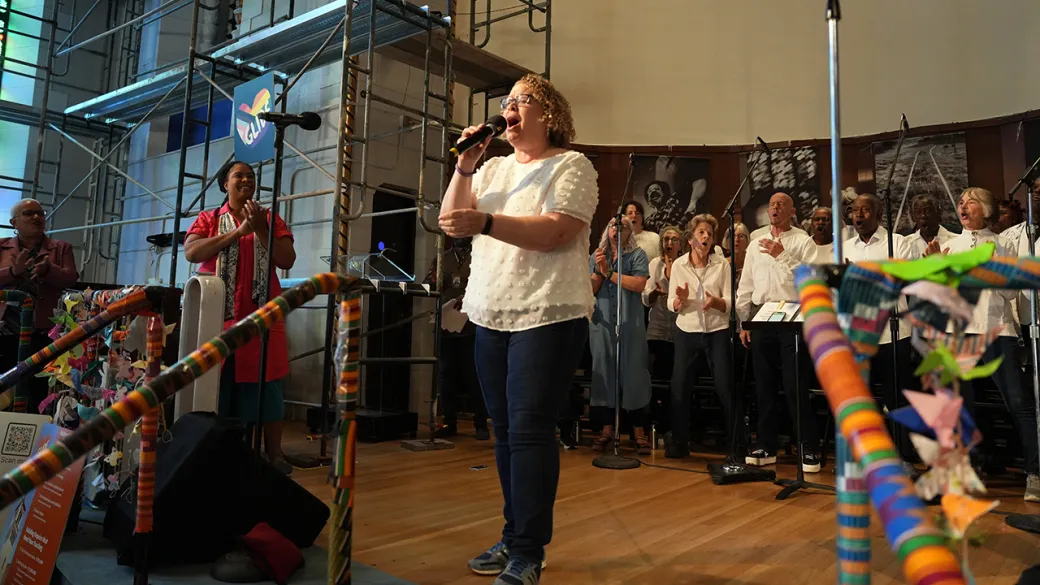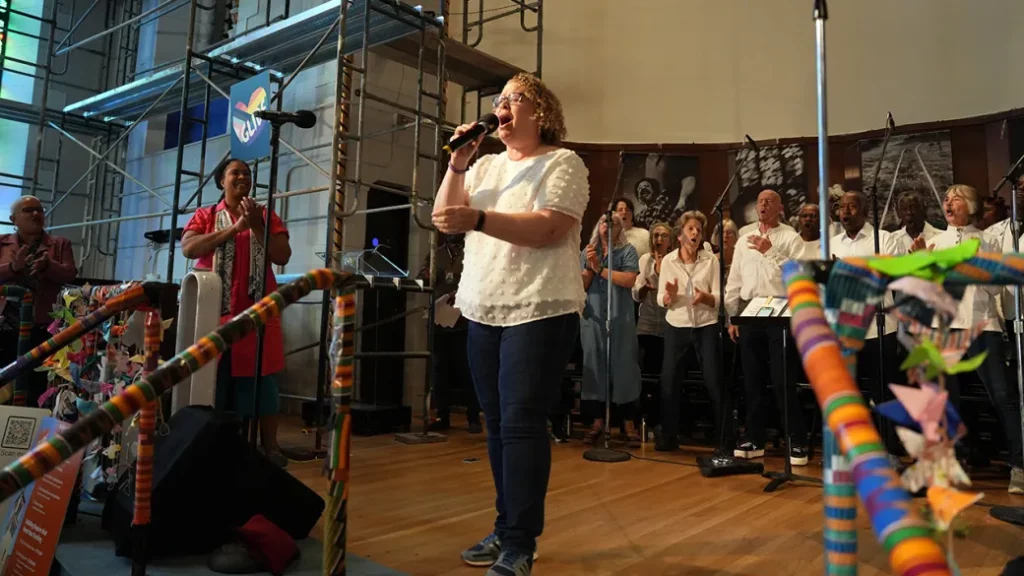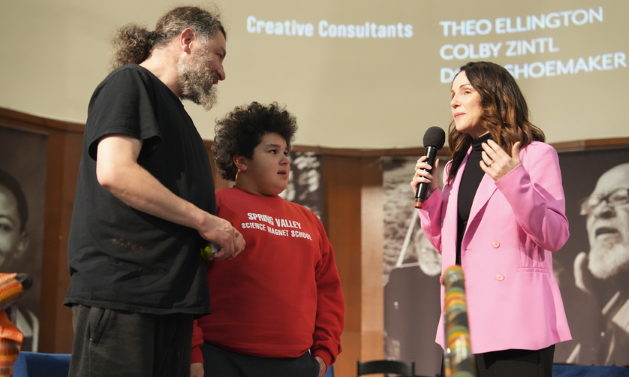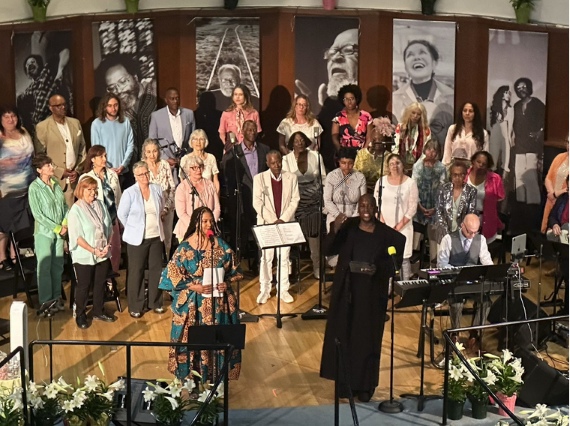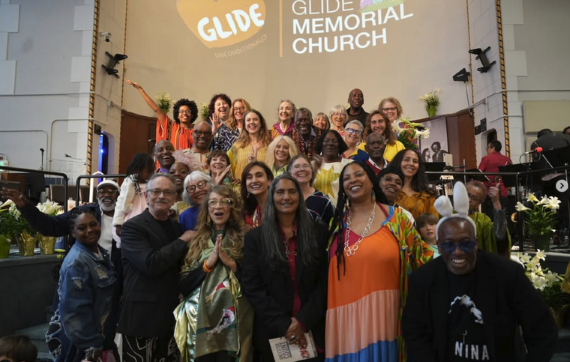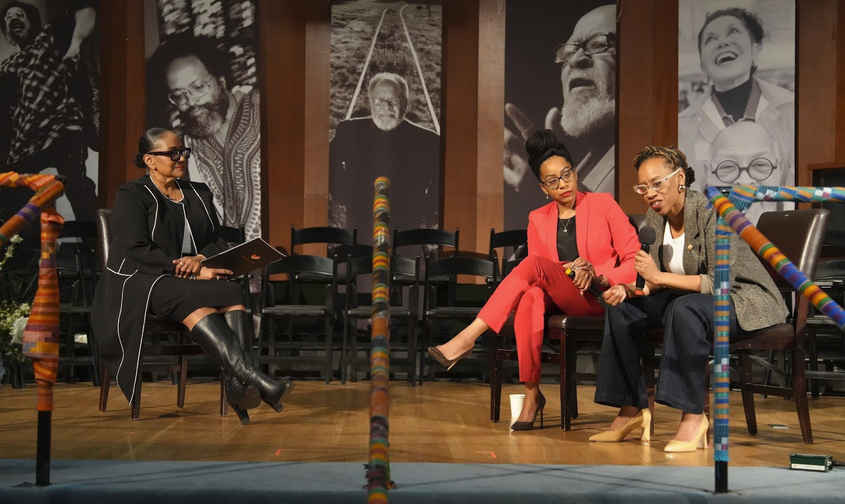


Women’s History Month at Glide Memorial Church highlighted the musical contribution of women in the Bay Area, choosing different local women musicians to feature as special performers at every service in March! 

Check out this highlight reel of their amazing sounds, and then read our special interview with Zoë Ellis, our Director of Music Ministries, about the ways these women are making history.

An Interview with Glide’s Director of Music Ministries About How Women Musicians are Making History in the Bay Area

Zoë: It was amazing to receive Minister Marvin K. White’s unconditional support for my vision of creating a month of programming dedicated to women musicians!  I arranged this lineup for Women’s History Month as a way for the Glide Memorial Church Music Department to say out loud, “look who we are, look what we do, look who we support.” Glide is a church with world-class music, and our choir is unbelievably committed and dedicated.  I wanted to give our choir a chance to work directly with legendary Bay Area Artists. (If you are interested in joining the Glide Ensemble, click here).

All the artists I showcased for Women’s History Month are my activist buddies–or as my kid liked to say when she was little, “actibuddies.” It’s so important to dive into the deeper meaning of their work–  music is a way we preserve our history, and music is also a way we MAKE history. Sunday by Sunday, here’s the rundown of the amazing women I invited into our sanctuary.

Sunday 1: Sermons and Songs – Sara Williams and Sheryl Evans Davis

Sara Williams is a preacher’s kid, steeped deeply in the tradition of church gospel music, as well as in the activism of the church. Sara was trained in both classical music and jazz, and she works closely with many popular music artists. However, she’s deeply rooted in the spirituals of the church, and understands how a single church (even just a corner church) can save an entire neighborhood, an entire community!

To understand gospel music and spirituals, you need to understand that songs the slaves sung were how people held on to their African culture and history. The famous song, “This joy that I have,” is about the ultimate decision in the moment of trial and hardship: basically, deciding: “no one else is responsible for my joy but me and my Higher Power.” 

The activism of Sheryl Evans Davis has always been deeply rooted in serving the youth. She is currently working on a new educational program called “The Art of Survival,” which debuted in the Commonwealth Club and will continue being offered on an ongoing basis. Sheryl is also the author and illustrator of Free to Sing, a children’s book about a little girl who refuses to stop singing in the face of discouragement. Making our voice heard is always the foundation! 

Sunday 2: Music as Medicine – Destani Wolf & Destiny Muhammed

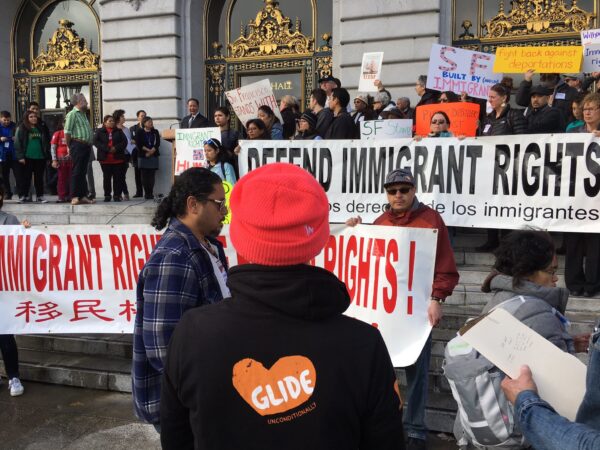
Destani Wolf develops “meditative music,” to use as medicine and self-care. She works with the Cirque do Soleil (most recently on their show Bazzar) and next up will be an amazing Cirque show that explores the themes of immigration. She also works with the BANDALOOP dance troupe, who are amazing: they literally dance off the walls of buildings. BANDALOOP is also working on a big piece on immigration. They use the image of migrating butterfly flocks to emphasize that immigration is beautiful. 

It is incredibly tragic how many children are being separated from their mothers at the borders, so defending immigrant’s rights is a cause that resonates with many women and children. When Destani sings for BANDALOOP’s performance on immigration, I will be on the site, hosting art activism for the Butterfly Effect, an organization dedicated to helping children at the border receive an education and obtain asylum. 

Destiny Muhammed’s music is completely invested in holding and moving forward the stories of what happened to us when we were enslaved– and taking those stories into the post-slavery era. She’s all about reminding people who they are. 

Destiny is deeply spiritual. When she’s in a room, you don’t feel forced to participate in the energy she’s moving– you just know that joining with the energy is the next right thing to do. She makes activism feel so comfortable and natural.. She can MUSIC you into understanding– understanding yourself, what’s around you, and why it’s important to open your mouth. And it’s all just wrapped up in this incredible package of care!

Sunday 3: Hip Hop as Ministry – Ryan Nicole

Ryan Nicole Austin is all the things! Advocate, activist, MC, rapper poet, singer, and songwriter. People turn to her voice on social media to get clarity on political subjects; on her Instagram you might find a song about protecting the waters of the Bay, a detailed commentary on Oakland election results, and a rap about African-inspired Black resistance to injustice, all in one quick scroll. 

She recently finished writing a show that is coming out in May, called Cofounders: The Musical, about the story of two unlikely partners (a Black woman and a small town college dropout) taking on the most competitive startup accelerator in Silicon Valley. Ryan Nicole unapologetically celebrates Blackness and even wrote a song explaining the meaning of the phrase, “Black Girl Magic.”  The song goes, “Don’t hide your shine, just let it flow, yeah you got it: that Black girl glow!”

Sunday 4: Message in the Music – Rhonda Benin

Rhonda Benin and I both participate in Linda Tillery’s Cultural Heritage Choir: it keeps Black folk music alive. Wherever we go, we use a two-hour show to explain how music lived in different parts of Africa. We explore Afro-Cuban and Yeruba traditions, and show people what happened to that music during transatlantic slave trade. 

In slavery, the drums were taken away: all people had were their voices, so they adapted. Historically, the slaves singing in the call and response style was built out of the need to communicate plans. For example, “I’m going to lay down my burdens / down by the riverside,” was a way to communicate that the riverside was the escape location. 

Rhonda is a keeper of the idea that absolutely any message can be delivered through music – love, misery, hate, a call to action, anything! And she sings the blues. The blues are hard to sing: you have to know it and mean it to sing it.

Sunday 5: The Other Side of Yes – Ashling Cole

Ashling Cole has a really interesting upbringing – her mother was an Irish activist who would travel to the middle of nowhere to stand in solidarity with Druids, and her father was a longshoreman. Ashling’s activism also lies in education: she’s always teaching people “You have a voice! Get your voice out of your body! Use it well!” 

She is a dedicated music educator, and works with an organization called Elevate Oakland, which fights to keep music and art alive in the schools, and gives kids a way to tell their stories.

Music Truly Makes a Difference

This only scratches the surface of the amazing activism and education work women musicians are doing in the Bay Area. I hope it whets your appetite for more, I hope you check out their shows, their projects, and get involved! 

Remember: there’s ministry in all music that touches people’s hearts, even secular music. For example, Destiny Muhammed’s song, “We are the ones.” It’s almost like a praise and worship tune: it uses similar cycles of repetition. You say it until you believe it! When my choir sings, I always tell them, “You have no idea if you’re saving a life today. Remember that, GLIDE Ensemble.”

fault lines movie screening 2025 family
Fault lines star, Carlos Roja and his son Andre, speaking with GLIDE Board member Emily Cohen

The decades-long battle for affordable housing in San Francisco is reaching a breaking point, with dire warnings for the rest of the country.  In the film you see how hard it is for single dad Carlos Rojas, his son Andre, and his mother to all share one tiny single occupancy room. Thanks in part to the awareness raised by the film, this little family is now housed.

But they are still getting back on their feet– which is why board member Emily Cohen introduced them to all of us at the event and raised $9,005 for them on GoFundMe.  As our President and CEO Dr. Gina Fromer pointed out, it takes a lot of vulnerability and courage to let the public have a window on your life when you are experiencing poverty. Carlos and Andre taught us so much, so we were grateful to be able to help them in turn. 

Analyzing the root causes of the housing crisis

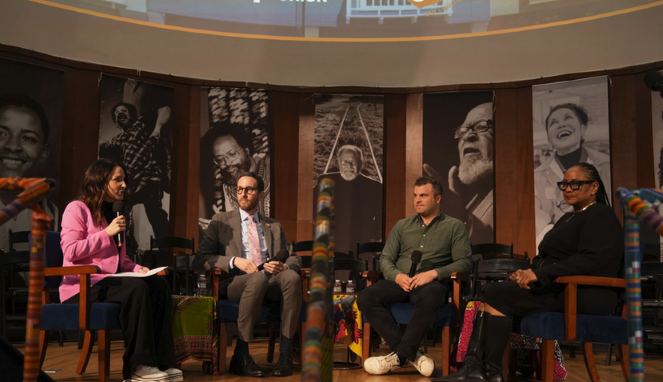
The film was followed by a panel featuring State Senator Scott Wiener, Glide President & CEO Dr. Gina Fromer, and the film’s director, Nate Houghteling (moderated by GLIDE Board Member Emily Cohen).  Together, they talked about the political forces stacked against solving the housing crisis, and how ordinary citizens can make their voices heard.

fault lines movie screening speakers round table
From L to R: GLIDE Board Member Emily Cohen, State Senator Scott Wiener, Director Nate Houghteling, and GLIDE President & CEO Dr. Gina Fromer

How to get involved in San Francisco housing activism

If you want to get involved in GLIDE’s work on affordable housing, we recommend you sign up to join the Justice Warriors, a group of citizens who phone-bank, sign petitions, and march for GLIDE!  You can sign up here. 

If you missed seeing the documentary, you can find out more about it on this website, or watch the trailer below.

easter 2025

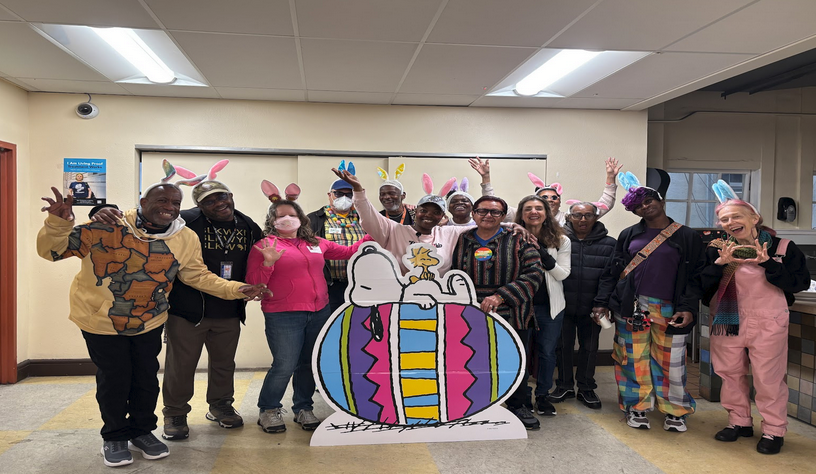
This Saturday, Glide Memorial Church’s dedicated team of Easter Bunnies gathered to give the children of the Tenderloin the time of their lives! In Freedom Hall, they played games like jenga and cornhole, made bunny hats, picked up coloring and picture books, and took pictures with an Easter Snoopy.

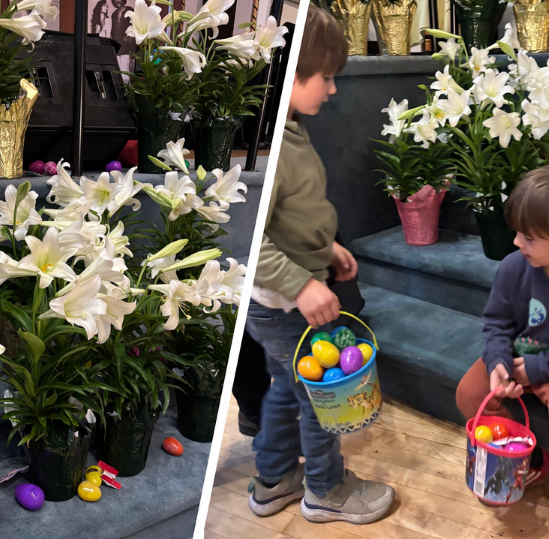
In the sanctuary, the children dashed about to find all the chocolate, candy and eggs our volunteer bunnies had cunningly hidden: 1500 eggs/treats in total (not counting the tootsie rolls). For years, our volunteers have followed this tradition of bringing joy to the families of the Tenderloin.

They started the tradition to help out an FYCC teacher who was like a foster mom to all the whole children of the neighborhood– and now, even though the teacher has passed, the tradition continues in her memory. Watch to the end of our Instagram video to hear a little bit of her story.

children Easter sanctuary 2025

On Easter itself, worshippers gathered bright and early for a sunrise service.  The sun had yet to peek through a dreamy curtain of fog, when Marvin K. White, Minister of Celebration first bellowed, “Good morning, GLIDE!” 

A chorus of good mornings echoed across the sanctuary. “I said GOOD MORNING,” repeated Minister Marvin. “Say it so everyone waking up on the sidewalk outside can hear you!” A resounding GOOD MORNING ricocheted through the air, spilling Glide’s iconic enthusiasm and goodwill into the pews and the foggy streets below.

On this holy morning, early risers came for a reflection on the Last Supper; to honor the holiest of days following Jesus’ triumphant return to Jerusalem and before his crucifixion.  “The Last Supper at Glide is a communion that takes the form of a hot meal in freedom hall, a clean syringe at our health access hub, and the bold and beautiful lashes of our trans brothers and sisters,” proclaimed Minister Marvin. “Here, nobody is screened for worthiness and everyone has a seat at the table.”

marvin Easter 2025 sanctuary service

Easter is a homecoming at Glide; an invitation to come exactly as you are. “Bring your hunger, your grief, your shame, your failed resolutions with you,” implored Minister Marvin. “Bring your appetite for home and for healing inside these walls. Because God does not sit at private tables. God breaks bread on sidewalks and in barbershops and recovery circles.” 

Slowly, the sun began to stream through the stained glass windows in the form of a rainbow on the wall. Grief turned into groove and Glide gave revelations a rhythm. The soul of Easter was rising, and the day had just begun.

The 9am service continued the arc of Christ’s story by diving deep into the Crucifixion. The church opened the space for suffering and heartbreak through communal prayers, stirring music, and personal testimonies, uplifting both lament and hope. 

Minister Marvin spoke of how communion is more than just a ritual at GLIDE:  it’s a warm meal, sober support from our Health Access team, a seat in our walk in Center or support in our Women’s Center groups. Everyone is served family style. 

The Glide resident poet, Ramona Laughing Brook Webb, prompted the congregation to write about “What does it mean to truly live? What’s something you feel called to do right now?” What better way to experience Resurrection Sunday than to explore the ways in which we crave to be reborn.

group shot Easter 2025 sanctuary

The 11am service focused on the resurrection of Christ– not just as an event in itself– but as a symbol for recovery. For many years, Reverend Cecil Williams asked us to see the crucified Jesus in the sufferings of low-income and unhoused people in the Tenderloin. Finding recovery, a safe home, a more stable life, is the resurrection of their hopes and dreams. 

We were especially happy to celebrate with Kimberly Williams, daughter of Reverend Cecil Williams. She shared memories of her father and the love he poured into this church. His spirit lives on in every Celebration and everyone walking through our doors.

The service ended with a reminder that recovery isn’t where the journey stops. It’s where new life begins. At Glide Memorial Church, we believe renewal means more than healing ourselves. It means reaching back to help someone else find their way too. Resurrection lives in the moments we rise together, not alone.

lewis greene san quentin

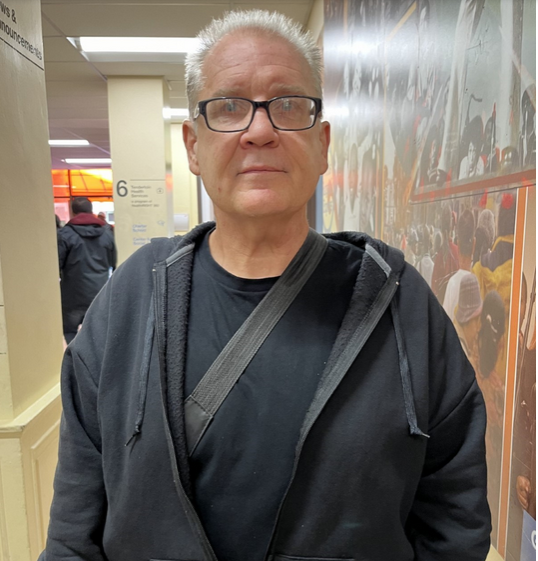
My name is Lewis A. Greene. I’m 60 years old and am originally from Humbolt County. I attended high school in Fortuna. I spent much of my youth living in different towns near the Redwoods, Avenue of the Giants, and Redcrest.  

I came to San Francisco in 2024. I was released from prison after having served 26 years. I now live on Taylor Street, here in the Tenderloin. I was incarcerated for several things having to do with self-defense, gun charges, attempted murder, those kinds of behavior. I received a double-life sentence.  

I was finally paroled from San Quentin. I’ve been out less than 60 days. While I was in prison, I sent out bunches of letters to various organizations in and near the Tenderloin, requesting assistance for when I might get released.  

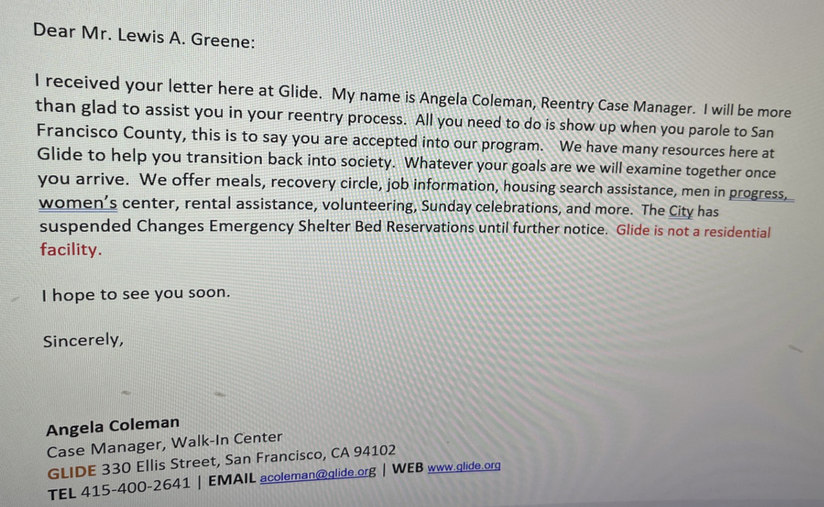
Angela Coleman of GLIDE’s Walk-In-Center responded to me and wanted to know how GLIDE could help me upon my release. “Many times, I receive letters from inmates throughout California wanting to know how GLIDE might be able to assist them with their release and what resources or services we offer,” said Angela. 

Angela shared more of her story.  “I spent 22 months at the California Institution for Women. Then I spent a year in the SF County jail before I finally spent a year at Walden House. I served for four years on San Francisco’s Reentry Council. And our purpose was to help people get out of prison. As a prior inmate myself, I empathize with folks like Lewis, who have done time and know what it’s like when trying to re-integrate yourself back into society,” added Angela. 

Thanks to Angela’s response to my outreach, I was able to secure release from the parole board.  

letter from angela
Angela Coleman's email response to Lewis A. Greene

Once I was out of San Quentin, I was able to secure shelter for myself at a halfway house here in the Tenderloin. But I told Angela how much I appreciated her reaching out to me in response to my letter. 

Her letter helped me get out of prison. It made a difference. It helped to correct an injustice. My hope now is to eventually work for an outfit like Urban Alchemy.   

But I came to GLIDE so I could experience the GLIDE community, and of course, eat one of the most delicious meals I’ve had in 26 years! 

This was more than I could have expected.  

And I wanted to let other folks know that it really can get worse, especially when you’re living out on the streets. And a place like GLIDE is such a tremendous resource and there is help here for those who need it. 

I have a direction for myself now, and it will include volunteering at GLIDE. But honestly, the letter that Angela sent me was so welcoming. It touched my heart.   

boys black transition youth
AI generated image

At GLIDE, we believe that every young person deserves to feel safe, supported, and empowered to build a life with hope and purpose.

That’s why we are so excited to introduce this summer the Transitional Age Youth (TAY) Health and Wellness Center—a welcoming, 24/7 Drop-in Center for young adults ages 18 to 27 who are facing homelessness or housing instability.

The TAY Health and Wellness Center is here to meet young people exactly where they are, offering respite, immediate and coordinated care, vital resources, and long-term support to help them move forward with confidence. 

Whether someone is looking for a warm meal, a safe place to rest, recovery support, or guidance toward education and employment, this Center will be a space of refuge and possibility.

Transitional Age Youth Center
The Center will offer a continuum of care all in one centralized location. Youth can simply drop in and access services ranging from basic street respite to structured group activities and classes. Our caring team will also provide personalized 1:1 case management to help each young person set and achieve their own personal and professional goals.

At the heart of the Center are essential respite services—clean showers, laundry facilities, restrooms, storage space, nourishing meals, pet support, and new clothing and shoes. We’ll also offer hygiene supplies and grooming services to ensure that youth feel prepared to live, work, and thrive in the community. But that’s just the beginning.

We’ll also provide comprehensive case management, health and wellness check-ups, behavioral health services, job readiness programs, and technology education and assistance—all designed to uplift and empower young people to build lasting stability and independence.

Making a difference in the lives of TAY youth
Our mission is clear: to reduce the time that youth and young adults spend unhoused and to help them access the tools and opportunities they need to achieve and sustain stable housing. But we’re also looking deeper—supporting young families led by TAY parents who are raising young children while navigating homelessness. We are committed to walking alongside these families every step of the way.

The Center will be closely connected to GLIDE’s entire network of services, extending the compassion and care we’re known for at our headquarters to this new location at 888 Post Street—just a short, 10-minute walk away from GLIDE.

This work is part of a larger vision. The TAY Health and Wellness Center directly supports San Francisco’s goal to reduce unsheltered homelessness by 50%, and we are proud to partner with the San Francisco Department of Homelessness and Supportive Housing, who have made key investments to help bring this vision to life.

We are beyond excited to open the doors to this beautifully renovated space in this summer. And we know it will take the heart and dedication of our entire GLIDE community to make this a true home for healing, connection, and transformation.

So, we invite you to stay close, because as we move toward Summer 2025, we will be calling on volunteers to help us build, nurture, and sustain this special place of hope and new beginnings.

Together, we will remind every young person who walks through these doors that they are valued, they are loved, and they have the power to shape their own future.

Let’s create this space of care and possibility—together.

As published  in the San Francisco Chronicle today, March 12, 2025 by GLIDE’s President & CEO, Dr. Gina Fromer.

———————————————————————————————————————————

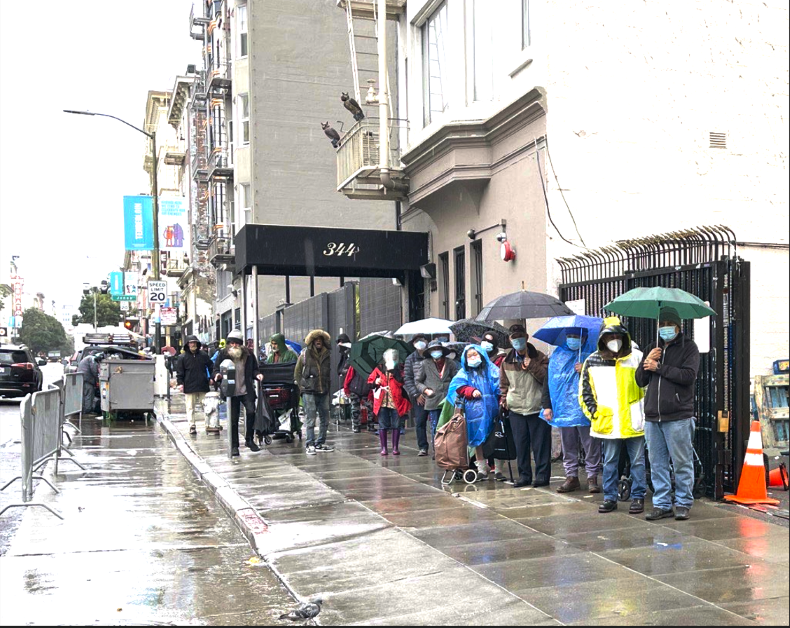
Each week, as president and CEO of the San Francisco social justice nonprofit Glide, I walk past the lines of people who wait for our free meal program. Those lines typically extend a city block.

They’re about to get longer.

Budget proposals by Republicans in Congress could reduce the Supplemental Nutrition Assistance Program by 20%. These cuts threaten all the people who consider this city their sanctuary. If San Francisco wants to be a safe place for the marginalized populations who call this city their home and others who seek refuge here in increasingly uncertain times, food security must be a top priority.

And we have to start now, before any SNAP cuts hit. Planning will take time and it’s a crime to let any child go hungry.

Solving hunger is foundational to solving poverty. For everyone who has never gone hungry, I have an urgent, vital reminder: When you’re hungry, it’s harder to get a job, go to classes, take care of your kids — harder to do just about anything. How can you transform your life and reach for the American Dream on an empty stomach?

We must do better. 

Long before I took my current position, I was a young mother who looked to Glide for help at a couple of down points in my life. Glide treated me with dignity and helped me see that providing food isn’t charity work — it’s justice work.

When we feed hungry families, those families become partners in the struggle to make a better city for us all. Food is the universal language in a city that’s rich with so many cultures.

It’s also a doorway.

People come for the food and stay for a community of life-transforming care. People who come for a meal can also find rental assistance to prevent their eviction, enroll in recovery programs or receive services to support well-being. Their journey to a new life begins with a few simple words: “We’re serving fried chicken today.”

The San Francisco Department of Public Health’s Biennial Food Security and Equity Report revealed that food insecurity rates among people in city programs are up 83%, and this public health crisis will only worsen with the expected cuts to SNAP.

San Francisco’s elected officials, nonprofit leaders and regular citizens must prioritize picking up the slack.

Demand for our meals at Glide dining room in the Tenderloin was up 7% this past year, and increasingly we are serving families, older adults, disabled people and hard-working ordinary people who just can’t afford that second or third meal of the day. Buying food often competes with fulfilling basic housing needs or paying sky-high rents.

The Tenderloin is home to 3,500 children (which makes it the neighborhood with the highest density of children in San Francisco), but it doesn’t have a single full-access grocery store. As of September 2024, over 106,000 people in San Francisco received CalFresh, the state food assistance program, but they still struggled to get all the nutrition they needed. Children and older people make up nearly 60% of CalFresh recipients in San Francisco. Uncertainty over the future of these benefits has never been higher.

The same innovative energy used by city officials to address the fentanyl emergency should be used to address the food access emergency that SNAP cuts will cause. Legislation that expedites city access to philanthropic dollars and improves cooperation between city departments and outside partners is something to pursue now. That way, we’ll be prepared before the shortfall hits.

Should San Francisco leaders pursue a food access emergency ordinance, the recommendations of the city’s Food Security Task Force will be invaluable: It already has studied ways to reduce silos and streamline referrals. It also recommends relying on the leadership of people with lived experience of food insecurity.

Those of us who understand what it feels like to be hungry see things a little differently.

Over the years, Glide has advocated for an emergency food system, immigrant food access and more CalFresh benefits. We have made progress by successfully advocating for free breakfast and lunch for all children in California’s public schools, greater access to fresh produce, farmers markets, summer meals programs and funding for San Francisco food programs.

Elected officials can start partnering now with nonprofit and community programs to create a centralized, long-term, citywide food plan so all our anti-hunger funding is targeted and coordinated. This food plan should focus on reaching high poverty areas with culturally appropriate foods.

Regular citizens can help by donating or volunteering at any organization that feeds low-income people.

You can also write or call your representatives asking them to oppose cuts to SNAP and support the federal Child and Adult Care Food Program, which reimburses childcare and adult daycare centers for food costs.

I hope all of us are up to the challenge of keeping San Francisco fed. 

Dr. Gina Fromer, President & CEO of the Glide Foundation

———————————————————————————————————————————

Take action today by writing your leaders!

Ask them to oppose cuts to SNAP and support the federal Child and Adult Care Food Program, which reimburses childcare and adult daycare centers for food costs.

I know that every day it feels like something new and alarming is happening on the news. I don’t want you to be overwhelmed, I don’t want you to give up. Always remember you’re part of a community that’s making a difference.

At GLIDE, we are taking concrete steps to make sure the future is one where everyone receives the love and support they need. You can help us make it happen!

So I’m asking you: please sign up to join our Justice Warriors team. You can join this amazing group of GLIDE community members who have been working tirelessly for years to advocate for racial justice, housing and homelessness justice, community health, and intergenerational support for women and families. We write letters, advocate to government officials, send emails, and hold rallies– let us know your preferences for getting involved. Big or small, every action matters and is needed now.

GLIDE stands in solidarity with our clients, staff, and community– with special attention and care for groups that are being targeted right now: immigrants, refugees, LGBT+ people, and BIPOC of all kinds. We will NEVER stop being a sanctuary for all. Our meals and services are for everyone, regardless of documentation or identity! 

Currently, our Center for Social Justice is fighting against budget cuts for sanctuary cities and against scapegoating Black, Brown and LGBT+ people for the overdose crisis. We are offering a monthly unconditional legal clinic, in partnership with the SF Bar Association, for clients who need legal help. 

We have immigration resources on our website, and of course no ICE officer will ever get past our lobby without a warrant.  We also have some projects in the works to better support homeless youth– nearly half the homeless youth in SF are LGBT+. Please stay tuned for updates on how you can help. 

It’s outrageous that churches have been removed as “sensitive” zones: people of every identity should have the right to be themselves– the right to worship in safety, peace and freedom. That’s why we must fight back in the war against diversity, equity, and inclusion. I’ve seen DEI attacked so many times. My husband even wrote a book called Race Track about the dynamics of institutional racism and fighting for equality. This is not a new battle for me. 

As we all know, one of the great heroes of this battle was the Reverend Cecil Williams.  As a child, his most cherished dream was to desegregate the church. Those who choose to engage in a “War on DEI,” are working against Cecil’s dream for all humans to live, pray, and work together in love and togetherness. But I have faith that hatred won’t win. Our love is stronger. 

Join us in the fight. Uphold Cecil’s legacy. I’m counting on you! 

Yours, 

Dr. Gina Fromer

stage lateefah simon malia cohen 2025 glide sanctuary
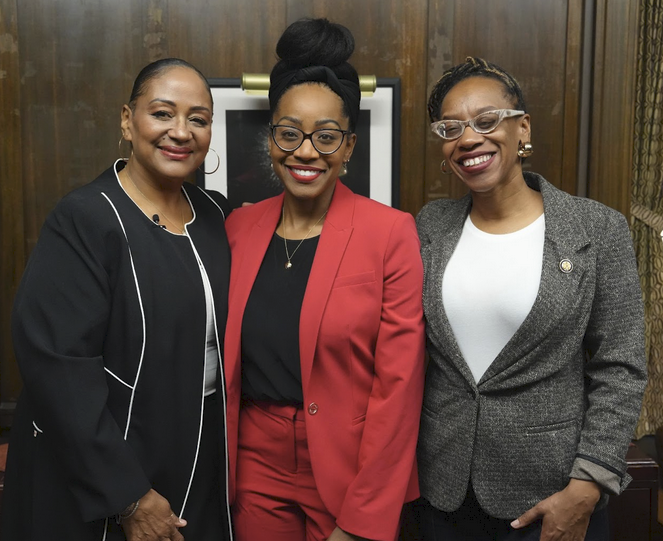
(L) GLIDE President & CEO Dr. Gina Fromer, Malia Cohen, & Lateefah Simon

What better way to celebrate Black History and Black Futures than to have three brilliant Black women on Glide Memorial Church’s stage representing nonprofit, local and state level leadership!

It was a night of humor, inspiration and a call to action last Thursday when Dr. Gina Fromer moderated a discussion with Controller Malia Cohen and Congresswoman Lateefah Simon. 

Before diving into current affairs, we all were so happy to learn of the deep personal connections shared between Cohen and Simon as they reminisced about Simon’s grandmother, Betty Simon, attending Cohen’s father’s church.

Also, how Cohen and Dr. Gina were connected decades ago from their work in Bayview.  It was so much fun to witness the wit, charm and connection among all three women on stage. 

The discussion covered topics that are on everyone’s minds – from the attacks on Bishop Budde when she stood up for the rights of immigrants and LGBT youth, to the attacks on organizations that center marginalized groups or have DEI training programs.

Collectively, we processed the disruption of the world we know.  Federal employee layoffs, delays in processing tax returns, the lack of guard rails to protect our data from DOGE– it’s a lot for all of us to process!

And our speakers warned the community to brace themselves for yet more chaos down the line. They also said, “We’ve seen this before: it’s time to lean into community, and dust off the Black Panther Party policies.” They pointed out there is opportunity in chaos: perhaps people will now finally understand the urgency of building a new system. 

It was clear that Cohen and Simon had differing, but complementary approaches to change. Lateefah Simon told a story of working for Kamala Harris only after she was assured she could get people out of prison and live her revolutionary values.

Malia Cohen’s approach to liberation focuses a great deal on financial literacy as a path to personal freedom. Although they approached liberation from different perspectives, they had a strong rapport from supporting each other throughout their unique challenges. GLIDE loves helping bridge diverse perspectives at our events.

The event closed with this advice: “We don’t have power over the government but we have people power.”

We must learn to leverage our people power in the days and weeks to come. One great way to do that is by signing up to join GLIDE’s Justice Warriors. We hope to see you in the future writing, phone banking, and marching with us!

chris medina glide client success story
(L) Christopher Medina, (R) GLIDE client Kendall Davis

It was MLK Day, January 20 and GLIDE was open only for breakfast. We were serving prime rib and eggs. I was downstairs in the kitchen. I didn’t notice this guy come in, at first. But I noticed he was eating rapidly; I mean, he was scarfing down his food like there was no tomorrow. It was shortly after that I left the kitchen, that GLIDE Meals Navigator Diane Truong came running to me, telling me there is a man choking.  

I ran back. Four co-workers attempted to pad him on his back. But the man was not responding. His face started turning purple. That’s when I knew it was time to spring into action. His body was getting weaker. And he collapsed to the ground. I looked into his face and knew he was about to die. 

I picked him up. He bent over. This is the first time I performed the Heimlich maneuver. Now I’m certified in CPR. And I have saved lives using Narcan. But I put my all into it. This guy was only about 5’2, 120 pounds, maybe. I’m 6’2, and 270 pounds.  

He seemed very light to me. But it hit me afterwards. I started realizing that this was not the first time this man had put his life in jeopardy. But I knew that if I was unsuccessful in getting that giant piece of meat stuck in his upper airway, he would have died.

If I had not been there at GLIDE on that day, this man would not be alive right now. And you have no idea how good it feels to have saved this man’s life.  

Four people tried to save him. And now it was up to me. And I succeeded. I had never seen this guy before. Ever since, he makes the effort to come by and see me every day for lunch and thank me. I feel like I’m an angel to him. It feels good; I won’t deny it. But I’m happier that he seems to be more thankful for his life.  

I found out he’s a Vietnam vet. His name is Kendall Davis. He’s been kicked out of his housing or transitioning into other housing for years. Without a steady place to live, he’s been juggling so many things, and that’s why coming to GLIDE for his meals has helped him so much.  

I look forward to coming to work every day at GLIDE. What I’m doing now is what I was born to do. You get such an adrenaline rush when you save a human being’s life. It makes coming to GLIDE even more exciting. You want more out of life yourself!   

I thank God for giving me the wisdom to be alert to my surroundings and being able to act fast enough and respond to situations like these, all the while staying calm. Prior to coming to GLIDE, I was busy saving lives using Narcan at SF Public Works. So I’m no stranger to it.  

Christopher’s Story of Recovery and Employment at GLIDE  

My day starts at 4:30 am here at GLIDE. I’ve been working here since September 2024. Since I was 17, I was an alcohol and crystal meth addict.  

When I came to SF, I knew I had to check myself into rehabilitation and visited St. Anthony’s. I did some training at the San Francisco Pit Stop. But whenever I was hungry, I went to GLIDE.

Once afternoon for lunch, while I was there, I saw Donna LaSala (GLIDE’s COO/CIO) pass by. And not knowing who she was, I asked her about employment. I told her I had de-escalation training. She told me to fill out an application. I had a phone interview and before I knew it, GLIDE offered me a job. 

I’ve been sober for three years now. Put your pride to the side, is what I say. I’m 43. I’m not ashamed of my past. I don’t have a foggy mind anymore and no longer do I have the urge to vomit or feel nauseous. I feel blessed. 

Christopher Medina
GLIDE Community Safety Monitor

Food Insecurity and Second Chances

Editor’s Note: Eating fast can be a psychological symptom of experiencing food insecurity, and it’s something we see in many of our clients. By building supportive bonds between staff and clients, we can create a safe space where folks can slow down.  

Christopher’s story of recovery and fulfillment at GLIDE is far from unique: we specifically hire people to work with clients who can relate to their experiences. Providing employment opportunities to people the system overlooks is very important to us. Everyone deserves a second chance at a good life.  

Rwanda Michael Lezak 2024

I made pilgrimage to Rwanda this past summer. As part of my racial justice and healing work at GLIDE, I was among 15 American religious leaders invited to an Aegis Trust conference commemorating the 30th anniversary of the Rwandan Genocide against the Tutsi.

Their neighbors killed close to one million people in 100 days in Rwanda in 1994. We visited genocide memorials and mass graves; we sat in reconciliation villages where perpetrators and victims live side by side; we heard testimonies and learned about concrete paths of healing and hope-building that this tiny little country has claimed.

I have a million stories I could tell you from my time on the ground there. Here’s one for now. 

I landed in Rwanda at 1am on a Wednesday. At 8am that morning, I took a 90 minute taxi ride outside of Kigali to the Agahozo-Shalom Youth Village.

The village was founded in response to the unspeakably sad and brutal orphan crisis caused by the Genocide Against the Tutsis. The word ‘Agahozo’ is a Kinyarwanda word that means ‘a place where tears are dried” and of course the word ‘shalom’ means ‘peace’ or ‘wholeness’. “Through healing, education, and love, this light-unto-the-Nations Youth Village empowers orphaned and vulnerable Rwandan youth to build lives of dignity and contribute to a better world.

This village helps to fill the gaping holes left behind after the genocide.

africans rwanda

Agahozo Shalom is located on a pristine, 144 acre pristine hilltop site in Rwanda’s Eastern Province. On my tour, I not only saw the camp-cabin like residence buildings where 25 students and one house-mama live together, I saw the classrooms and the technology labs and the outdoor amphitheater and the massive dining hall that can seat 700 people.

I watched as students from deeply troubled-backgrounds greeted their teachers with a sense of gratitude and respect. Richard Niyibira, the lead educator, told me humbly, that after several years of learning and relationship building, many of his students ask if they can call him ‘father.’ 

Agahozo-Shalom Youth Village in rwanda

Agahozo Shalom is modeled after a kibbutz-like Youth Village in Northern Israel called Yemin Orde. Situated on top of Mount Carmel, 20 minutes south of Haifa, Yemin Orde was founded in the winter of 1953, eight short years after the end of World War II and the systematic annihilation of European Jewry.

Yemen Orde’s founding mission was to create a safe haven for children orphaned by the Holocaust, after the darkest years in all of Jewish history. In the years that followed, thousands of these orphaned children were welcomed and housed and taught and loved at this 77 acre-hilltop oasis. In the 1970’s,

Yemin Orde became a village for at-risk youth from all over the Jewish world and Israel: vulnerable Jewish, Christian and Muslim youth are housed together, learn together, build community together and work together on building visions for a shared future.

How did the hilltop miracle that is Yemin Orde come into existence?  Reading about and seeing the shockwaves of trauma after the Holocaust, leaders in the British Friends of the Youth Aliyah movement raised funds, secured land and hired educators and trauma-oriented therapists who could welcome and love and begin to heal these Jewish children whose parents had been murdered in Nazi Europe.

Soon after the 1994 genocide, Anne Heyman, a South African born Jewish philanthropist who knew about Yemin Orde envisioned that there should be a Yemin Orde like sanctuary in Rwanda for the tens of thousands of now-orphaned children after the genocide. Thanks to Anne’s fierce determination along with thousands of partners and co-creators on the ground in Rwanda and around the world, Agahozo Shalom opened its gates in 2008. 

Tragically, Anne died six years later at the age of 52. When I arrived at Agahozo Shalom this past summer, I met with one of Anne’s friends named James Smith, who along with his brother Richard, founded the Aegis Trust. At the same time that Anne and her team were building Agahozo Shalom, the Aegis Trust was helping, at the request of Rwandan authorities, to help build the Kigali Genocide Memorial.

Here’s what James told me about Anne:

‘In all honesty when I first heard about what she planned I wasn’t sure that it was possible or sustainable.  Yet she made the village operational within three years of the idea. There’s a mango tree at the village, planted to mark the time when the negotiations with all the landowners was complete. I will never forget when she told me about those negotiations and when she showed me the tree. It represented significant work undertaken before there could be detailed plans, work that was about building trust with the communities and local authorities.  Securing the hill upon which the village would be built meant that Anne’s vision could begin.’

The 13th Psalm pulses with questions, pleas and screams:

How long, O God; will You ignore me forever?

How long will You hide Your face from me? 

עַד־אָ֨נָה אָשִׁ֪ית עֵצ֡וֹת בְּנַפְשִׁ֗י יָג֣וֹן בִּלְבָבִ֣י יוֹמָ֑ם עַד־אָ֓נָה ׀ יָר֖וּם אֹיְבִ֣י עָלָֽי׃ 

How long will I have cares on my mind,

grief in my heart all day?

How long will my enemy have the upper hand? 

הַבִּ֣יטָֽה עֲ֭נֵנִי יְהֹוָ֣ה אֱלֹהָ֑י הָאִ֥ירָה עֵ֝ינַ֗י פֶּן־אִישַׁ֥ן הַמָּֽוֶת׃ 

Look at me, answer me, Adonai, my God!

Restore the luster to my eyes,

lest I sleep the sleep of death

The Psalm turns a corner at the end. After all of the pain, after all of the anguish, after all of the grief, the Psalmist reclaims agency, reclaims faith and reclaims hope and a redemptive vision for the path of healing ahead:

וַאֲנִ֤י ׀ בְּחַסְדְּךָ֣ בָטַחְתִּי֮ יָ֤גֵ֥ל לִבִּ֗י בִּֽישׁוּעָ֫תֶ֥ךָ אָשִׁ֥ירָה לַֽיהֹוָ֑ה כִּ֖י גָמַ֣ל עָלָֽי׃ {פ}

But, you God, I trust in Your chesed, in your lovingkindness,

my heart will exult in Your redemption, in your deliverance.

I will sing a new song to you O God,

for You have been so good to me.

Here’s how James closed his note to me about Anne Heyman:

 “I can’t believe it was only seven years later that I attended the memorial held for her by the students, who spoke about her as their mother. When I reached the mango tree I could not stop weeping. Not because of the loss of such a dear visionary friend, though I did, and still do, mourn her. It was because  Anne created something transformative. It wasn’t the bricks and mortar on the hill that was her achievement, though that is of course impressive. 

It was something more beautiful than that. I’m not sure what to call it. Perhaps the closest word we have is love, a love that touched a myriad of hearts. 

As the name of the village describes, Anne did dry the tears of a thousand crushed souls, restoring peace and affirming life.  From the dark days of genocide she and the Heyman/Merrin family turned a hillside in Rwanda into a small piece of heaven.’

Rabbi Michael Lezak
GLIDE Social Justice Director