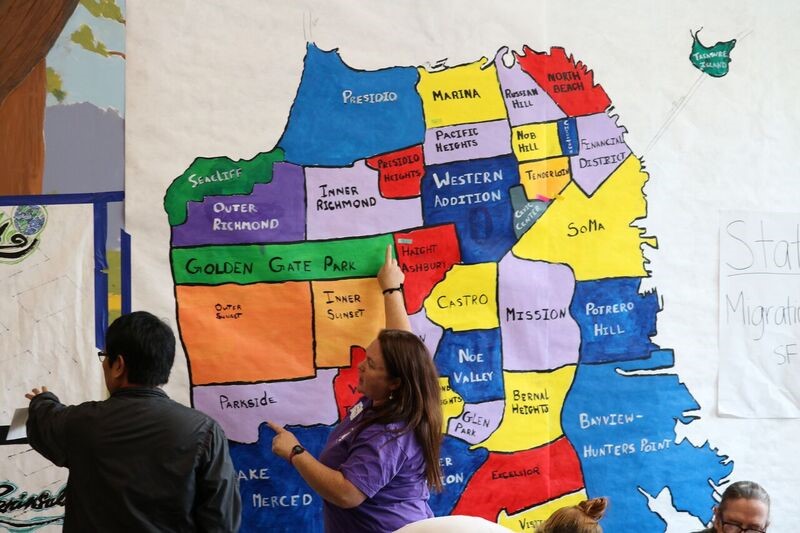
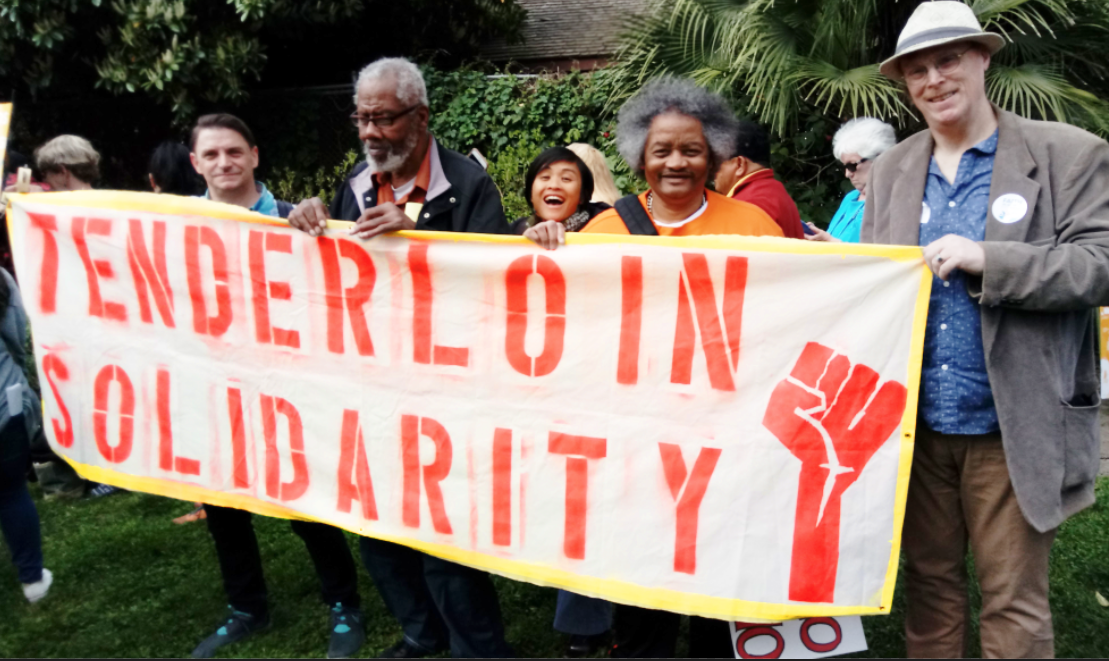
This week, our first of many Development Without Displacement Community Workshops met in collaboration with over 80 residents and nonprofit allies. We talked about displacement and how to create a neighborhood and a city where we can all live in the neighborhoods we’ve been a part of for so long. Continue reading “Eye on the Ball: How to keep housing, for you and everyone in the Tenderloin”
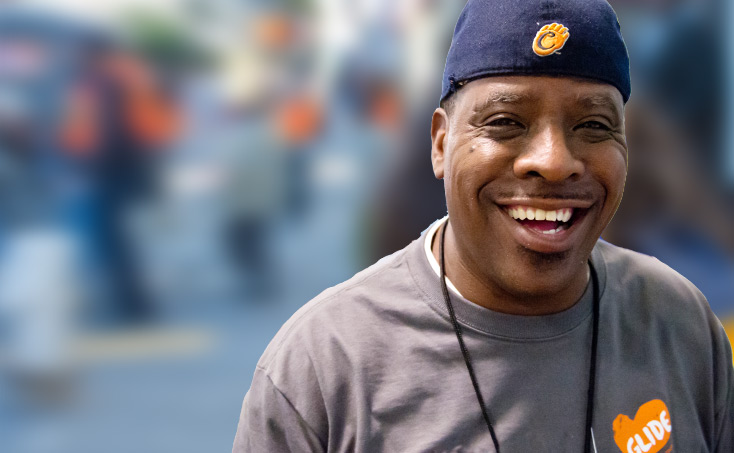
Jonathan Fennell has worked at GLIDE for over 17 years, and seen a lot of changes during his time here. As San Francisco celebrates the 50th Anniversary of the Summer of Love, members of GLIDE staff are reflecting on how the Church and Foundation have evolved over time. We were thrilled to catch up with Jonathan after the lunch shift one day to hear his thoughts. Many thanks to Jonathan, a dedicated employee and integral member of the GLIDE family, for taking the time to talk about his life experiences and the values he shares with GLIDE!
I have been at GLIDE for 17 years. I came here in 2004. I was on GA [General Assistance], and I knew about GLIDE because my dad used to work here. My dad was here for 10 years way back, when it first started. He was a right-hand man. He did accounting. In fact I met Cecil when I was eight or nine. I really didn’t know much about GLIDE, so one day I decided to come and volunteer. I was here for four days, just volunteering. They asked if I wanted a job and I have been here ever since.
I am a shift leader/supervisor in the Meals Program. I am responsible for cooking, making sure the kitchen is set up, making sure everybody is here on time, making sure everyone knows what they are doing. If someone is late, they call me and let me know that. I make sure everything runs right.
I was born and raised in San Francisco, in 1960, at St Luke’s Hospital. When I was born I was 90 days premature; I only weighed one pound and 14 ounces. I died three times. The doctors brought me back to life three times. That is one reason my parents named me Jonathan, because it means gift from God.
Our programs have helped people in the Tenderloin or wherever they live at in San Francisco. I have seen tremendous progress. And I have seen all the employees grow and become better people, seen them learn and respect people for who they are.
I’m from Pacifica, but I live in Excelsior now in the family house. It was my aunt and uncle’s first, then my mother and father moved in. Now my cousin owns it and my mother and I are in it, as my cousins are in Texas. My dad has gone on to bigger and better things.
Changes over the years Here at GLIDE, I have seen security change over the years, each year getting better and better. It’s similar to the Meals Program. When they first started frying chicken back then, they were only frying chicken thighs and you could only eat one time. As the years progressed and the money got better, the food got better and GLIDE’s programs have gotten a thousand times better.
Back then everyone was on crack, everyone was on drugs—the programs have helped people 100%. They really didn’t have the medical program back then like they do today. Programs like the Women’s Center—when I first came it wasn’t here. Our programs have helped people in the Tenderloin or wherever they live at in San Francisco. I have seen tremendous progress. And I have seen all the employees grow and become better people, seen them learn and respect people for who they are.
Jonathan with the superstar GLIDE Daily Free Meals Program Team. They are always looking for more volunteers!
Proud moments at GLIDE I made a one-week job turn into 17 years—that was my proudest moment. This is the longest I have ever been at one spot, and I am 57 years old! I have had jobs—three years here, four years there, but this here is a place where I have seen myself grow and I have become a better person. I could cook a little bit then but now I’ve started cooking for my mother and grandmother. I have seen myself progress. Some of my best moments were right when I first got hired.
I just want to grow with GLIDE as long as they are here. Because all good things must come to an end and nothing lasts forever. But I just take it one day at a time, take a personal interest in how I can better myself or how I can help better someone else.
I saved someone’s life once. He was choking on a chicken bone and I had to do the Heimlich Maneuver. It took about 30 seconds but it came out. That is probably my greatest accomplishment, saving someone’s life. It’s just the struggles I have been through, since I have been at GLIDE. I have been to an alcohol program twice. You get struck down sometimes but I have learned from it. Straight road to recovery.
All I can do is thank God that I have a job, thank God we all have a job. I just want to grow with GLIDE as long as they are here. Because all good things must come to an end and nothing lasts forever. But I just take it one day at a time, take a personal interest in how I can better myself or how I can help better someone else. Whether it is a client or somebody that works here, if I can help with their growth and help them understand that once you walk in these front doors, let outside stay outside, and let GLIDE be GLIDE.
Cooking family-style I have done it all. Fried chicken is GLIDE’s mainstay, but I really love spaghetti. I made spaghetti here one day and they loved it. We made it out of ground turkey. When you cook ground turkey it can be watery so you have to let everything reduce down. And we have brisket for the Mother’s Day celebration. I think actually my favorite thing is cooking for the holidays, when they have the special parties.
GLIDE has been around 54 years. This is one big happy family. Without GLIDE, a lot of these people wouldn’t know what to do, and that is why I love this place.
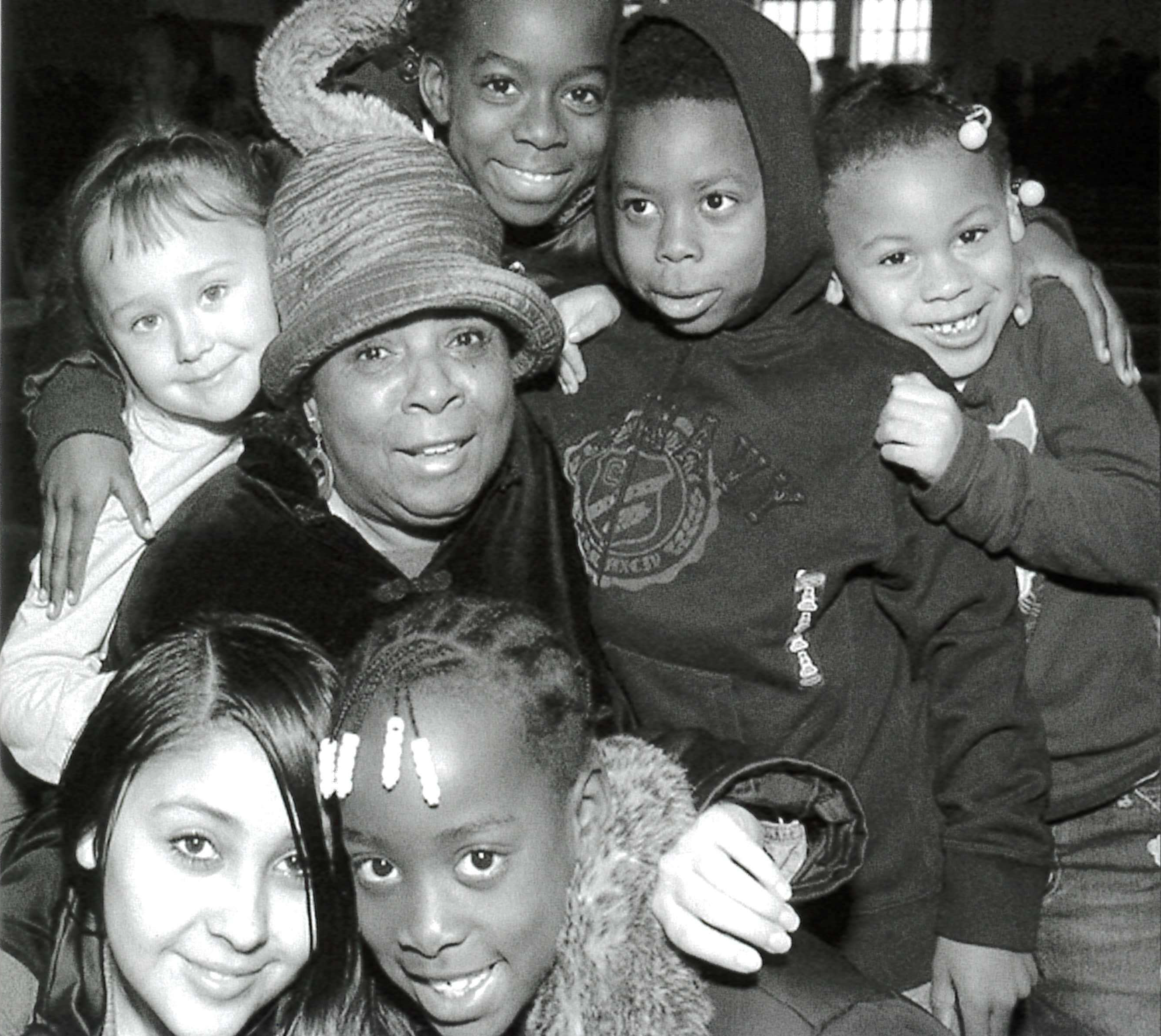
On May 23, 2017, an irreplaceable member of the GLIDE family and essential figure in our organization’s history passed away. Joyce June Hayes first came to GLIDE in 1971 as a church member, and quickly became instrumental in developing GLIDE’s early children’s programs, which later became the Janice Mirikitani Family, Youth and Childcare Center in 1991. While at GLIDE, Joyce served in many roles from resident writer to Youth Program Director. Joyce’s love was boundless and in her life was foster mother to 87 children from the community.
GLIDE Co-Founder Janice Mirikitani described those early years with Joyce and the kids.
“We started with 15 latchkey kids running the streets of the Tenderloin, giving them tutoring, books and shoes and school supplies,” remembers Janice. “The program grew through the months until we had to take down walls to make a bigger space for all the kids, volunteers and parents in the program, but Joyce was the heartbeat of it all. She worked two other jobs and volunteered here every day, including every Sunday, with mostly homeless kids or small children whose parents were on drugs and left them to her.” “Joyce pointed a new way for saving children, and that was through her love,” says Rev. Cecil Williams, GLIDE Co-Founder and Minister of Liberation.
In the 1980s, Joyce became the director of the Children and Families Program. Sometime later, the building at 434 Ellis Street that is now the Janice Mirkitani Family, Youth and Childcare Center was offered to GLIDE at a favorable price. Janice and Joyce worked to raise the money to remodel the building in order to make it the safe and welcoming space it is today.
“I always said to Joyce, we bought this building for you,” Janice recalls. In 2001, Joyce received the prestigious Congressional Angels in Adoption Award from Nancy Pelosi for her commitment to making a difference in the lives of children and families through her work at GLIDE as well as by being a foster parent for so many years.
“I do it because the need is there,” Joyce used to say. “I love the spirituality at GLIDE. Here, spirituality means action, seven days a week. When I first came to GLIDE, it changed the concept of what I wanted to do with my life.”
“I met Joyce when I was a teenager,” remembers La Monica Hopkins, FYCC’s Education Director. “At that time my grandmother, Etta Page, worked at GLIDE in the Celebration office as a receptionist. I would come to GLIDE a little infrequently, mostly for church. I became better acquainted with Joyce as a mentor when, as an adult, I applied to be one of their Licensed Childcare Teachers in 1999 when FYCC was being renovated. I remember Joyce telling me, ‘I won’t be in your interview because I already know you,’ which I really appreciated honestly because it was important to me to get the job not because I knew Joyce or was related to my grandmother but because the interviewer felt that I was the right fit for the position.
“Joyce was the on-site model of the vision for FYCC,” says La Monica. “It’s important to have someone who is always living a vision of a place like FYCC. From her I learned compassion organically. Not by just what she said, but by what she did. Beyond what I already knew or where I grew up. She encouraged me to always be accepting of others, consider their faults but never to judge them for them. To think beyond my assumptions and ask more questions empathically. Through her eyes and way of being I could literally feel what compassion was supposed to feel like even when I didn’t agree with the way something was being done.”
“Joyce, who we called Joy back in the day, was the most loving, kind and compassionate woman I have known,” says Janice. “She loved to laugh and make others laugh. Her unconditional love for all people, but especially children and teenagers, is the model of how holistic healing can save the lives of the most vulnerable among us. Her beautiful smile and laughter is contained in GLIDE’S walls, and I can still hear the echoes of her laughter in our rooms. I am reminded, each time I look into the faces of young people, of the power of love, the comfort of kisses, and the warm embrace of a mother—Mother Joyce Hayes, who took every child in need into her arms.”
GLIDE is blessed and privileged to have had the support, talent and love of Joyce Hayes through the decades. So, too, is San Francisco. On June 13, on behalf of the City, District 6 Supervisor Jane Kim introduced and presented a posthumous Certificate of Honor for Joyce, accepted by her daughter Jayne Rovianek, in recognition of Joyce June Hayes’s many accomplishments and her fostering 87 children over four decades. Her legacy of love is vast, and she remains a model of how each of us can save one life at a time through our own commitment, passion and perseverance.
There will be a Celebration of Life on June 4th at 1:00 PM in the Sanctuary. A reception will follow the services in Freedom Hall.
Reverend Harry Williams talks about the Nation, our City, and Low-Income Housing
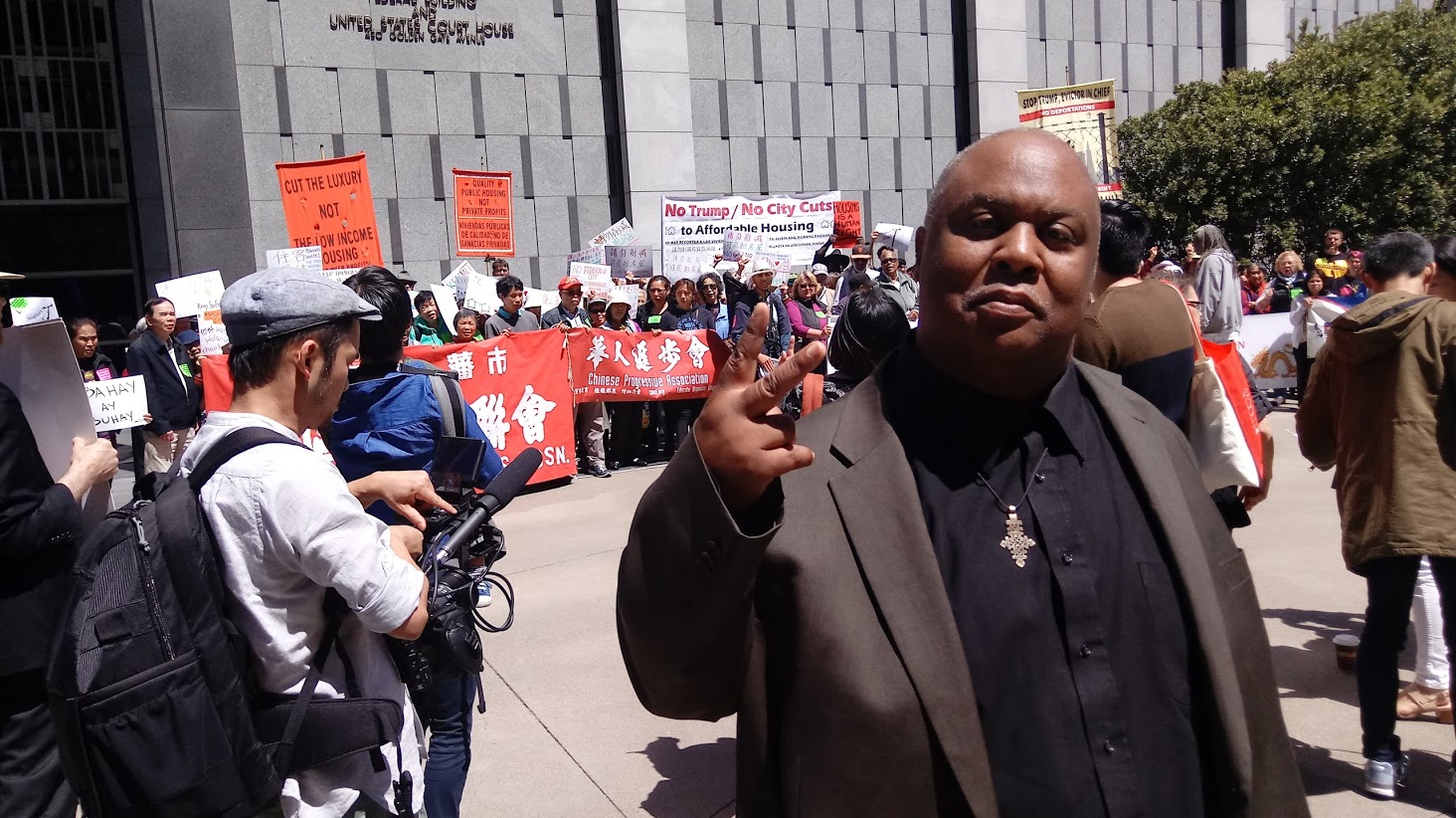
On April 27, Reverend Harry Williams, representing GLIDE Memorial Church and the Tenderloin, addressed a rally on the steps of City Hall. The rally, which started at the Federal Building and numbered several hundred people, was there to urge the planning commission to recommend against halving the 12% of new housing that is currently dedicated to low-income families and individuals. This is a mandate from the people of San Francisco, as a super-majority of voters turned out in elections last year to support more affordable housing across the income spectrum. Continue reading ““You all ready to fight?””
A conversation about Standing Rock, solidarity, and faith with GLIDE Seminary Intern Todd Whitley
How has Standing Rock figured in your time here at GLIDE? The first time I preached at GLIDE I spoke about Standing Rock. I was scheduled to preach on the first day of Advent in 2016. The sermon was based on that verse that says, “To whom much is given, much will be required.” I used that verse as a way to talk about privilege—whether that’s white privilege or male privilege or cis-gender privilege — and leveraging it for groups with less privilege.
The Gender Summit that I am helping to coordinate for the weekend of May 5 — 7 is one of those ways of leveraging privilege. Part of the reason for the summit is to help people be allies. A lot of people just don’t know what to ask. And they are afraid to ask, or they don’t know who to ask, so they won’t do anything because they don’t want to offend anybody. That’s the last thing that they want to do. We want to tell people, “Here’s what you need to know, in a place where it’s safe to ask questions.” If you can’t do that at GLIDE, where can you do it? Continue reading “"The Work Is Resistance"”
In honor of Women’s History Month, and on this International Women’s Day, we begin a series of posts focusing on the role of women in resisting oppression and advancing social justice. At a time in our nation’s history when overt, unabashed sexism, misogyny and homophobia are on the rise, encouraged by those in power, we at GLIDE remain committed to lifting our voices in demanding gender equity, freedom and dignity for all. This month, people from across GLIDE’s extensive community are responding to the following question: “When you think of the role of women in the advancement of social justice and resistance to oppression, who comes to mind as an inspiration?” Continue reading “Embracing Our Power, Giving Voice to Our Possibilities: Women’s History Month at GLIDE”
We are proud to share this second installment of reflections in our Women’s History Month series honoring women’s roles in resisting oppression and advancing social justice. GLIDE remains deeply committed to the struggle for gender equality. In the current national climate, it is more crucial than ever that we resist and repel the misogynist forces arrayed against us, and that we unconditionally stand with the women and LGBTQI people who are put at risk under the dangerous policies of the current administration.
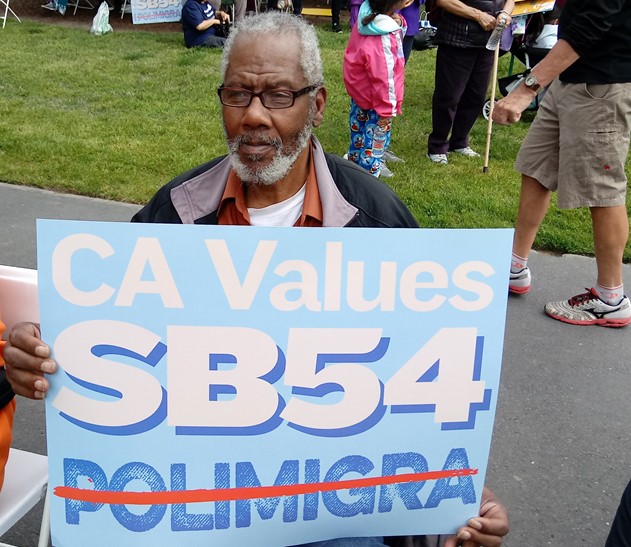
Last Wednesday, GLIDE joined over a thousand Californians gathered at the state’s capitol to support the passage of SB 54, “The California Values Act.” The bill was introduced by State Senate President Pro Tem Kevin de León in December, and if passed, the law would extend “Sanctuary City”-style protections to the entire state, prohibiting local law enforcement agencies from sharing information with federal immigration officials.
In our concluding post in honor of Black History Month, we offer the following excerpts from a recent conversation with GLIDE’s Isoke Femi and James Lin about the African American roots of GLIDE’s ethos of radical inclusion.
Isoke Femi: People who have studied African cosmology have recognized syncretism as a quality of the African consciousness, which is about bringing in and including various [ideas and influences] in the common [culture]. Part of what got Africans in trouble with Christian [missionaries] was that tendency. Because Africans said, “Jesus was cool! We’ll adopt him as a deity.” And the church fathers were like, “No, no! He cannot be one of many, he has to be the one.” There’s something about that that feels like it’s at the root of this idea of inclusion—that we can include almost anything. That’s one of the jump-off points for me.
James Lin: I came to GLIDE without any background. What I noticed was that people behaved differently here from what I thought was normal. It showed up in a bunch of ways. One example is [GLIDE staff member] Iris Butler. Iris has a way of addressing people who are, for example, breaking some rule, that really strikes me. Let’s suppose you’re having a really bad day, and you’re screaming and shouting, basically causing a ruckus, or trying to cut in line for the Meals Program. Instead of just commanding you to “settle down!” or trying to do that nice polite thing, “Please, Sir…” Iris will come up to you and say, “Hey. We don’t do that here.” There’s something about the way she says it that says, “You’re part of this ‘we,’ and I believe that you can hold yourself to a standard if I say to you, ‘Hey, this is the way it is. And you belong here.’”
I think part of this attitude of inclusion results from being forced together and being forced to hold each other accountable. You had to figure out how to govern without kicking people out. That was just not an option. You develop a brilliance for how to intervene and how to talk to somebody.
Isoke: I want to bring in another cultural antecedent to that. You had this rich community of people who were enslaved. They didn’t come from the same tribes; they didn’t originally speak the same languages, didn’t have the same customs. In Africa, they might have been at odds with each other; but here, they had to figure out a way to be on this continent. You couldn’t exile people. There was nowhere to exile them to! You had to figure out how to keep them in and contain everybody’s madness, and even sometimes relate to it.
I think part of this attitude of inclusion results from being forced together and being forced to hold each other accountable. You had to figure out how to govern without kicking people out. That was just not an option. You develop a brilliance for how to intervene and how to talk to somebody. And not everybody has it, not all Black people have it, but the culture supports it in some ways so that a significant number can hold that for the rest of us.
James: I think that phrase is central: Kicking people out is not an option. Exclusion was the bread and butter of how I was raised. There was always the threat that if you don’t do it right you’re cut off, you’re no longer a member of this family. The threat of exclusion [was real], even though it never happened. But GLIDE is a place where that threat is not available, and you see that in the Meals Program. If you can’t be downstairs in the Meals Program because you didn’t take your meds, we have bag lunches. We never don’t feed people.
Isoke: I remember my mother had antipathy for some people in the community where she couldn’t stand the sight of them. But if she found out they were sick, or they didn’t have anybody to cook for them, she’d cook something and say, “Take this over to that tramp, that son-of-a, take this over because I can’t stand nobody to be hungry. I can’t stand it. I can’t stand nobody be hungry.” So while you couldn’t kick people out, you had to be able to be real, otherwise it would have been impossible. So people would say, “You know, you gettin’ on my last nerve.” You couldn’t hide, and you can’t hide how you’re being affected by people. There was a lot of truth-telling, which I think helped people to not exile you. “I just gotta tell you how I’m feeling about you.”
James: I do want to say that the particular way that this [cultural history] manifests at GLIDE goes significantly beyond just the cultural norms that we’re talking about because of the way that Cecil and Janice arrived here and immediately started working with the LGBT community. It clearly wasn’t a norm that they inherited. Cecil takes that radical inclusion to another level and into the universe. He’s one of those people who is basically looking back and thinking, “Who is next? Who else needs to come through that door?”
Isoke: Even in the way he talks about his family, as a family in which you just didn’t know who was going to show up. Everybody could show up. And he wanted to expand and extend that.
Isoke Femi is GLIDE’s Maven of Transformative Learning. James Lin is the Director of GLIDE’s Center for Social Justice.