
gina, bullhorn, proposition 1, 2024, february

Earlier this week, I attended a rally outside of Boeddeker Park here in the Tenderloin to address the dire consequences of the fentanyl epidemic.

At this rally, I shared a message that GLIDE stands ready to combat the overdose epidemic ravaging our community using any effective tools at our disposal.

I joined fellow community members to mourn the tragic and preventable deaths from this epidemic and share how GLIDE is actively working to expand treatment programs that address this public health crisis.

This includes reducing risk for drug users through proven health interventions, promoting full abstinence and sobriety, and creating safer spaces for the community at large.

I want to reassert and clarify GLIDE’s commitment to this work. Since the beginning of the AIDS and crack epidemic, GLIDE has implemented harm-reduction strategies to curtail the spread of disease and reduce stigma and shame.

GLIDE strongly believes in embracing this approach to minimize the risks of drug use rather than criminalizing substance use disorders.

We are committed to working with the community, the City and those directly impacted to address the overdose epidemic we are experiencing at an unprecedented level. At GLIDE, we believe Harm Reduction promotes health across a broad continuum.

We are resolutely committed to addressing a public health crisis that has taken more than 800 lives from us in 2023 alone. One overdose is one too many. 

Overcoming the overdose epidemic is not a one-size-fits-all all approach. GLIDE provides a 360-degree view of this issue, with services ranging from Safe Syringe Access to Narcotics and Alcoholics Anonymous.

We meet people where they are, in the spirit of radical inclusion and unconditional love, recognizing that substance use is a health issue (not a criminal issue) and therefore is addressed most effectively through public health interventions. We strongly believe the best way to treat a disorder is through data-driven and effective public health interventions. 

Our message is simple. 

For anyone who walks through the doors at GLIDE – we see you, we love you, your life matters, and we will accept you exactly as you are. To fight the overdose crisis, we have more work to do, and we won’t stop until we see this crisis abate. As the President & CEO at GLIDE, you have my assurance I will continue to lead GLIDE in this fight.

gina, fromer


Dr. Gina Fromer
President & CEO
The GLIDE Foundation

veterans, homelessness,

Join GLIDE in supporting Proposition 1

California stands at a pivotal moment in its history. Our homelessness crisis has reached unprecedented levels, with our state now home to 28% of the nation’s unhoused population despite comprising only 12% of the country’s residents.1

The numbers speak volumes, but behind each statistic lies a human story of struggle, trauma, and resilience. 

As the President and CEO of the GLIDE Foundation, a beacon of hope in San Francisco’s fight against poverty, the challenges faced by our most vulnerable communities are personal to me. 

Three decades ago, I was a young mother of three, navigating the hardships of poverty in Bayview Hunters Point. It was organizations like GLIDE that offered a vital support network, empowering me to break the cycle of poverty that holds people back from pursuing lives filled with dignity, purpose, and opportunity. 

But my journey is just one among many, and countless others, who continue to grapple with the harsh realities of homelessness and mental health challenges. Homelessness is the most  complex and pressing public policy challenge facing our
society.
2

A comprehensive study by UCSF on people experiencing homelessness found that two-thirds of participants had experienced multiple forms of trauma throughout their life, increasing their vulnerability to homelessness and contributing to their mental health and substance use challenges.

In March, California voters will have an important decision to make. Proposition 1, the Behavioral Health Services Program and Bond Measure, will expand mental health and addiction services for tens of thousands of Californians each year.

This bond measure will create housing for over 11,000 Californians with the most severe mental health needs to live, recover, stabilize and thrive, and provide $1 billion to ensure our veterans experiencing homelessness, mental health and substance use issues are given the care they deserve.

This proposition represents a lifeline for tens of thousands of individuals struggling with severe mental health and addiction issues. 

By expanding access to vital services and creating supportive housing environments, Proposition 1 offers a path toward stability and recovery for those in need. 

At GLIDE, we understand the transformative power of compassion and support. However, our efforts are hampered by a chronic lack of resources. Proposition 1 helps address this critical gap by providing the funding necessary to scale up our programs and reach those who need it most. 

In partnership with Code Tenderloin, Executive Director, Donna Hilliard supports Proposition 1. Ms. Hilliard said, “As a mother who has a son who struggles with mental health challenges, I understand the need for supportive housing. Many mothers lose sleep at night worried that their child may be taken to jail for an incident that happens because their child is struggling with mental health. Real-time help is needed. Treatment, not jail is the answer.”

GLIDE and Code Tenderloin are gateways out of poverty. Yet, the mental health struggles so many poor people face, and the dire shortage of services, is one of the biggest barriers to break cycles of poverty.

To fix this, we need the resources available through this bond measure, estimated to be between $2 billion and $3.5 billion annually.

I speak from personal experience when I say that poverty is not just about financial hardship; it is also about the emotional toll it takes on individuals and families.

Growing up, my own family could barely afford the essentials, let alone therapy or mental health services. Proposition 1 offers hope to those who, like me, have faced adversity and persevered to find a way out.

There is no easy solution to the homelessness crisis, but Proposition 1 represents a significant step in the right direction. As the President and CEO of the GLIDE Foundation, I urge you to join me in voting YES on Proposition 1.

Together, we can break the cycles of poverty and marginalization that are holding communities across California back.


gina, fromer

Dr. Gina Fromer 
President & CEO of the GLIDE Foundation 


1. Housing & Homelessness (n.d.) California State Auditor – Housing & Homelessness. Available at: https://www.auditor.ca.gov/issues/briefs/housing-and-homelessness (Accessed: 12 February 2024).

2. University of California San Francisco. (2023, June 20). California Statewide study investigates causes and impacts of homelessness | UC San Francisco. California Statewide Study Investigates Causes and Impacts of Homelessness | UC San Francisco. https://www.ucsf.edu/news/2023/06/425646/california-statewide-study-investigates-causes-and-impacts-homelessness

stupski, sarah, paredes
Stupski Network participant Sara Paredes

Stupski Network Participants Receive Certificate of Completion

This past February saw Glide Memorial Church (GMC) celebrate approximately 36 individuals made up of community leader volunteers, GLIDE staff, and partners who completed training through the Stupski Community Care Network, for purposes of learning how to identify congregants and community members who need care, or are caregivers for those in need of care, and their families who care for them.  

The network is a collaboration with the MERI Center for Education in Palliative Care (UCSF/Mt Zion) and the Alameda County Care Alliance (AC Care Alliance).  

The celebration included recognizing and handing out certificates to those who completed two or more training courses created by MERI & ACCA.

Linda Mantel receiving her Stupski Community Network training certificate. Stupski Training Coordinator, Miguel Palmer is to her right.

“I am so grateful to have had the opportunity to participate in the Stupski Community Care Network training and program,” said a beaming Linda Mantel. “The training sessions were excellent, and I learned a great deal about palliative care — what it is and how it works for those experiencing a terminal illness and facing end of life.” 

Because of population ageing and an associated increase in prevalence of chronic conditions across OECD countries, the number of people in need of end-of-life care is growing and expected to reach 10 million people by 2050, according to The Organization for Economic Co-operation and Development (OECD). 

Worldwide, only about 14% of people who need palliative care currently receive it, according to the World Health Organization. 

Stupski training participants learned how to have conversations about serious illness, advanced illness, multiple diagnosis, palliative, and/or end of life stage care needs.

This is done with hopes of providing resources and matching participants and their caregivers with much needed resources; such as: healthcare providers, food resources, essential medical equipment support, care giver respite, and many other needs that may exist to increase health, quality of life, or alleviate challenges & needs.  

“The objective was and is an important step for any of us to begin the conversation about healthcare choices that we will all confront sooner or later,” said Community Care Minister, Martial York. 

martial york stupski

Community Care Minister Martial York receives his Stupski Community Network training certificate. To his left is Dr. Reverend Clyde Oden Jr., retired Pastor and Associate Director of the Alameda County Care Alliance (AC Care Alliance).

“From my perspective I/we do not begin the conversation about health care and end of life decisions until we are in crisis mode, which is not by any means the best time to start the discussion. The questions that the Stupski project brought to my attention were when and with whom do we have this conversation,” added York.  

“We talk about death and going to “heaven or hell”, but the important conversation is about how we die,” summarized York. “It’s how we approach the dilemma of serious illness among family, friends, or loved ones when approaching the end of life.”

The Stupski project training was a step forward for participants into having the types of conversations that are many times held too late or made to seem too uncomfortable to talk about.  

Future trainings will be offered to GLIDE participants in the near future for Stupski through the AC Care Alliance. In the meantime, those interested can contact Freddy Martin,Congregational Life and Community Engagement Manager via email at fmartin@glide.org with any questions.

As an Asian-American, I often find myself caught between two worlds, forever stuck in the hyphen that is “Asian-American.”  I am neither Asian enough nor entirely American, perpetually viewed as an outsider. 

I arrived in the United States at the age of 7, retaining only fragments of memories from my early years in Vietnam. I strived to assimilate into American life. The allure of blending seamlessly with my peers and embracing Western custom often eclipsed the traditions my parents sought to uphold.

My parents, uncles, and aunts tirelessly tried to preserve our cultural identity through old customs and traditions for the kids in the extended family. However, as a child and teenager, I viewed these practices as outdated, tired, and unnecessary.  

During Lunar New Year, the adults in my extended family would pull all kids out of school. We would gather at my Grandma’s house to exchange New Year greetings with blessing words such as 恭喜发财 (gōng xǐ fā cái) or 万事如意 (wàn shì rú yì). Red envelopes would be given to the children followed by traditional Chinese meals and a trip to the local temple.

As a child, I would go through the motions, looking forward most to the money inside the red envelopes, without truly appreciating what it represented—a token of love and a symbol wishing us luck for the new year. 

As the years pass, and with a few gray hairs and two little kids, I often reflect and question who I am- why I think the way I do and why I act the way I do. I’ve gravitated towards my Asian roots, finding comfort in learning more about the threads woven together to make up the fabric of my confusing “hyphenated” identity. Ironically, I am now the one trying to uphold the customs for my kids.

I now realize that Lunar New Year, and other holidays, is more than just a series of rituals and celebrations; it is a profound reflection of our collective Asian-American identity. It serves as a bridge between our past and present, connecting the old world with the current. The New Year’s vibrant red decorations, the tantalizing aroma of traditional dishes, and the joyous gatherings with family create a mosaic of cultural richness. For one moment, we are transported to a seemingly simpler time. That sense of nostalgia and connection with one’s root is powerful and fills us with hope for the future. 

Recently, Tina Huang, GLIDE’s Client Advocate at our Walk-In Center, held a spectacular Lunar New Year celebration for the Asian seniors in our community. She, along with our facility crew, transformed Freedom Hall with vibrant decorations.


Seeing all the smiling faces was truly special and heartwarming. The parade of seniors adorned in traditional qi pao gave a sense of being transported to ancient times. The clapping, laughter, and chatter were magical. 

I wish everyone a Happy Lunar New Year, Happy Chinese New Year, CHÚC MỪNG NĂM MỚI, Xīnnián kuàilè (新年快乐),  Manigong Bagong Taon, Haengbokan Saehae Doeseyo (행복한 새해 되세요), and in all other ways in which it is expressed.

A personal reflection by:
Tri Nguyen, GLIDE’s Director of Marketing and Digital Communications

homeless, board, megan, del, seymour, funding,
San Francisco Local Homeless Coordinating Board members (from left to right) Cedric Akbar, Rommie Nottage, (GLIDE Board Member) Del Seymour – Co-Chair, Dr. Megan Rohrer- Co-Chair, Kelley Cutler and Mercedes Bullock

GLIDE works tirelessly to help the houseless with any manner of support, including working with the city of San Francisco to secure more funding for safe housing and a continuum of care.  

This past February 5th, the Local Homeless Coordinating Board (LHCB) announced that thanks to its work, the City and County of San Francisco was able to secure $53,794,910 in Department of Housing and Urban Development (HUD) funds for Continuum of Care awards.  

This year’s award is a $770,000 increase from last year, with new funds supporting the planning of a new permanent supportive housing project and an increase in fair market rates.  
 
“I’m so grateful, and while there will always be more to do, this makes for a strong leap forward to ensure every San Franciscan is housed safely and securely,” said Dr. Megan Rohrer, GLIDE’s Senior Church Communications Specialist, who serves as co-chair of the LHCB, along with Del Seymour, GLIDE Foundation Board member.  

The LHCB serves as an advisory body to the Department of Homelessness and Supportive Housing (HSH) and ensuring a unified homeless strategy that is supported by the Mayor, the Board of Supervisors, City departments, nonprofit agencies, people who are homeless or formerly homeless and the community at large. The LHCB works at permanent solutions to address a range of services required by individuals threatened with or who are currently experiencing homelessness. 

The LHCB oversees the annual Point in Time (PIT) count of the homeless and sheltered individuals living in San Francisco, the coordinated entry process that triages shelter and supportive housing resources and provides oversight for the HUD Continuum of Care grants.  

This year’s 2024 Continuum of Care Renewal Awards will include:   

  • $42.2 million for 29 renewal permeant supportive housing projects that serve chronically homeless, veterans, and youth  
  • $318,000 for one new permeant supportive housing project, which will provide 98 affordable homes for low-income seniors in the Richmond District  
  • $445,00 for one Transitional Housing (TH) project serving youth    
  • $6.4 million dedicated to four Rapid Rehousing projects that serve families, youth, and survivors of domestic violence  
  • $750,00 for two Homeless Management Information System projects    
  • $2.1 million for three Coordinated Entry projects that serve families, youth, chronically homeless, and survivors of domestic violence  

“I’m very happy to see how well this scoring procedure went towards San Francisco as we received a much-needed gift of additional funding for affordable housing projects,” said a beaming Del Seymour. “The teams from the Mayor’s Office and HSH really came through for us. I can’t wait to hand out the keys.” 

We thank Del, Megan, and HSH and all who helped to secure these vital funds for our community! 

megan, del, seymour, mlk, 2024, march
Dr. Megan Rohrer and GLIDE Board Member Del Seymour at the 2024 MLK March
black, slaves, hands, alabama,

History

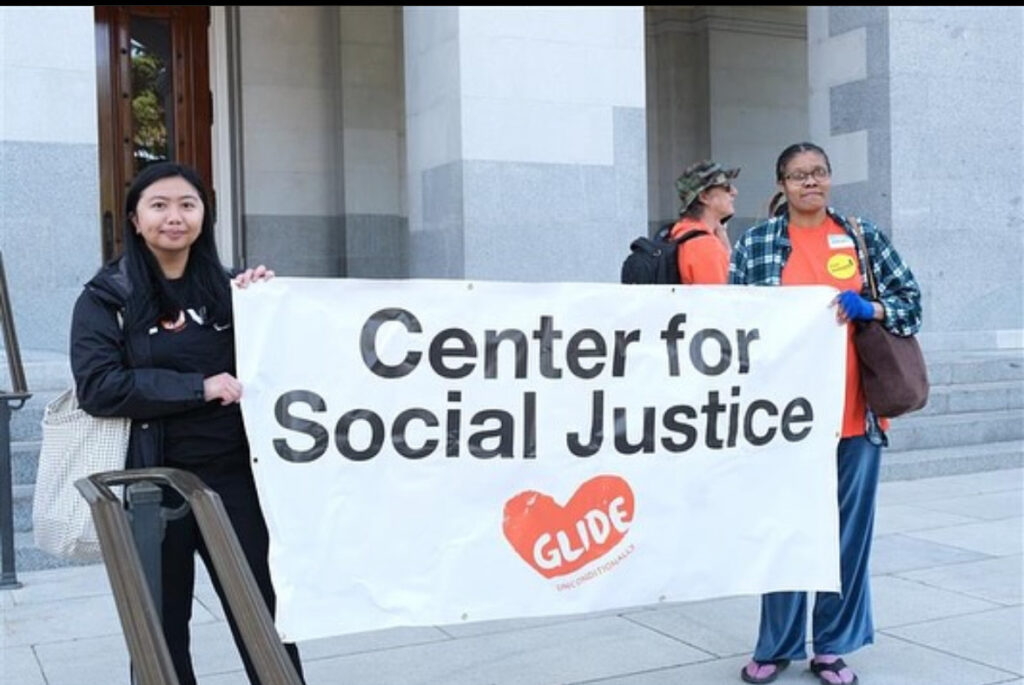
In April 2018, the GLIDE Center for Social Justice led a group of 85 people on a pilgrimage to the opening of the Legacy Museum and National Memorial for Peace and Justice in Montgomery, Alabama.

This journey was more than a visit; it was an awakening, deeply affecting each participant with our nation’s history of racial injustice.The images we saw and the stories we heard not only agitated us but summoned us to ask hard questions. Motivated by this experience, we returned home to San Francisco to deepen our collective justice.

This year, we are embarking on our fifth Pilgrimage to Alabama, a deliberate move toward healing the deep-seated wounds of racism and economic inequality, and specifically, examining their impacts on healthcare and mass incarceration.

This journey unites practitioners from UCSF, participants in GLIDE’s Men in Progress program, and members of the GLIDE community. It aims to expand our understanding of Black history, foster empathy across diverse lived experiences, and empower us to use our positions of influence responsibly to drive meaningful change.

Follow along with us:

You can follow this journey through our social media channels (@GLIDEsf) using the hashtag #PursuingProgress as we head out of SFO on Saturday, February 17. We will send updates through our GLIDE enews. You can sign up to receive the newsletter here (scroll down to the signup box at the bottom).

Finally, we will produce a five-minute video on this transformational work, #PursuingProgress, which will debut in the spring of 2024.

Vision

Our history and our future are so intertwined, it is worth considering that in many places around the country Black History is currently under attack. Books that shed light on our collective pasts are being removed from libraries.

Academic classes that examine our history and its role in our current society are being canceled, de-funded and re–written. Teachers can be fired for sharing some of our most critical stories.

CBS recently dedicated a stand-alone page to expose current instances of disturbing racism happening around our country. And the premier of Ava Duverney’s movie Origin, a spectacular and loving interpretation of the book Caste by Isabel Wilkerson, has been shared and amplified across cultures and around the world.

The Hebrew word תשובה / teshuva, which is often translated as ‘repentance’ appears in daily and High Holy Day liturgy. A better translation of the word would be ‘to make amends.’ As Americans, we have never made teshuva for slavery on our soil. We’ve never had a process of Truth and Reconciliation as South Africa did after Apartheid. This is a poignant invitation to repair or heal America as we know it today.

We view the opening of this Legacy Museum and Memorial and GLIDE’s recurring Pilgrimages as important steps in an American Teshuva Project. It is a journey of truth-telling that we must engage in if we are ever to heal the festering wounds of slavery.

Part of this enduring Teshuva work necessitates a constant and persistent pursuit of equity and fairness in the American healthcare and criminal justice system.

The journey to Alabama strikes at the heart of our work at GLIDE – radical truth telling, unconditional love, systems change, and the striving of a more equal, just world. As a member of the GLIDE community, you are an essential part of that work. We look forward to sharing this experience with you.

GLIDE welcomes Naeemah Charles as our new Senior Director for the Center for Social Justice.

Naeemah is a proud San Francisco Bay Area native with a lifelong passion for social justice. She brings over 10 years of high-level experience in public policy, community organizing and government affairs. She is a political veteran that uses her expertise to uplift and advocate for social justice causes.

Most recently Naeemah worked at Childrens Council of San Francisco (CCSF) as their Senior Director of Public Policy, where she co-founded the SF Early Care & Education Advocacy Coalition, secured millions to expand child care access in S.F & push forward innovative child care policy for San Francisco families.

Prior to CCSF, Naeemah worked for Planned Parenthood Northern California, the SF Democratic Party and was a Jesse M. Unruh Assembly Fellow.

Naeemah is a hobbyist and enjoys the arts and movement. She spends her free time as an avid practitioner of Ashtanga yoga, occasional water color painter and dedicated dog mom to her mini poodle Meadow.

Please join us in welcoming Naeemah to GLIDE!

#GlideForward

gina, fromer, black, history, 2024, february

GLIDE staff were treated to a special presentation by President & CEO Dr. Gina Fromer inside Freedom Hall this week where she spoke about her research into Black women who emerged from poverty and transitioned into executive positions. 

Black women are significantly underrepresented in corporate America. 67% of executive leadership positions are held by White men, compared to 1.4% by Black women. This is no accident, according to Dr. Fromer, who emphasized that Black children living in poverty grow up to be adults living in poverty 92.7% of the time. 

Given the low percentage of Black women in executive leadership positions, Dr. Fromer’s research studied two central questions: 

1) How do Black women perceive the factors that may have contributed to their emergence from poverty into executive positions? 

2) How do Black women perceive the role of resilience in emerging from poverty into executive positions? 

Dr. Fromer’s research aimed to shed light on the value of practitioners who work in leadership development on antipoverty strategies. It also provided insights for leadership development and what childhood factors affect opportunities and outcomes for Black girls living in poverty. 

 As part of her research, Dr. Fromer interviewed nine Black women who were born into poverty and later were able to grow professionally and move into executive leadership positions. 

Dr. Fromer concluded that Black girls are resilient and aspire to lead but many are mired in inter-generational poverty, and few can break out of their economic conditions.  

Five key themes emerged from Dr. Fromer’s research for how to improve the prospects of black girls raised in poverty. These include experiencing a sense of community, the building of strong family ties, awareness of economic status, Black mothers and fathers who can show greater elevated self-esteem, confidence, and an appreciation of self along with a drive for change. 

Black girls and Black women share a common bond of resiliency, and to work on anti-poverty strategies means devising ways of helping Black girls overcome their own bleak circumstances.  

This means showcasing examples of Black women who have overcome their own economic challenges to attain roles of executive leadership. Dr. Fromer’s research outlines several recommendations, including: 

  • Investigate further the factors Black executives leaders believe contributed to their leadership journeys 
  • Further examination of the impact of Black role models on the leadership development of Black girls 
  • The use of focus groups with Black women executives to share their stories

In the context of individual resilience theory, Dr. Fromer’s research concluded that Black girls growing up in poverty who felt a sense of safety in their communities, were exposed to Black teachers, and remembered positive aspects of their childhoods were able to move forward toward positive leadership outcomes as adults. 

black, history, month, gina, london, breed, sf

Dear GLIDE Community,I am honored to celebrate this Black History Month with you – or as we refer to it at Glide Memorial Church, Black Futures Month! While we recognize February for Black History, every day is Black History. One month a year is not enough!Our history and our future are so intertwined, it is worth considering that in many places around the country Black History is currently under attack. Books that shed light on our collective pasts are being removed from libraries. Academic classes that examine our history and its role in our current society are being canceled, de-funded and re–written. Teachers can be fired for sharing some of our most critical stories.These attacks not only tamper with the way our past is understood; they are an attempt to take power over our futures. Black History is not just something that happened to other people generations ago; it is the lives we lead and the communities we share every day.As we celebrate Black History Month and honor the struggles and journeys that brought us to this place, please commit some of your own personal energy towards uplifting these stories we call Black History. Read a book that someone is trying to prevent you from reading. Go see the new movie Origin, a spectacular and loving interpretation of the book Caste by Isabel Wilkerson, which examines the ways that hateful ideologies have been shared and amplified across cultures and around the world. Ask your friends or neighbors to share their personal stories of challenge and perseverance, or offer your own story to someone who will listen.And by all means, please join us at GLIDE for the many opportunities to celebrate Black History Month this February together:

  • Dream Keeper Initiative: This month we launched our 2nd round of the Dream Keeper Initiative Grant. The Dream Keeper Initiative (DKI) is a community-driven fund with the goal of reinvesting into San Francisco’s Black communities across a number of different activities, events and programs. As a proud participant in the Dream Keeper Initiative, GLIDE will support low-income Black San Francisco residents who have experienced intergenerational violence due to systemic racism. GLIDE aims to further our mission of breaking cycles of poverty and ensure that new investments – including in youth development and economic opportunity – are accessible to San Francisco’s families who are most in need. Learn more here.
  • Black History/Future video series: A new video interview series will feature the voices of our African American community. They will offer their personal stories of growing up Black in America, the learnings that were passed down to them from generations past, and share what Black History Month means to them. We will be releasing these weekly. You can view the first story of Ken Ward, our Social Media coordinator, here.
  • Sunday, February 11th, Tenderloin Black History Walking Tour at 1:00 pm. Participants are invited to enjoy a short film screening of “Reparations Conversations at Glide Memorial Church 2023,” filmed by Don Bowden (Tha Don), in GLIDE’s Freedom Hall. Afterward, at 1:30 pm, Del Seymour, founder of Code Tenderloin and GLIDE Board member, will showcase and share a piece of Black history in the Tenderloin. The tour will begin and end at Glide Memorial Church at 330 Ellis St. RSVP for the tour and film screening here.
  • Saturday, February 17th – Thursday, February 22nd, The 5th Annual Alabama Pilgrimage. The Alabama Pilgrimage is an immersive, experiential learning program of GLIDE’s Center for Social Justice. The pilgrimage seeks to tell the truth about American history, highlight inequities in health, economic, and criminal justice outcomes, articulate connections between slavery and mass incarceration, and interrupt current, incomplete narratives about oppression, crime, and punishment. This year, 50 participants from UCSF, GLIDE, and our Men in Progress Program will travel to Alabama together. The goal of this trip is to heal the wounds of enduring racism and economic inequality in San Francisco and beyond, and commit to concrete steps that promote racial justice in the future. You can follow along with our sojourners through the hashtag #PursuingProgress on social media and through our Love and eNews series.
  • Sunday, February 18th, Justice Sunday. Join us after services at Glide Memorial Church to help distribute blankets and hygiene kits to our neighbors, engage in justice advocacy and register to vote. Services begin at 9:00 am and 11:00 am. Learn more about the Celebration and events after here.
  • Sunday, February 25th, 1:00 pm – Soul of Justice Hybrid Movie Screening about the Honorable Thelton E. Henderson. Thelton E. Henderson graduated from Berkeley Law in 1962 – where he was one of just 2 Black students in his class – and was the first Black attorney in the Civil Rights Division of the U.S. Department of Justice. In the Deep South, he protected voter rights alongside everyday citizens and visionaries like Dr. Martin Luther King, Jr. In 1980, President Jimmy Carter appointed him to the federal bench, where he has championed transformative justice for nearly four decades. View the 57 minute film, by Bay Area filmmaker Abby Ginzberg, followed by a panel discussion hosted by Naeemah Charles, Senior Director of GLIDE’s Center for Social Justice. The film will screen in the sanctuary and online. Learn more and RSVP here.

Our work at GLIDE to create pathways out of poverty, fight systemic injustice, and transform lives is never ending. Thank you for being part of our shared history, and for working with us to alleviate suffering and build a radically inclusive future.With gratitude and love,

Dr. Fromer

Dr. Gina FromerPresident & CEO

harm, reduction, services

Dear members of the GLIDE community,

I am writing to share an article published in the New York Times that describes GLIDE’s approach to Harm Reduction in a few short sentences. In its brevity, the article did not fully capture our core belief in a personalized approach to treat substance use disorder (SUD). This approach includes introducing safer drug use habits, complete sobriety, and everything in between. It includes the needs of drug users and non users alike with the goal of creating safer, healthier communities for everyone. 

At GLIDE, we believe Harm Reduction promotes health across a broad continuum. We are resolutely committed to  address a public health crisis that has taken more than 800 lives from us in 2023 alone. We do this every day with people who need help navigating the complex journey of SUD. Addiction is a disease. We strongly believe the best way to treat a disease is through data-driven and effective public health interventions.

Under the leadership of our Chief Programs Officer, Lillian Mark, and our Director of Health Access, Michael Discepola, we are working hard to expand our services. We recently added additional testing and treatment programs in our new Service Hub located in the outdoor area next to 330 Ellis Street. Our Health Access program, including our Harm Reduction work, embodies our most core values of unconditional love and radical inclusivity. 

Our Health Access and Programs teams are hard at work building out a comprehensive set of services to address the overdose crisis. We recently added additional testing and treatment programs in our new Service Hub located in the outdoor area next to 330 Ellis Street and we are re-introducing our Narcotics Anonymous (NA) and Alcoholic Anonymous (AA) support groups for our community.

Our message is simple. 

For anyone who walks through the doors at GLIDE – we see you, we love you, your life matters, and we will accept you exactly as you are.

To fight the overdose crisis, we have more work to do, and we won’t stop until we see this crisis abate.

With love and gratitude,

Dr. Gina Fromer
President & CEO