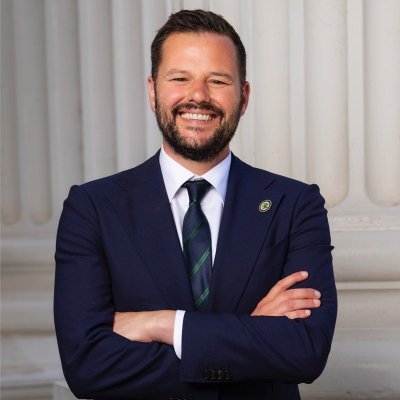
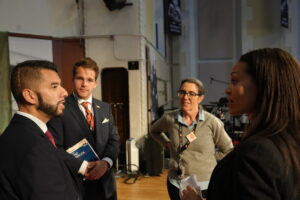
GLIDE is deeply grateful for Assemblymember Matt Haney’s consistent love, support and partnership, beginning with his participation in GLIDE’s first class of Legacy Committee members (our young professionals advisory board) in 2001, and his recent support to include a $1 Million request into his budget for our GLIDE modernization project!
With California operating at a deficit, our community’s needs are growing and resources are shrinking.
We’re thankful that Assemblymember Haney prioritized GLIDE during a tough time with many competing needs and for supporting GLIDE’s work to serve marginalized residents in San Francisco and beyond.
We also want to thank Governor @gavinnewsom and Assemblymember Phil Ting for their tireless work on California’s budget.
The GLIDE Modernization Project will upgrade the facilities of Glide Memorial Church and sanctuary building.
This will improve support for GLIDE’s dining services and safety net programs, which serve over 500,000 meals and 10,000 clients every year. The Project will expand GLIDE’s reach and impact by utilizing its current property space allotment.
The Project will expand GLIDE’s reach and impact by utilizing its current property space allotment.
Thank you Assemblymember Matt Haney!
#CommunityFirst
2023 GLIDE Legacy Awardees
In 2009 a small group of compassionate young entrepreneurs came together at GLIDE to inspire a new audience of young professionals across the San Francisco/ Bay Area about GLIDE’s mission to alleviate suffering and break the cycles of poverty and marginalization.
And now the GLIDE Legacy Committee proudly invites you to join us for the 14th annual GLIDE Legacy Gala! The event will occur at Terra Gallery in San Francisco beginning at 8:00 pm on August 18.
We will display the work of young changemakers who are dedicating their lives to improving the world. It will be a night of dance, celebration, and music, with performances from the infamous GLIDE Ensemble and Change band, DJ KingMost, and the fierce Newoncé.
People who are new to San Francisco have sought GLIDE out as a place to share their compassion for those who are less fortunate only to discover just how fulfilling the experience can be of making a difference in someone’s life.
At the Legacy Gala, the GLIDE Legacy Committee will honor two people who embody GLIDE’s mission and the spirit of its Co-Founders, Cecil Williams and Janice Mirikitani. Veteran Bay Area journalist and Bay Area resident Priya David Clemens returns as host.
This year’s Gala will honor the following awardees: president and founder of New Breath Foundation, Soros Justice Fellow, and ROOTS program founder, Eddy Zheng and co-founder of San Francisco’s Transgender District, founding queen of Drag Story Hour, co-owner of the Stud Bar, and the first transgender Chair of the San Francisco Democratic Party, Honey Mahogany.
Eddy works to mobilize resources to support Asian American, Native Hawaii, and Pacific Islanders (AANHPIs) harmed by violence and the unjust immigration and criminal justice systems. Eddy is the subject of the award-winning documentary “Breathin’: The Eddy Zheng Story,” a TEDx speaker, a SXSW featured speaker, and a contributor to the book: Contemporary Asian American Activism: Building Movements for Liberation.
Honey is a co-founder and served as the inaugural Executive Director of San Francisco’s Transgender District, she is a founding queen of Drag Story Hour, a co-owner of the Stud Bar, a singer with nu-metal group Commando, and recently ran a historic campaign for District 6 Supervisor in San Francisco.
Currently, Honey is working as the District Director for Assemblymember Matt Haney and serves as Chair of the San Francisco Democratic Party.
The GLIDE Legacy Committee works on initiatives for fundraising, volunteering, and social engagement in its first year. Above all else, the committee’s sole purpose remains to engage new audiences and deepen community involvement within GLIDE.
Matt Haney (California Assemblyman and former San Francisco Supervisor), Mike Kim (Head of Google for Startups, APAC and Korea), and Laura Thompson (committee co-founder and currently serving on GLIDE’s Board of Directors) are notable past members of the committee.
This event connects and mobilizes changemakers to honor GLIDE’s legacy of love, compassion, and community. More than 800 guests are invited to GLIDE Legacy Gala to promote the power of unconditional love for creating social impact in San Francisco and beyond.
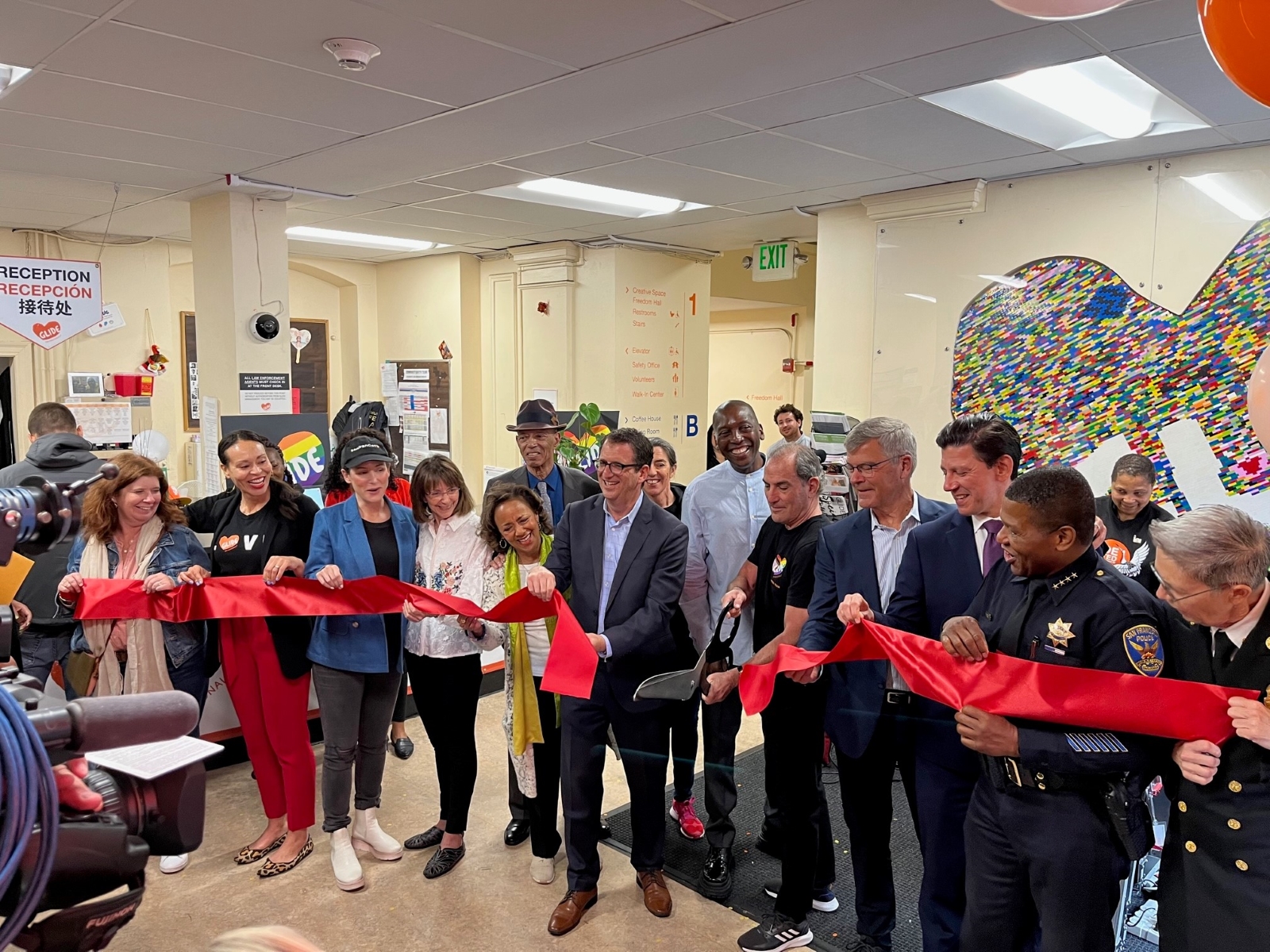
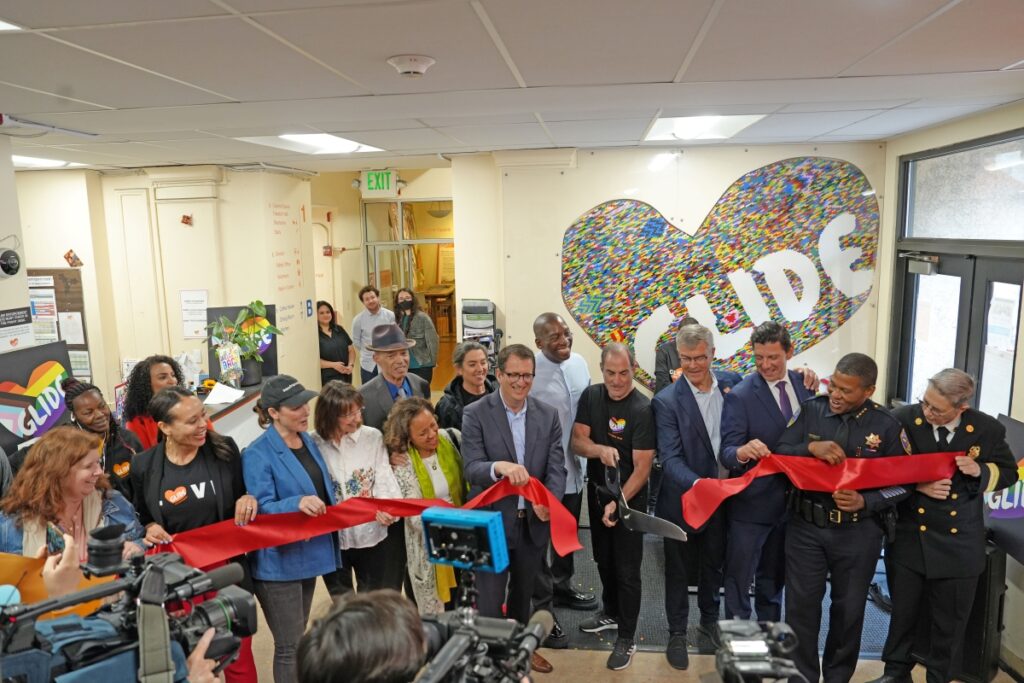
It was a #ReturntoCommunity like no other! GLIDE officially re-opened its doors and welcomed clients back to its indoor dining service this past July 6.
With a snip of the ribbon, GLIDE invited its community back indoors to savor the warmth of our hospitality and the flavors of our togetherness. “We”ll be referring to this moment for the next 60 years,” said a beaming Interim-CEO Malcolm Walter.
Achieving a GLIDE Milestone
Coming to celebrate this triumph with us included our esteemed guests San Francisco Fire Chief Jeanine Nicholson, SF Police Chief William “Bob” Scott, Supervisor Dean Preston, and City Assessor – Recorder Joaquin Torres. GLIDE’s Board of Directors, staff, the Tenderloin’s unofficial Mayor Del Seymour, friends and family were also present and our special event was covered by local press, including ABC 7, FOX/KTVU 2, CBS/KPIX 5, and NBC 11.
For more than 3 years, our team of dedicated professionals and volunteers persevered and adapted to a pandemic while continuing to serve our clients three meals a day on the sidewalk outside of GLIDE. Now, this milestone marks a major step forward in our mission to provide a welcoming indoor space for our clients.
Our long-awaited reopening comes with heartfelt gratitude for our exceptional volunteers who play a pivotal role in making this possible, day in and day out. Their tireless efforts and unwavering commitment have truly transformed lives within our community.
Heralding a six-month return to Community campaign
Re-opening our dining room is just the first step in a six-month Return To Community program that will also involve all of our GLIDE programs, the Center for Social Justice, and Glide Memorial Church. Today and moving forward, we welcome this new chapter of compassion and service, and continue to uplift and empower those in need. Together, we are the driving force behind positive change!
In the words of Glide Memorical Church’s Minister of Celebration Marvin K. White:
“If your body needs feeding, GLIDE serves health and social services through our programs. If your truth needs feeding, GLIDE serves advocacy through your Center for Social Justice. If your spirit needs feeling, GLIDE serves faith through Glide Memorial Church.”
Volunteer now and make a difference!
This is a place of hope, meaning and purpose. And when you volunteer, you become a part of something bigger – a movement that is changing lives.
If you can spare a few hours a week, and want to make a difference in the lives of others, please step up and volunteer with us. We look forward to working with you.
Thank you!
o.
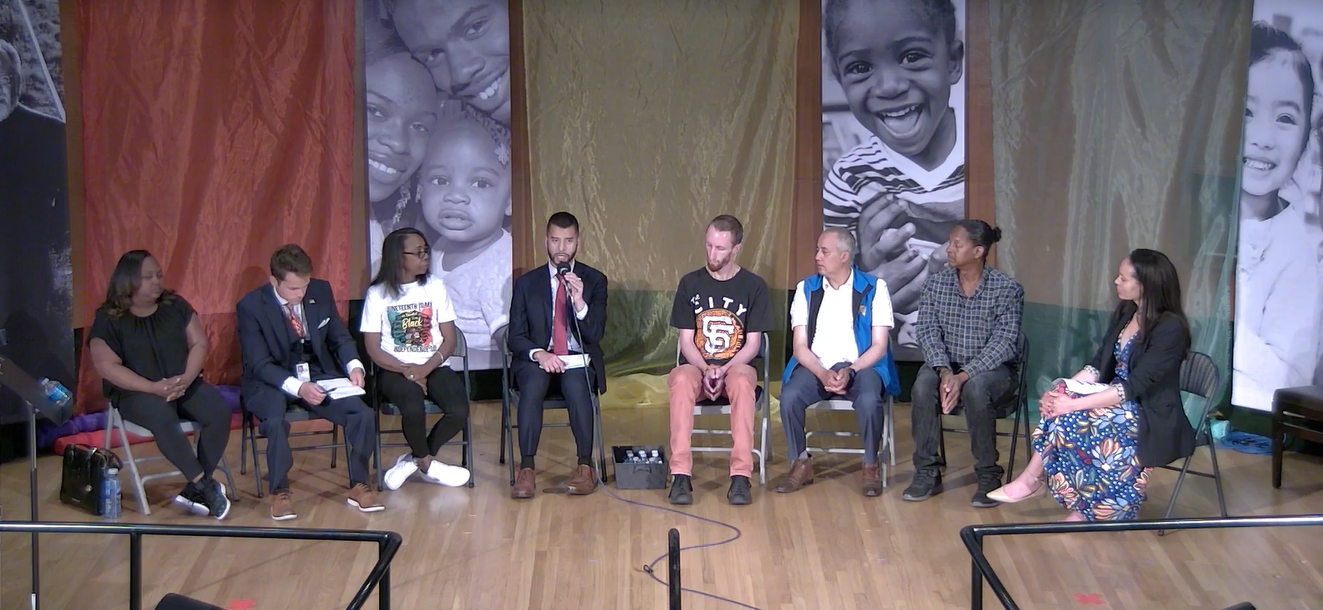
GLIDE’s Center for Social Justice Director Dr. Holly Joshi (far right) hosts a roundtable discussion with representatives from local food organizations and the USDA
June 15th, 2023
GLIDE’s presence in the Tenderloin acts as a pivotal haven of hope not just for Black residents but LGTBQIA2S+, those with disabilities, new immigrants, and anyone who has ever felt marginalized and/or in need of love and support.
Representatives from the United States Department of Agriculture (USDA) and local organizations came face to face inside Glide Memorial Church’s sanctuary this month to follow-up on a prior visit and discuss the successes and challenges in tackling racial equity and food security.
GLIDE’s Director for the Center of Social Justice, Dr. Holly Joshi served as moderator and guided the conversation around food scarcity and the barriers still facing people of color who struggle to see their voices integrated into the availability and delivery of fresh food.
Roundtable Success Stories
On the roundtable, Pamela Brown, GLIDE’s Zero Food Waste PantryCoordinator described the achievements of GLIDE’s pantry program, a sustainability-focused initiative that started off in 2021 making available nourishing food in reusable and compostable containers to 30 food-insecure families a week and is now serving approximately 100 families a week.
“When COVID-19 seemed everywhere, many lost their jobs and families suffered,” said Brown. “GLIDE saw a need for the pantry, and the opportunity to give food that these families needed and wanted, and we haven’t stopped since.”
Richard Patrick of From the Heart, shared how during the pandemic, he heard about the availability of free groceries in the Bayview neighborhood only to find himself one week later delivering those groceries to seniors and those with disabilities who were unable to leave their homes.
Pia Harris, founding member of the Fillmore Merchants and Neighborhood Collaborative and the Fillmore and Japantown for Justice Coalition reflected upon COVID-19’s impact and how difficult it was to distribute grocery bags that contained culturally inappropriate food.
“Many times, we were stuck giving food away that many in the Black community or seniors who were on special diets couldn’t really make use of, which is why we created our own food security program, making sure there were options that met the diverse needs of our community,” said Harris.
Alberto A. Gonzalez, Jr., USDA speaking to Dr. Holly Joshi, GLIDE’s Director of Center for Social Justice
USDA Policies and Actions
The disparity in who is experiencing poverty and hunger in San Francisco is discouraging. Black residents who make up 6% of the city’s population, now constitute 38% of its homeless population, and makes up 69% of people served at GLIDE are people of color.
Alberto A. Gonzalez, Jr., USDA’s Senior Advisor for External Engagement Food and Nutrition Servicerecognizes the gravity of the problem. The pandemic exacerbated the disparities in local communities when it came to equitable food access.
“USDA staff understand the relationship between systemic racism and food insecurity and we’re using data informed decision making to help us devise policies in response to it,” said Gonzalez.
“Right now, under the current Biden administration, we’re busy expanding healthcare, increasing the minimum wage, advancing the child tax credit, and looking at further ways to empower families economically.”
Alexei Schnakenburg,USDA’s Program Specialist and the Regional Chairperson of the department’s Food and Nutrition Service described the presence of “food deserts” in communities such as the Tenderloin, Hunter’s Point or Bayview where the paucity of grocery stores means residents must travel outside their local environs and travel across the city to get access to fresh fruit and vegetables.
Schnakenburg tipped his hat to the Supplemental Nutrition Assistance program (SNAP) and how the USDA initially rolled out an online pilot version that enabled users to order food online.
“When the pandemic hit, we were forced to pivot and work within existing regulations to collaborate with stores and states across the country, acting as a thought partner, to move SNAP ordering and shopping online,” said Schnakenburg. “What started 3 years ago during the pandemic and was only accessible to a handful of states is now available across all 50 states.”
A Hopeful Future
Local organizations continue to work on improving fresh food access and availability, along with reducing systems of racial oppression. “We’re excited to continue to be able to offer hot, fresh cooked meals to our seniors who are still at home,” summarized Pia Harris of Fillmore Merchants. “Because they cannot cook for themselves, they normally would go to Mcdonalds. We’re now feeding up to 1,000 seniors a year and we just got funding to continue our program for another two more years!”
Gonzalez also touted a recently authorized program by Congress called the Summer Electronic Benefit Transfer for Children (SEBTC) which will debut in the summer of 2024. Back in 2022, Congress authorized the Summer EBT as a permanent, nationwide program. It will provide families whose children are eligible for free and reduced-price school meals with grocery benefits on a debit-type card during the summer months.
According to the USDA, this model has been proven to decrease food insecurity among children through Summer EBT demonstration projects. A permanent summer EBT will help close the summer hunger gap for more than 29 million families across the country.
“It’s vital for the USDA to have trusted community partners to help us spread the word about the Summer EBT” said Gonzalez. “I also encourage all local communities to also raise their voices about the upcoming Farm bill renewal as well.”
Celebrating Juneteenth renews our hope for change and our commitment to creating a more equitable society where everyone belongs and thrives.
It is a joyous moment to witness our country’s leaders agreeing to declare Juneteenth a federal holiday. This significant development reflects progress towards a more meaningful understanding of the Black experience in America. It displays a fresh ownership of our shared history. It also acknowledges the historical practice of enslaving persons of African descent.
On this Juneteenth, we recognize the impact of GLIDE’s Co-Founder Reverend Cecil Williams and his legacy. Reverend Cecil was born in Texas in 1929. He says he grew up with the “festivals, community gatherings, shared BBQ and soda water, and other wonderful soul foods” that marked Juneteenth as a joyous affirmation of hard-won freedoms.
Reverend Cecil announced his retirement earlier this year after six decades of transformative leadership at GLIDE. During this time, he provided our community with a legacy of love and liberation. He instilled in us the values shaped by his lived experience of Jim Crow laws and systemic racism as well as the power of the civil rights movement and the triumph of achieving real social change.
Because of Cecil, GLIDE stands for social justice. We are dedicated to fighting systemic racism and breaking the cycles of poverty and marginalization that have harmed African American families for generations. In San Francisco today, African Americans make up 38 percent of the city’s homeless population but only 5 percent of its total population; 46 percent of African American children here live in poverty, compared to 3 percent of white children.
Because of Cecil, we know that the way to win the fight against systemic inequity is to create a radically inclusive, just and loving community—a community where African Americans and other historically oppressed people who have suffered trauma can heal.
To build this community means bringing a range of strategic and innovative approaches to this effort. GLIDE has helped lead the following to date:
We co-hosted a visit by the US Department of Agriculture for a special Juneteenth celebration and roundtable discussion about racial equity and barriers to healthy food and nutrition that included spokespersons from a variety of local community organizations working on solutions to curtail this festering problem.
We sparked conversations about reparations for San Francisco’s Black residents. We partnered with the San Francisco African American Reparations Committee to host listening sessions to help gather reparation recommendations around education and healthcare, which will be submitted to the San Francisco Board of Supervisors and Mayor London Breed. “We talk about ‘repair’ in reparations, but how do we repair generations of systemic oppression against Black people, and ultimately, people of color in general?” asks Marvin K. White, Minister of Celebration at GLIDE.
We invested in Black communities as part of San Francisco’s Dream Keeper Initiative. With funding from the city, we awarded mini grants to Black youth affected by community or domestic violence, grants that they could use for any wide range of necessities, including transportation, education, and clothes. For Saundra Haggerty, GLIDE’s Violence Intervention Program Manager, the mini grants were a form of stimulus for youth who have gone through trauma because of the color of their skin. “So many African American youth have been deeply harmed by the disparities of the criminal justice system.”
We continue to work with people in positions of power to transform systems of oppression and seek racial justice and reconciliation. We provide immersive training programs for law enforcement officers and healthcare professionals through our Center for Social Justice to help them develop empathy with the African American community and other communities of color. We support municipal and state laws that fight housing discrimination, end racial inequities in policing, sentencing, and incarceration, and work to end the systems that perpetuate inequity.
Juneteenth reminds us that freedom and justice have too often been denied or delayed for the people who have suffered the most. But this holiday also teaches us that change is possible when we strive for it. We see it every day as we continue Reverend Cecil’s legacy at GLIDE: we see people finding pathways out of poverty and hunger. Barriers torn down by empathy. Lives transformed by love.
Thank you for joining us in making change and building a radically inclusive, just and loving community,
Malcolm Walter, Interim CEO GLIDE Foundation
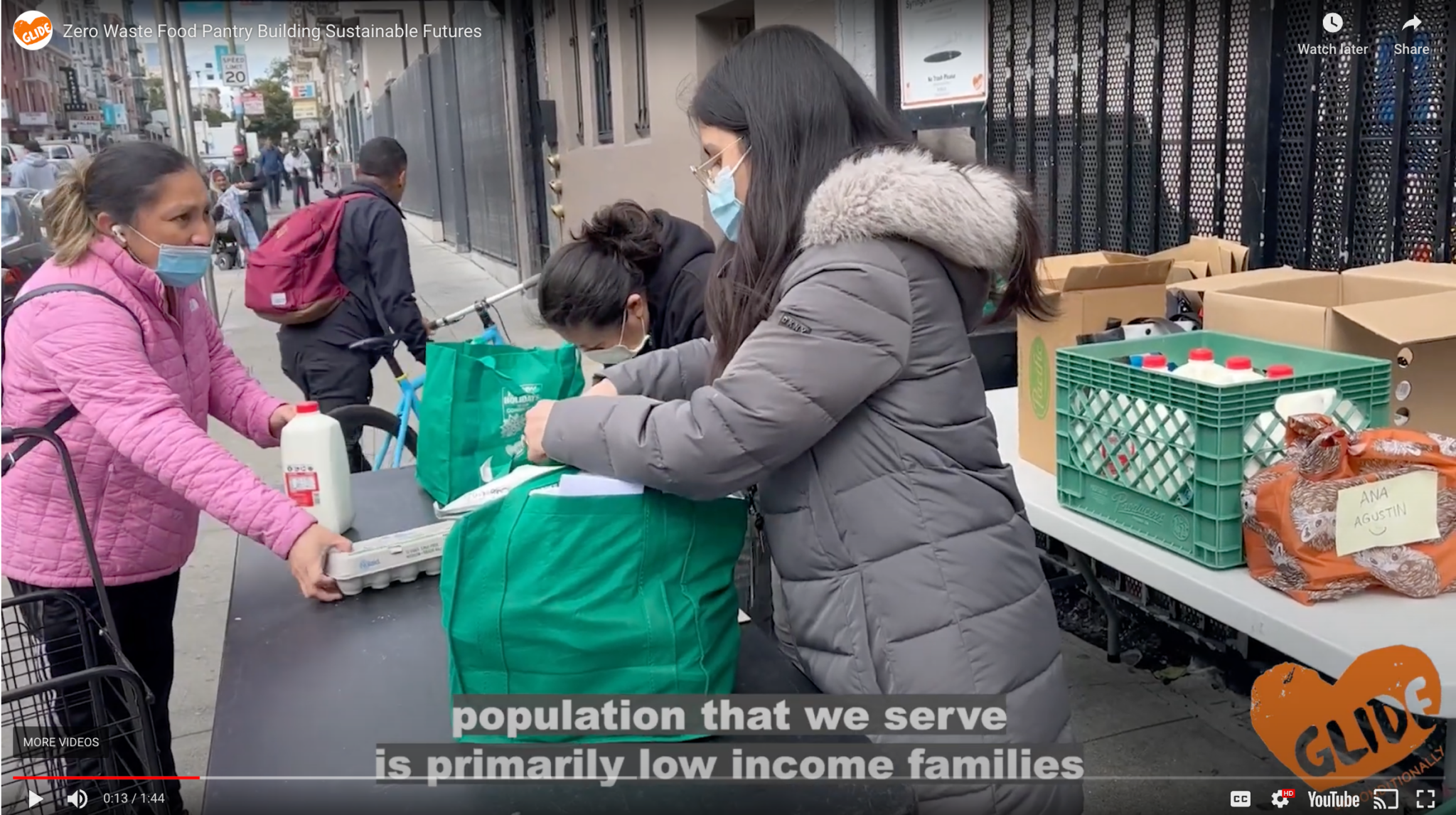
Zero Waste Food Pantry: Building Sustainable Futures
GLIDE’s Foundation’s Zero Waste Food Pantry is a vital program that prioritizes providing nutritious food to families with limited access. Our program serves low-income families with children aged 17 and under.
Each week, between 70 to 75 individuals with families select from a list of food items. The pantry team then packs those food items into reusable containers, distributing them to families while collecting containers from the previous week to be used again.
We are mindful of sourcing our food items and work with local Bay Area vendors to ensure fresh food. Our program is also committed to sustainability. By supporting local businesses, we not only help the community but also minimize the carbon footprint of our program through reduced food transportation distances. We believe that giving families the autonomy to choose what they eat promotes healthy eating habits and encourages self-reliance and dignity.
Access to healthy food is a fundamental human right, and we are committed to ensuring that all families have access to it. By prioritizing food and family at the forefront of our program, we aim to create a more equitable and eco-friendly future for ourselves and future generations.
We invite you to be part of our mission to prevent hunger and starvation by spreading awareness about GLIDE and our initiatives. Please take a moment to visit us at 330 Ellis Street in San Francisco’s Tenderloin neighborhood to see our pantry in action. By witnessing the impact firsthand, you can truly understand the importance of our work. Let’s collaborate to build a brighter future for our community, working hand in hand to make a lasting difference. To learn more about how you can contribute and get involved, please visit our website at https://www.glide.org.
Advancing the Cause of Mental Health at GLIDE
May is Mental Health Awareness month and as an organization that is radically inclusive and seeks to alleviate suffering, we know that much more needs to be done to treat mental illness; a condition that affects close to 60 million Americans.
Tackling a complicated problem like mental illness requires patience and empathy. We know that a decline in mental facilities can contribute to issues such as drug overdose and contribute to poorer health outcomes. Studies done by the National Institutes of Health have found that people with mental disorders such as anxiety, or post-traumatic stress disorder may use drugs or alcohol as a form of self-medication.
Recognizing the inherent value that each human being holds means overcoming the stigma attached to mental illness and providing the care needed to improve overall health.
GLIDE’s implementation of harm reduction strategies puts it at the forefront of evidence-based actions that help reduce harm and improve results associated with drug use and drug overdose mortality.
“We train our harm reduction staff to be clinically minded,” says GLIDE’s new Director of Health Access, Michael Discepola. “This means we’re training them to understand ways to de-escalate, understand and respond effectively to trauma, and know how to respond to someone in distress, to someone who may be hearing voices or might be actively psychotic.”
The past few years have seen drug overdose deaths skyrocket in California while overdose deaths in San Francisco climbed year over year, according to the San Francisco Medical Examiner. Overdose deaths among Latino and Black people have also seen a particularly significant increase in 2023.
Drug overdoses in San Francisco killed 34 Latino people in 2023, a 62% increase from the 21 deaths last year, while deaths of Black people rose by 61%, from 41 to 66. Total accidental overdose deaths for this year in San Francisco are up to 268 (up from 142 in 2022) with a vast majority of deaths involving fentanyl.
We know from evidence that Black San Franciscans are far more likely to die of an overdose than people of other racial groups relative to their population, according to medical examiner data.
These distressing facts are not lost upon Michael, who oversees GLIDE’s harm reduction team as they engage individuals on the streets who are suffering from psychiatric disabilities. GLIDE’s resource navigators use a low threshold to provide help to those seeking to overcome their difficult circumstances.
“A one size for care does not fit all. We need many approaches – we need to fund and value all methods that are effective and not judge or stigmatize,” says Michael. “We must recognize that people are struggling and using substances to cope with their trauma. People on the street will use stimulants to protect themselves and they will use more stimulants to stay up at night, so they do not lose their belongings, or get attacked.”
We know supervized overdose prevention centers work. GLIDE’s Center for Social Justice alongside community partners worked to get legislation passed in Sacramento last year that would have created a pilot study to evaluate the effectiveness of creating three supervised consumption sites in San Francisco, Oakland, and Los Angeles. Governor Gavin Newsom vetoed the legislation.
Shapreece Martinez, GLIDE’s Walk-In-Center (WIC) Shift Lead says many of GLIDE’s day to day homeless clients have mental health and/or substance abuse disorder. WIC tries hard to give proper referrals depending on what their needs are.
But chronic homelessness can lead to depression, according to Shapreece.
“Our clients are low-income, poor, on public assistance, and cannot afford the proper care and treatment they require. Many times, we offer a shoulder to cry on in times they need to release,” says Shapreece. “We offer an ear in time of grief and a hand when they need help with guidance,” she added.
Michael is no stranger to driving the tenants of harm reduction having formerly worked as Vice President of Behavioral & Substance Use Health for the San Francisco AIDS Foundation and previously at UCSF (University of California, San Francisco) as Associate Director for the Stonewall Project.
“We know that there has never been an overdose in any one of these overdose prevention centers. And if we want to approach this from a public health perspective, then it is our responsibility to intervene and do the work to assist those people on the streets. We do not have enough providers willing to do this kind of work. And this is where GLIDE steps in.”
Improving Digital Literacy in the Asian-American Community at GLIDE
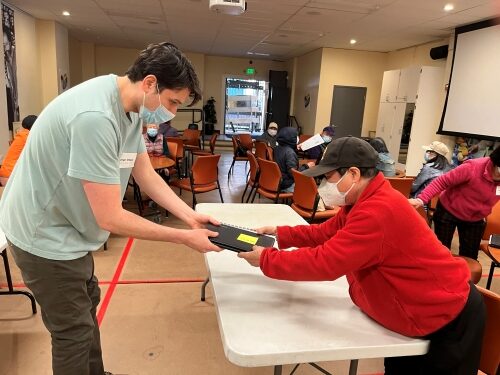
CTN participant and Tenderloin resident Su Cui Li receives a Lenovo laptop
How do I connect to Wifi? Where do I access email? What is Google search? Questions that sound so rudimentary to us but to seniors who’ve been left out of the digital revolution seem remote and complicated.
For older adults, 65+, the importance of being able to use technology to help remain mentally fit and support self-sufficiency can’t be stressed enough. But also in times of social isolation, being able to hop on the Internet and find helpful online resources can be of tremendous value.
GLIDE is currently partnering with the Community Tech Network (CTN), a San Francisco-based non-profit organization that supports computer centers and technology training programs for the undeserved in our community enabling participants to learn how to connect to basic services, including lost-cost Internet and laptop access.
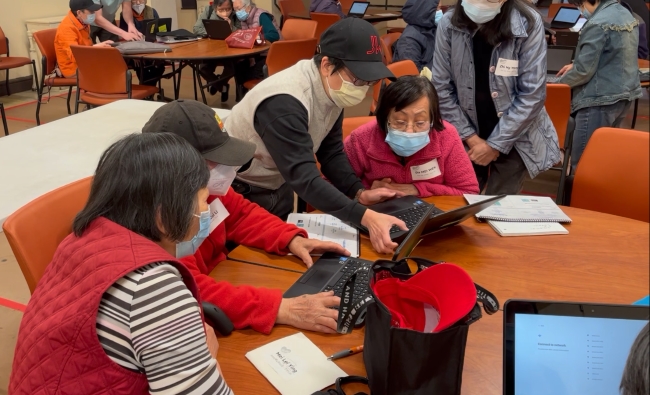
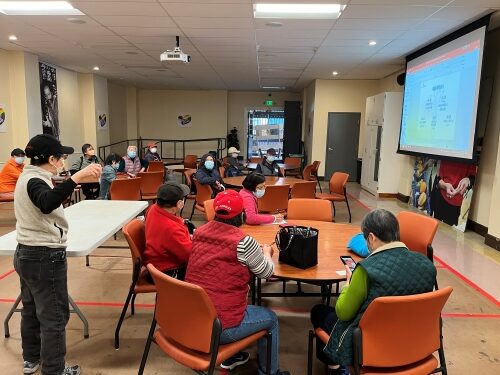
Instructor Melissa Ao was busy teaching to a group of Asian-American seniors in Freedom Hall eager to make use of a Lenovo laptop in their training. Once they complete the five one hour weekly training lessons, the laptop is theirs to keep. “The seniors here have never used a computer before so they are most interested in learning, ” says Melissa. “But today was particularly challenging, as I was teaching in both Mandarin and Cantonese.”
During the pandemic, many low-income seniors were stuck at home and without any access to the Internet. “What I love teaching most is when I see their reactions. I see that “Aha” moment on their faces. What’s a simple task for us becomes a new sense of discovery for them. I see their smiling faces as soon as they learn how to email a photo to one of their friends.”
CTN instructor Melissa Ao teaching Asian-American seniors how to use their computers
CTN provides two separate services to GLIDE, including Home Connect, funded by the Department of Disability & Aging Services (DAS), which offers tablets, Internet & ACP (Affordable Connectivity Program) application connectivity assistance, remote device training and tech support to older adults and persons with disabilities aged 60+ in English, Spanish, Cantonese, Mandarin, Russian, and Tagalog languages. In addition to Digital Equity, a service funded by the Mayor’s Office of Housing & Community Development (MOHCD), which provides laptop devices, device training, internet & ACP application connectivity assistance, and device tech support to those aged 18+ to Cantonese, English, and Spanish-speaking language groups.
“It’s always an honor for CTN to partner with GLIDE in bringing inclusive digital literacy skills training to Tenderloin residents,” said Stephen Minor, Sr. Digital Equity Program Manager, CTN.
“CTN’s Digital Equity program exemplifies the mission of GLIDE by providing radically inclusive services to marginalized communities by getting them tools, training, and support to get online and connected to life changing essential resources,” Stephen added.
Watch Tenderloin resident and Cantonese CTN participant Su Cui Li express her joy at learning about computers in the video below. CTN coordinator Josh Tran interprets for us.
We Love Our Volunteers!
April is National Volunteer Month and where would GLIDE be without its treasure-trove of volunteers? These are the team players who passionately seek to make a difference in the lives of others.
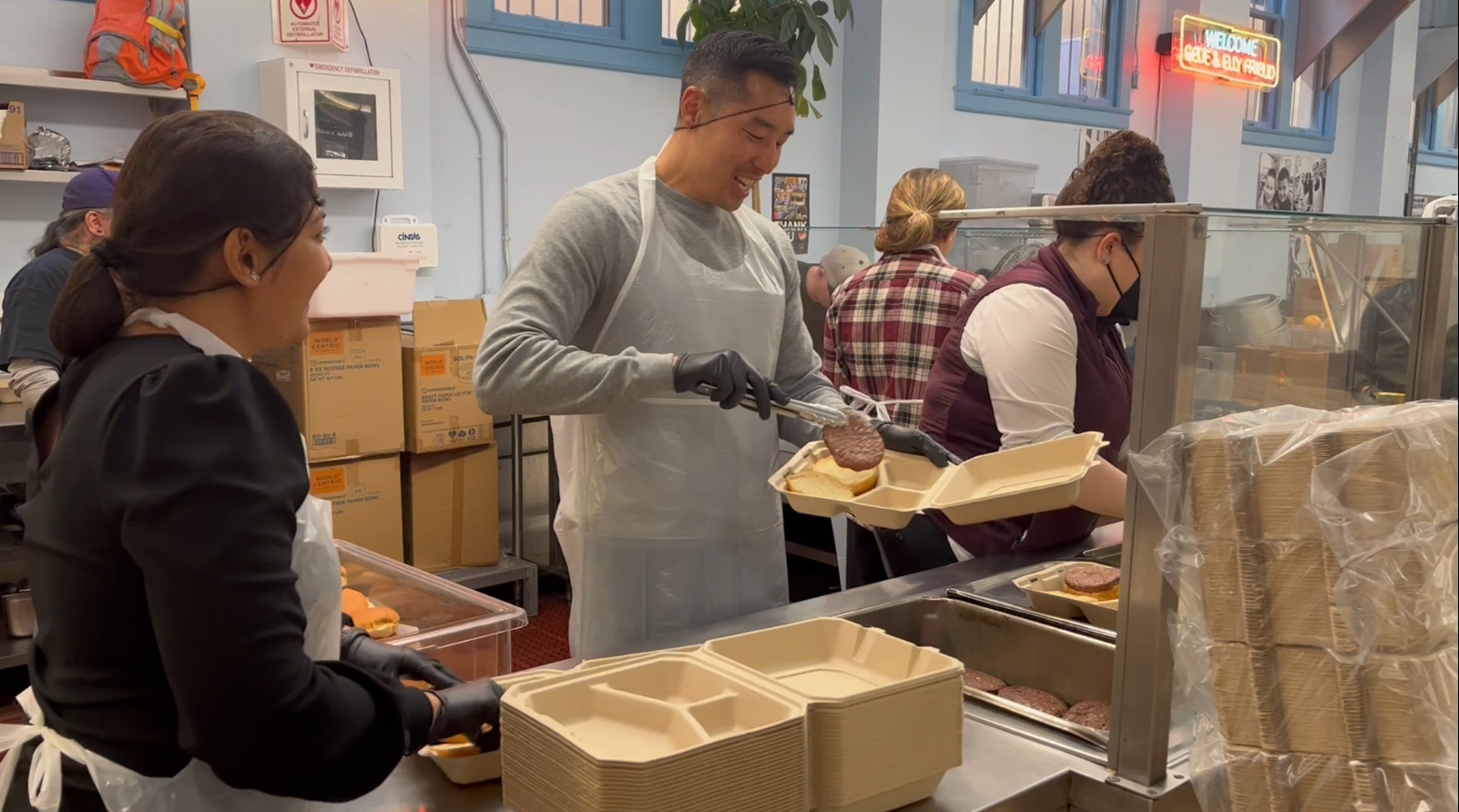
Our volunteers serve us in so many ways, from preparing food trays for distribution to welcoming guests to serving individuals in the dining areas, and all with the express purpose of improving the quality of life for those who may have fallen on hard times.
“It’s been awesome to learn about GLIDE’s history and the services they provide. I’m thankful to help this community out,” said David Lee, who came with a group of volunteers from Zendesk and helped prepare lunches. “It’s easy, fun, super relaxed and I encourage anyone to get involved and volunteer.”
Volunteering at GLIDE is a meaningful way to develop empathy for the less fortunate. For those who lack access to the most basic of necessities, volunteers are able to provide services that inspire a more hopeful present and future, sharing their lives and giving them a helping hand.
WE WOULD NOT BE GLIDE WITHOUT OUR VOLUNTEERS
When you volunteer, you’re building connections with others as Querida Wright explains having now been a volunteer at GLIDE for nearly a year now.
“Volunteering at GLIDE is a very organized experience, where you’re given lots of direction, and all you need to do is show up. I love that you get to meet new people with every shift you volunteer for,” says Wright. “People from different backgrounds with different stories. You feel very welcomed here and like your part of the team. Each time I come to GLIDE, I feel I’m doing something important. It’s not just preparing meals but you’re conversing with people, you’re giving people warmth and service. I like that.”
GLIDE is beyond grateful for our volunteers who generously donate their time to help us serve and build connections with the community.
It’s never too late to volunteer at GLIDE. Sign up for the next available shift. Watch our video!
Ali Winston and Darwin BondGraham illuminate American police culture and the struggle for reform by using Oakland as a case study. Through the lens of the city’s police department, the authors trace Oakland’s history from its inception through the Palmer Raids, McCarthyism, the Civil Rights movement, the Black Panthers, and the crack era to its current revival. It tells the story of a single city and its police force, but it also tells the story of American policing and its future. Over 21 years of fearless reporting have culminated in The Riders Come Out at Night – Brutality, Corruption, and Cover – up in Oakland
Host: Dr. Holly Joshi, Director for GLIDE’s Center for Social Justice
Our panelists include:
Ali Winston Ali an independent reporter covering criminal justice, privacy, and extremism. A former reporter for The New York Times, he has also been a fellow at Type Investigations and reported documentaries for BBC Panorama and PBS Frontline. His reporting on police corruption, right-wing extremism, and surveillance have earned him several honors, including a George Polk Award for local reporting, an Alfred I. duPont Award, and a News & Documentary Emmy.
Darwin BondGraham Darwin is the news editor for The Oaklandside. Before joining The Oaklandside, he worked with The Appeal and The Guardian covering policing and gun violence. He was a staff writer for the East Bay Express from 2015 to 2018. He holds a doctorate in sociology from UC Santa Barbara and was the co-recipient of the George Polk Award for local reporting in 2017. You can follow him on Twitter @DarwinBondGraha. Eleana Binder Eleana is the Policy Associate for GLIDE’s Center for Social Justice. Before joining GLIDE in 2021, she worked in eviction prevention at the Homeless Advocacy Project, as well as in nonprofit and local government settings in Berkeley, San Francisco, and Sacramento. Eleana also was in the Emerging Leaders Program at GLIDE when she was in college. In her work, she advocates for changes to oppressive and discriminatory institutional structures and laws to benefit GLIDE’s clients and marginalized people in San Francisco and across the state.